Embracing Joy in Shared Celebration
"And thou shalt rejoice in thy feast, thou, and thy son, and thy daughter, and thy manservant, and thy maidservant, and the Levite, the stranger, and the fatherless, and the widow, that are within thy gates." - Deuteronomy 16:14
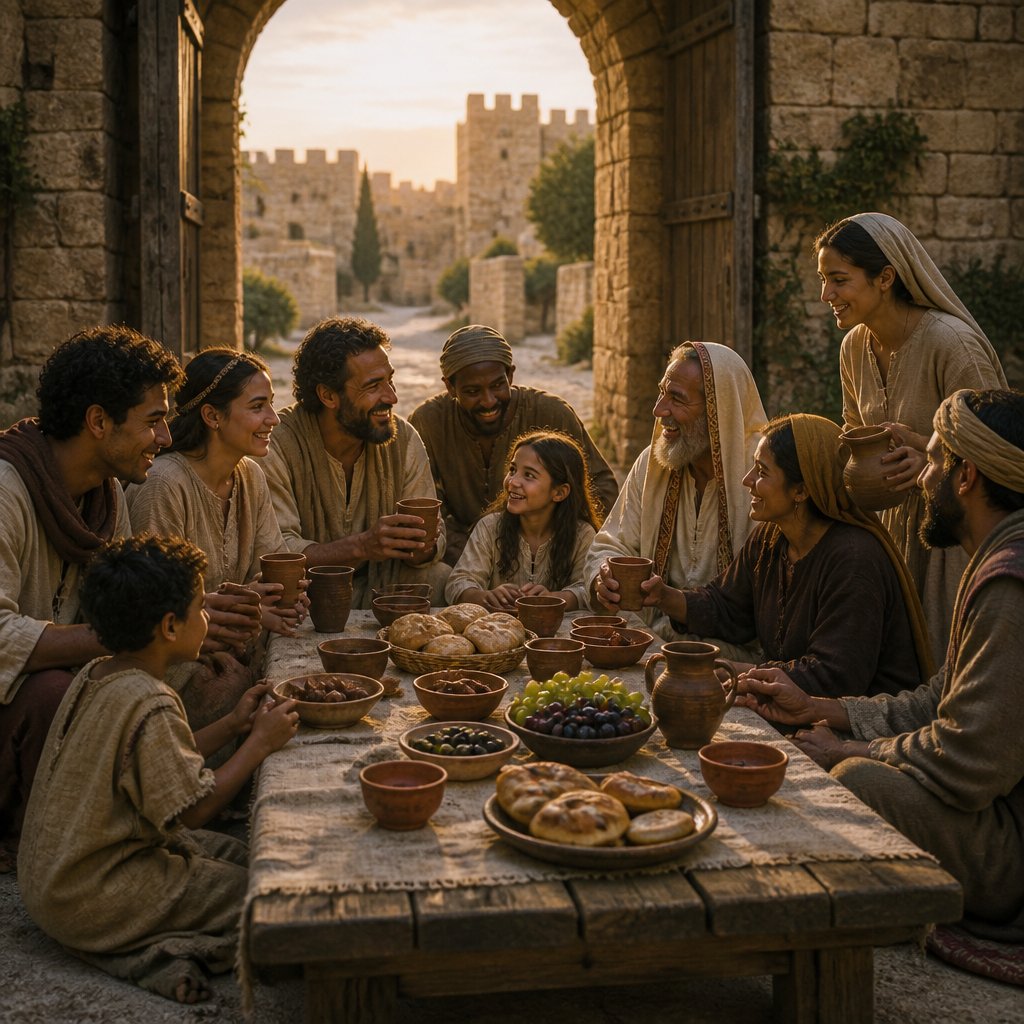
As we immerse ourselves in the richness of Deuteronomy 16:14, which states, "And thou shalt rejoice in thy feast, thou, and thy son, and thy daughter, and thy manservant, and thy maidservant, and the Levite, the stranger, and the fatherless, and the widow, that are within thy gates," we find a profound call to joy that transcends mere personal happiness. This verse is nestled within the context of God’s instructions to the Israelites regarding the festivals, annual feasts that served as vital moments of communal worship and celebration.
First, let us understand the purpose of these feasts. In the ancient context, the feasts outlined in Deuteronomy were not just times of merriment; they were critical opportunities for the people to remember God’s provisions and to testify to His faithfulness. Three major feasts are prescribed: Passover, Pentecost (Feast of Weeks), and Tabernacles (Feast of Ingathering). Each occasion was a divine orchestration instituted by God to remind His people of their history, identity, and relationship with Him. Rejoicing, therefore, was deeply intertwined with remembrance.
The structure of the verse indicates a communal dimension to joy. It emphasizes inclusivity—"thou, and thy son, and thy daughter, and thy manservant, and thy maidservant"—showing that joy is not meant to be a solitary endeavor, but rather a shared experience that entails everyone in the household and beyond. The deliberate mention of the Levite, the stranger, the fatherless, and the widow underscores the importance of inclusivity in God’s vision for His people.
True rejoicing in Christ signifies belonging, acceptance, and celebration of life’s goodness together. The societal framework of ancient Israel allowed for differentiation between social classes, yet God’s command disrupts these norms. Everyone—regardless of social status—was invited to participate in the joy and the feasting, reflecting the heart of God for unity and compassion. In our own lives, this is a call to recognize those who might be marginalized among us. We are urged to include those who are often overlooked or omitted from our celebrations. As we gather with family and friends, we are challenged to reach out to the forgotten, extending our tables to include them in our joy.
The act of rejoicing is also a reflection of our gratitude. When we feast, it is a time to acknowledge all that God has done for us. These moments of celebration serve as reminders of how God’s hand has provided for our needs. When we recognize God’s provision and grace, it naturally ignites a spirit of joy in our hearts. Our gratitude transforms our perspective and deepens our appreciation for life’s blessings, prompting us to joyfully share those blessings with others.
Moreover, while this verse emphasizes the act of celebration, it is not prescriptive merely to feast physically but to engage in a feast of the spirit. Rejoicing extends beyond the physical act of enjoying food and drink; it encompasses a heart posture that acknowledges God’s goodness, grace, and mercy toward us and others. One cannot truly rejoice when harboring bitterness or unkindness. Therefore, as we celebrate, we are invited to evaluate our hearts and relationships.
In today’s world, festivity can often feel personal and individualistic. Yet, as believers, we are called to a higher standard rooted in the joy of communal gatherings. We can cultivate a lifestyle and community marked by rejoicing together, ensuring that no one is left out of the joy that God offers.
In conclusion, the call to rejoice in Deuteronomy invites us into a rhythm of life characterized by shared joy and remembrance. Let us heed this call, creating atmospheres where every voice is heard, every heart is included, and where our celebrations reflect our gratitude for God’s faithful provision. May our feasts—literal or metaphorical—be overflowing with joy as we embrace not only our blessings but also those whom God has called us to love and include.
Want to reflect more on Deuteronomy 16:14?
Continue your spiritual journey with Bible Chat — an AI-powered tool for exploring God's Word through conversation. Ask questions, discover connections, and deepen your understanding.
Get Our Apps


Deuteronomy 16:14 Artwork

Deuteronomy 16:14 - "And thou shalt rejoice in thy feast, thou, and thy son, and thy daughter, and thy manservant, and thy maidservant, and the Levite, the stranger, and the fatherless, and the widow, that are within thy gates."
"And thou shalt rejoice in thy feast, thou, and thy son, and thy daughter, and thy manservant, and thy maidservant, and the Levite, the stranger, and the fatherless, and the widow, that are within thy gates." - Deuteronomy 16:14

Deuteronomy 14:16 - "The little owl, and the great owl, and the swan,"

"The little owl, and the great owl, and the swan," - Deuteronomy 14:16

Deuteronomy 14:14 - "And every raven after his kind,"

Deuteronomy 20:16

Deuteronomy 20:16

Deuteronomy 20:16

Deuteronomy 14:17 - "And the pelican, and the gier eagle, and the cormorant,"

"And every raven after his kind," - Deuteronomy 14:14

Deuteronomy 10:16 - "Circumcise therefore the foreskin of your heart, and be no more stiffnecked."

Deuteronomy 14:3 - "¶ Thou shalt not eat any abominable thing."

Deuteronomy 14:11 - "¶ Of all clean birds ye shall eat."

Deuteronomy 14:20 - "But of all clean fowls ye may eat."

Deuteronomy 14:13 - "And the glede, and the kite, and the vulture after his kind,"

Deuteronomy 28:16 - "Cursed shalt thou be in the city, and cursed shalt thou be in the field."

Deuteronomy 14:18 - "And the stork, and the heron after her kind, and the lapwing, and the bat."

Deuteronomy 14:12 - "But these are they of which ye shall not eat: the eagle, and the ossifrage, and the ospray,"

Deuteronomy 14:15 - "And the owl, and the night hawk, and the cuckow, and the hawk after his kind,"

Deuteronomy 29:14 - "Neither with you only do I make this covenant and this oath;"

Deuteronomy 14:4 - "These are the beasts which ye shall eat: the ox, the sheep, and the goat,"

Deuteronomy 32:16 - "They provoked him to jealousy with strange gods, with abominations provoked they him to anger."

Deuteronomy 14:19 - "And every creeping thing that flieth is unclean unto you: they shall not be eaten."

Deuteronomy 25:14 - "Thou shalt not have in thine house divers measures, a great and a small."

Genesis 16:14

John 14:16

Deuteronomy 6:16 - "¶ Ye shall not tempt the LORD your God, as ye tempted him in Massah."

"And the pelican, and the gier eagle, and the cormorant," - Deuteronomy 14:17

Deuteronomy 27:14 - "¶ And the Levites shall speak, and say unto all the men of Israel with a loud voice,"

Deuteronomy 14:10 - "And whatsoever hath not fins and scales ye may not eat; it is unclean unto you."