The Cost of Compromise: A Call to Radical Faithfulness
"And thou shalt gather all the spoil of it into the midst of the street thereof, and shalt burn with fire the city, and all the spoil thereof every whit, for the LORD thy God: and it shall be an heap for ever; it shall not be built again." - Deuteronomy 13:16
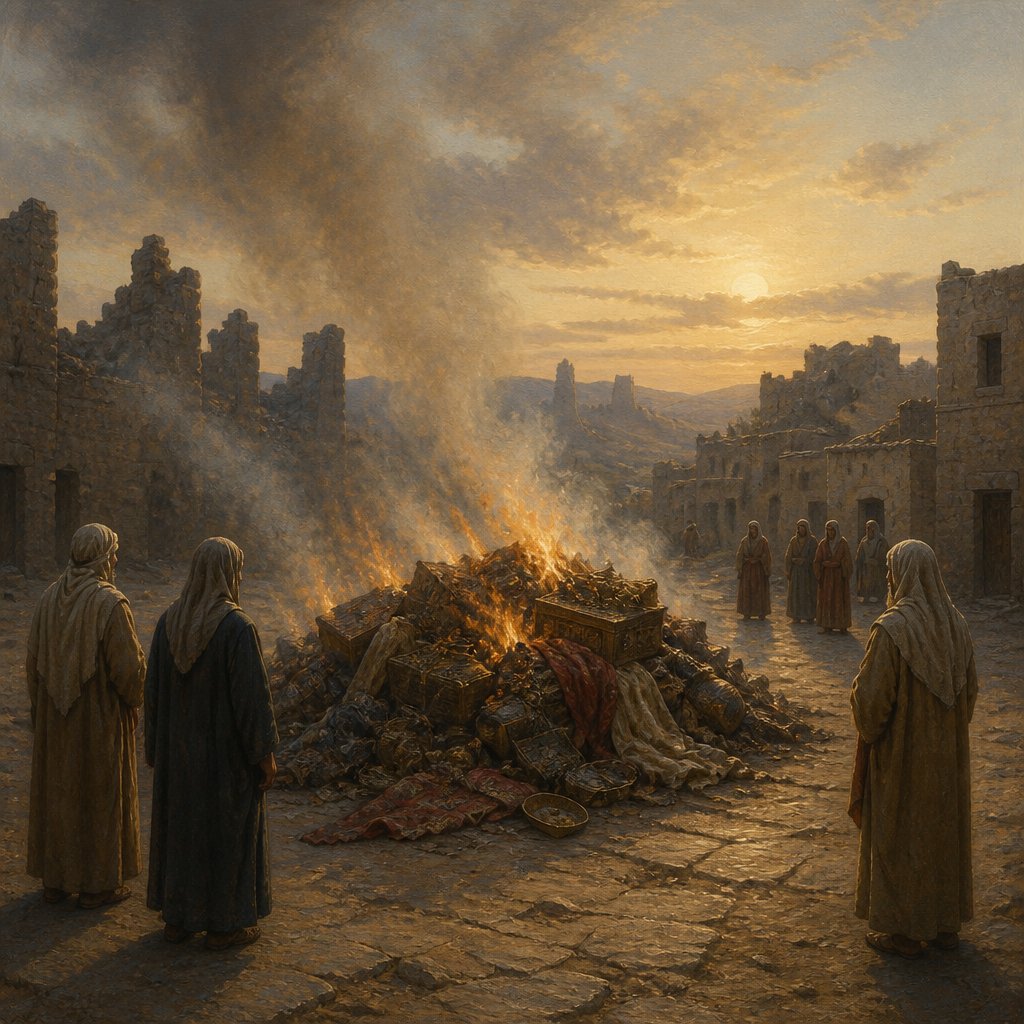
As we delve into the solemn command found in Deuteronomy 13:16, "And thou shalt gather all the spoil of it into the midst of the street thereof, and shalt burn with fire the city, and all the spoil thereof every whit, for the LORD thy God: and it shall be an heap for ever; it shall not be built again," we are confronted with the stark reality of spiritual fidelity and the radical measures sometimes required in our walk with God. This verse, situated within the broader context of commands against idol worship and unfaithfulness, beckons us to reflect deeply on the cost of compromise and the seriousness of our covenant with God.
In ancient Israel, the directive given was not merely about the destruction of a physical city or its spoils, but it encapsulated the idea of total allegiance to God. The Israelites were to eliminate all remnants of idolatry and perversion that could lead them astray from their relationship with the Lord. It draws our attention to the principle of "no compromise" in the life of a believer. In today's context, the threat of spiritual compromise is equally present, though perhaps it is more subtle than the overt idol worship that the Israelites faced.
The burning of the city and all its spoils signifies the complete eradication of anything that may challenge or tarnish our relationship with God. What does this look like in our lives? It may require us to make hard decisions regarding relationships, media consumption, activities, or habits that draw our hearts away from Him. The command to gather the spoil and burn it reflects that which was once a temptation must now become ash. This act of destruction is twofold: it signifies our commitment to God, and it serves as a deterrent against future compromise. Just as the heap left behind would stand as a visual reminder of the consequences of straying from God, so too should our own "heaps" of past temptations stand as a reminder of the serious nature of our spiritual commitments.
Moreover, this passage emphasizes the permanence of the decision to eliminate that which opposes God. "...and it shall not be built again" speaks to the idea that once we decisively remove the influences that could lead us into compromise, they should not be allowed to find roots in our lives again. The struggle against sin is ongoing, but there are landmarks of devotion and dedication where we, too, can say, "I will not revisit this path." In a world filled with distractions and alluring alternatives to divine faithfulness, our commitment to God demands a steadfast resolve to leave behind in the ashes what does not honor Him.
The ultimate purpose of such a drastic command is for the glory of God: "...for the LORD thy God." Everything we do is to be done as an act of worship, a testament to our relationship with Him. In our context, worship requires that we be vigilant against anything that could rival our devotion. Are we gathering the spoils of spiritual distraction in our lives? What would we need to burn in order to honor our commitment to God?
The story doesn’t end with the destruction. It's also a call to build something new, to lead a life that reflects obedience and trust in God. When we remove the distractions and commit fully to God, we create space for His purpose and blessing in our lives. The heaps of ash symbolize not only what we've sacrificed but also the freedom to be transformed anew, drawing us closer to Him, allowing us to fully embrace His promises.
In closing, let us take a moment to examine our lives before the Lord. What needs to be gathered and burned so that it becomes a heap forever, serving as a monument to our fidelity to God? May we approach this task with courage and conviction, knowing that in our obedience, we reflect the holiness and might of our God.
Want to reflect more on Deuteronomy 13:16?
Continue your spiritual journey with Bible Chat — an AI-powered tool for exploring God's Word through conversation. Ask questions, discover connections, and deepen your understanding.
Get Our Apps


Deuteronomy 13:16 Artwork

Deuteronomy 13:16 - "And thou shalt gather all the spoil of it into the midst of the street thereof, and shalt burn with fire the city, and all the spoil thereof every whit, for the LORD thy God: and it shall be an heap for ever; it shall not be built again."
"And thou shalt gather all the spoil of it into the midst of the street thereof, and shalt burn with fire the city, and all the spoil thereof every whit, for the LORD thy God: and it shall be an heap for ever; it shall not be built again." - Deuteronomy 13:16

Deuteronomy 16:13 - "¶ Thou shalt observe the feast of tabernacles seven days, after that thou hast gathered in thy corn and thy wine:"

Deuteronomy 20:16

Deuteronomy 20:16

Deuteronomy 20:16
"¶ Thou shalt observe the feast of tabernacles seven days, after that thou hast gathered in thy corn and thy wine:" - Deuteronomy 16:13

Deuteronomy 14:16 - "The little owl, and the great owl, and the swan,"

Deuteronomy 10:16 - "Circumcise therefore the foreskin of your heart, and be no more stiffnecked."

Deuteronomy 28:16 - "Cursed shalt thou be in the city, and cursed shalt thou be in the field."

Deuteronomy 14:13 - "And the glede, and the kite, and the vulture after his kind,"

Deuteronomy 18:13 - "Thou shalt be perfect with the LORD thy God."

Deuteronomy 17:13 - "And all the people shall hear, and fear, and do no more presumptuously."

Deuteronomy 32:16 - "They provoked him to jealousy with strange gods, with abominations provoked they him to anger."

Deuteronomy 25:13 - "¶ Thou shalt not have in thy bag divers weights, a great and a small."

Deuteronomy 5:13 - "Six days thou shalt labour, and do all thy work:"

Deuteronomy 22:13 - "¶ If any man take a wife, and go in unto her, and hate her,"

Deuteronomy 6:16 - "¶ Ye shall not tempt the LORD your God, as ye tempted him in Massah."

Deuteronomy 19:16 - "¶ If a false witness rise up against any man to testify against him that which is wrong;"

Deuteronomy 16:12 - "And thou shalt remember that thou wast a bondman in Egypt: and thou shalt observe and do these statutes."

Deuteronomy 25:16 - "For all that do such things, and all that do unrighteously, are an abomination unto the LORD thy God."

Deuteronomy 12:16 - "Only ye shall not eat the blood; ye shall pour it upon the earth as water."

Deuteronomy 13:1 - "If there arise among you a prophet, or a dreamer of dreams, and giveth thee a sign or a wonder,"

Genesis 16:13

Deuteronomy 2:16 - "¶ So it came to pass, when all the men of war were consumed and dead from among the people,"

Deuteronomy 27:16 - "Cursed be he that setteth light by his father or his mother. And all the people shall say, Amen."

"The little owl, and the great owl, and the swan," - Deuteronomy 14:16

Deuteronomy 6:13 - "Thou shalt fear the LORD thy God, and serve him, and shalt swear by his name."

Deuteronomy 13:11 - "And all Israel shall hear, and fear, and shall do no more any such wickedness as this is among you."

Luke 16:1-13