The Fire That Transforms: Encountering God in the Wilderness
"And when forty years were expired, there appeared to him in the wilderness of mount Sina an angel of the Lord in a flame of fire in a bush." - Acts 7:30
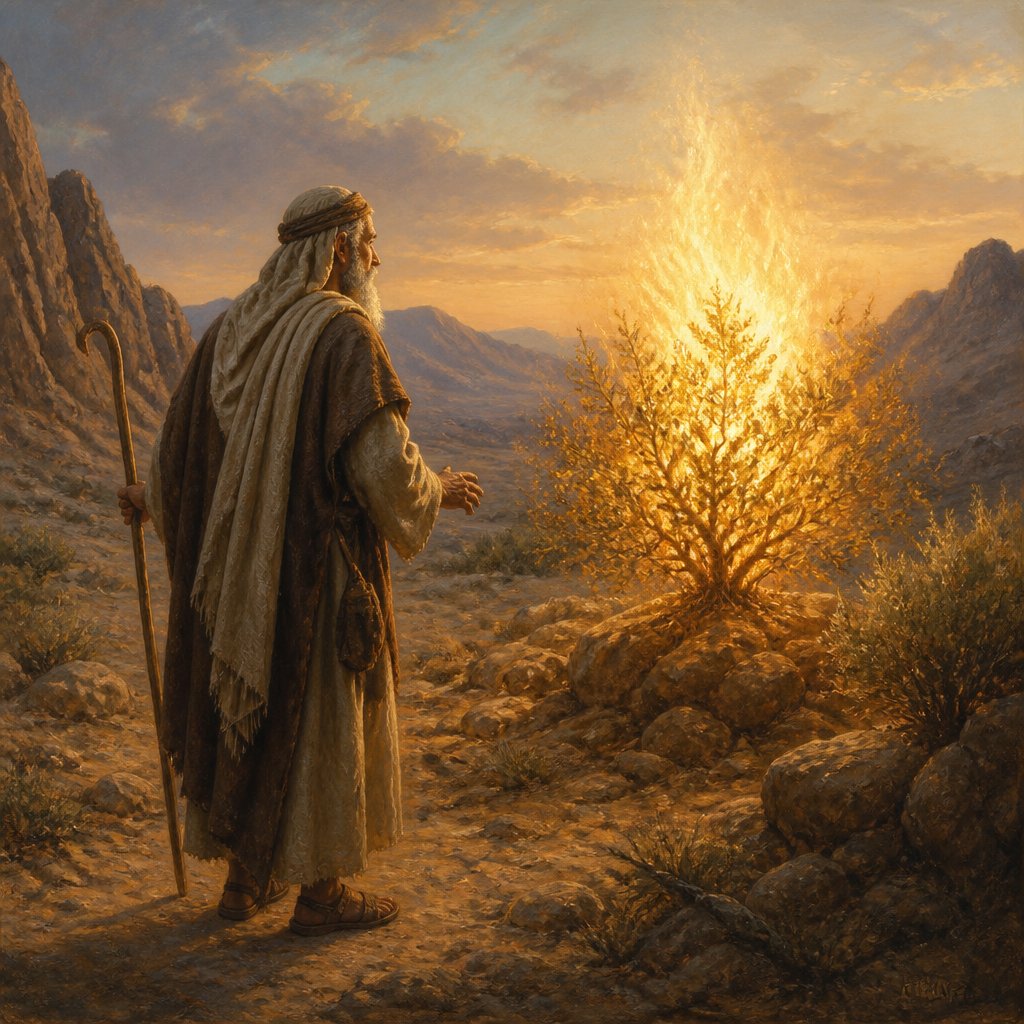
In Acts 7:30, we encounter a pivotal moment in the life of Moses: “And when forty years were expired, there appeared to him in the wilderness of mount Sina an angel of the Lord in a flame of fire in a bush.” This verse does not merely recount a miraculous event; it serves as an invitation to reflect on the transformations that occur in our lives when we encounter God in our own wilderness—those desolate, frustrating places where we often feel lost and unfulfilled.
### Understanding the Context
To fully grasp the significance of this encounter, let us take a brief look at the context of Moses’ life leading up to this moment. Moses spent his first forty years in the palace of Pharaoh, raised as a prince of Egypt. However, after witnessing the oppression of his people, he chose to identify with the Israelites, ultimately resulting in him fleeing to the wilderness of Midian after he killed an Egyptian.
For the next forty years, he made his home in obscurity—tending to sheep, working as a shepherd, and marrying Zipporah, the daughter of Jethro. This lengthy period can appear as a wasted time, lost in the perpetual cycle of mundane tasks. Yet, it was here, in the wilderness, stripped of his Egyptian grandeur, that Moses began to discover a deeper purpose for his life.
### The Wilderness as a Place of Encounter
The wilderness is often portrayed in Scripture as a place of testing and preparation. It is where Jesus fasted for forty days and faced temptation (Matthew 4:1-11). It is where the Israelites wandered before entering the Promised Land. Here, we see that the wilderness is not just a physical location but a spiritual journey—a place where distractions fall away, and one can encounter God in profound ways.
Moses’ encounter with the angel of the Lord in the fiery bush is remarkable for its intensity. The flame represents the presence of God, holy and transformative. In this instance, fire symbolizes purification, call, and revelation—a metaphor for how God can ignite our spirits even in times of desolation.
### The Significance of the Flame
When the bush burned without being consumed, it communicated a powerful truth: God is a consuming fire (Hebrews 12:29), yet He does not destroy what He seeks to transform. This dual aspect of God’s nature—His ability to purify while sustaining—offers a vivid picture of how our lives can be touched by divine interaction. God desires to set our hearts ablaze with purpose and passion, shaping us into the images of His Son. Just as the fire in the bush drew Moses’ attention, our own encounters with God can spark significant change in our lives.
### The Call to Action
Moses’ journey shifted dramatically when he responded to God’s call. God informed him of His mission: to lead the Israelites out of captivity. In that moment, Moses transitioned from a shepherd taking care of earthly sheep to a leader shepherding God’s chosen people toward liberation. This call challenges us: Are we inviting God into our wilderness? Do we look for His presence even in our struggles, or do we allow despair to overshadow our trust?
As we consider our own wilderness experiences, may we be reminded that God sees us in our trials. Like Moses, we can encounter God in the most unexpected places, and it is there that we can become agents of His will. We must not shy away from our wilderness but approach it with expectancy and openness, prepared to see God move in our lives. Is the flame of God's spirit igniting your heart today? Are you recognizing His call amidst the ordinary?
### Conclusion
Acts 7:30 invites us into a narrative of renewal and purpose. It encourages us to be watchful for the divine encounters that can lead to significant transformations in our lives. Just as Moses stepped into a new mission, we too can emerge from our wilderness experiences equipped and renewed to fulfill God's call in our lives. May we be open to seeing the fire of God in the bushes along our journey, ready to respond as He reveals His plans for us.
Want to reflect more on Acts 7:30?
Continue your spiritual journey with Bible Chat — an AI-powered tool for exploring God's Word through conversation. Ask questions, discover connections, and deepen your understanding.
Get Our Apps


Acts 7:30 Artwork

Acts 7:30 - "And when forty years were expired, there appeared to him in the wilderness of mount Sina an angel of the Lord in a flame of fire in a bush."
"And when forty years were expired, there appeared to him in the wilderness of mount Sina an angel of the Lord in a flame of fire in a bush." - Acts 7:30

Acts 4:30

Acts 4:30

Acts 4:30

Acts 4:30

Acts 13:30 - "But God raised him from the dead:"

ACTS 8:30 Philip and the Ethiopian

Acts 11:30 - "Which also they did, and sent it to the elders by the hands of Barnabas and Saul."

Acts 19:30 - "And when Paul would have entered in unto the people, the disciples suffered him not."

Acts 16:30 - "And brought them out, and said, Sirs, what must I do to be saved?"

Acts 17:30 - "And the times of this ignorance God winked at; but now commandeth all men every where to repent:"

Acts 5:30 - "The God of our fathers raised up Jesus, whom ye slew and hanged on a tree."

Acts 9:30 - "Which when the brethren knew, they brought him down to Caesarea, and sent him forth to Tarsus."

Acts 3:6-7

Acts 3:6-7

"But God raised him from the dead:" - Acts 13:30

Acts 3:6-7

Acts 3:6-7

Acts 3:6-7

Acts 26:30 - "And when he had thus spoken, the king rose up, and the governor, and Bernice, and they that sat with them:"

Acts 15:30 - "So when they were dismissed, they came to Antioch: and when they had gathered the multitude together, they delivered the epistle:"

Acts 4:30 - "By stretching forth thine hand to heal; and that signs and wonders may be done by the name of thy holy child Jesus."

Acts 28:30 - "And Paul dwelt two whole years in his own hired house, and received all that came in unto him,"

Acts 14:7 - "And there they preached the gospel."

Acts 20:30 - "Also of your own selves shall men arise, speaking perverse things, to draw away disciples after them."

Acts 8:30 - "And Philip ran thither to him, and heard him read the prophet Esaias, and said, Understandest thou what thou readest?"

Acts 21:30 - "And all the city was moved, and the people ran together: and they took Paul, and drew him out of the temple: and forthwith the doors were shut."

acts 20:7-12

Nehemiah 7:30 - "The men of Ramah and Geba, six hundred twenty and one."