The Weight of Integrity: Honoring God in Our Deeds
"Whiles it remained, was it not thine own? and after it was sold, was it not in thine own power? why hast thou conceived this thing in thine heart? thou hast not lied unto men, but unto God." - Acts 5:4

Acts 5:4 presents a profound moment in the story of Ananias and Sapphira, where Peter confronts Ananias about his deceitful act. The verse states, "Whiles it remained, was it not thine own? and after it was sold, was it not in thine own power? why hast thou conceived this thing in thine heart? thou hast not lied unto men, but unto God." In these few lines, we see a powerful exploration of ownership, integrity, and the high calling of honesty in our relationship with God.
To understand the gravity of this passage, we must first consider the context. Ananias and Sapphira were part of a newly formed community of believers who had just experienced a fierce outpouring of God’s spirit at Pentecost. This community was characterized by unity, shared resources, and mutual support; there was a sense that everything belonged to God and each other. Many believers sold their possessions to contribute to the needs of the community. However, Ananias and Sapphira, with a desire for recognition and status, hid part of the proceeds from their sale while presenting their actions as completely generous. They wanted to appear generous without actual sacrifice, deceiving both the community and God.
Peter's pointed questions hold significant weight for us today. Let's break down his inquiries:
1. **Ownership**: "Whiles it remained, was it not thine own?" This first question invites us to examine our concept of ownership. We often mistakenly think that what we possess belongs solely to us. However, as believers, we must recognize that everything we have ultimately belongs to God. Our time, talents, and treasures are gifts from Him, and we are mere stewards of these resources. The principle of ownership should liberate us rather than bind us, encouraging us to use our gifts generously, not just for our gain but for the kingdom of God.
2. **Freedom to Choose**: "and after it was sold, was it not in thine own power?" Here, Peter highlights the freedom that Ananias had in choosing how to respond to God's calling on his life. He had the power to be transparent about his actions. God does not compel us to give or act against our will; instead, He desires our heart's willingness. Too often, Christians can feel pressured to engage in acts of generosity that stem from obligation rather than genuine desire. The freedom we have in Christ is a beautiful reminder that our actions should flow from our love for God, not from the desire for recognition.
3. **Heart Conditions**: "why hast thou conceived this thing in thine heart?" Peter reveals that the issue was rooted in Ananias’s heart. It was not merely about the money; it was about intention and the motives behind his actions. This challenges us to reflect on our own heart conditions. Are we giving for the approval of others? Or are we genuinely motivated by our love for God and His people? We must continually guard our hearts against deceit and pride, for God sees our intentions and knows our true hearts.
4. **Immediate Accountability to God**: The final part of Peter’s statement stabs to the core: "thou hast not lied unto men, but unto God." Ananias had underestimated the severity of his wrongdoing by mistaking that he was only misrepresenting himself to the disciples. Yet, the truth was that every act we commit is done in the presence of God. Our interactions with others are reflections of our relationship with Him. When we choose dishonesty in any form, we defile our relationship with God.
As we ponder Acts 5:4, let us consider the mirror it holds up to our lives. Are we honest in our dealings? Do we reflect the integrity of Christ in our daily conduct? In an age where transparency can be compromised for personal gain, stand firm in integrity, remembering that all we have belongs to God. Let your dealings be characterized by truthfulness, and in doing so, you honor not just the community around you but ultimately, God Himself.
Want to reflect more on Acts 5:4?
Continue your spiritual journey with Bible Chat — an AI-powered tool for exploring God's Word through conversation. Ask questions, discover connections, and deepen your understanding.
Get Our Apps


Acts 5:4 Artwork

Acts 5:4 - "Whiles it remained, was it not thine own? and after it was sold, was it not in thine own power? why hast thou conceived this thing in thine heart? thou hast not lied unto men, but unto God."

"Whiles it remained, was it not thine own? and after it was sold, was it not in thine own power? why hast thou conceived this thing in thine heart? thou hast not lied unto men, but unto God." - Acts 5:4

Acts 1:4-5

Acts 4:5 - "¶ And it came to pass on the morrow, that their rulers, and elders, and scribes,"

"¶ And it came to pass on the morrow, that their rulers, and elders, and scribes," - Acts 4:5

Acts 4:30

Acts 4:30

Acts 4:30

Acts 2:4

Acts 4:30

Acts 2:4

Acts 2:4

Acts 21:5-6

Acts 20:5 - "These going before tarried for us at Troas."

Acts 4:8-12

Acts 4:4 - "Howbeit many of them which heard the word believed; and the number of the men was about five thousand."

Acts 5:5 - "And Ananias hearing these words fell down, and gave up the ghost: and great fear came on all them that heard these things."
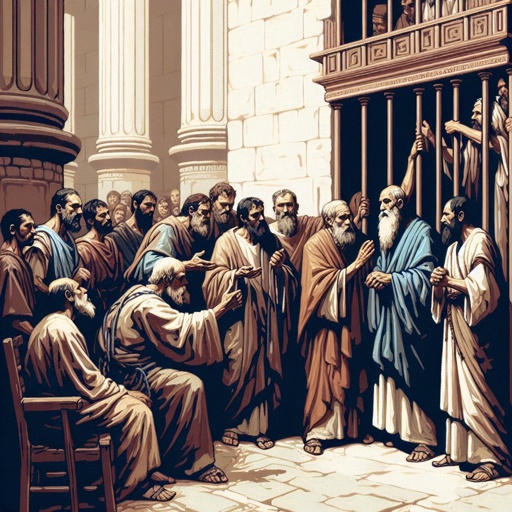
Acts 5:18 - "And laid their hands on the apostles, and put them in the common prison."

Acts 28:5 - "And he shook off the beast into the fire, and felt no harm."

Acts 19:5 - "When they heard this, they were baptized in the name of the Lord Jesus."

Acts 4 Peter before the Sanhedrin

Acts 16:5 - "And so were the churches established in the faith, and increased in number daily."

Acts 5:20 - "Go, stand and speak in the temple to the people all the words of this life."

Acts 5:22 - "But when the officers came, and found them not in the prison, they returned, and told,"

His shadow healed the sick (Acts 5)

Acts 6:4 - "But we will give ourselves continually to prayer, and to the ministry of the word."

1 Timothy 5:4 - "But if any widow have children or nephews, let them learn first to shew piety at home, and to requite their parents: for that is good and acceptable before God."

Acts 23:4 - "And they that stood by said, Revilest thou God's high priest?"

Acts 8:5 - "Then Philip went down to the city of Samaria, and preached Christ unto them."

Acts 5:13 - "And of the rest durst no man join himself to them: but the people magnified them."