Measuring Grace: The Line Between Judgment and Mercy
"And he smote Moab, and measured them with a line, casting them down to the ground; even with two lines measured he to put to death, and with one full line to keep alive. And so the Moabites became David's servants, and brought gifts." - 2 Samuel 8:2
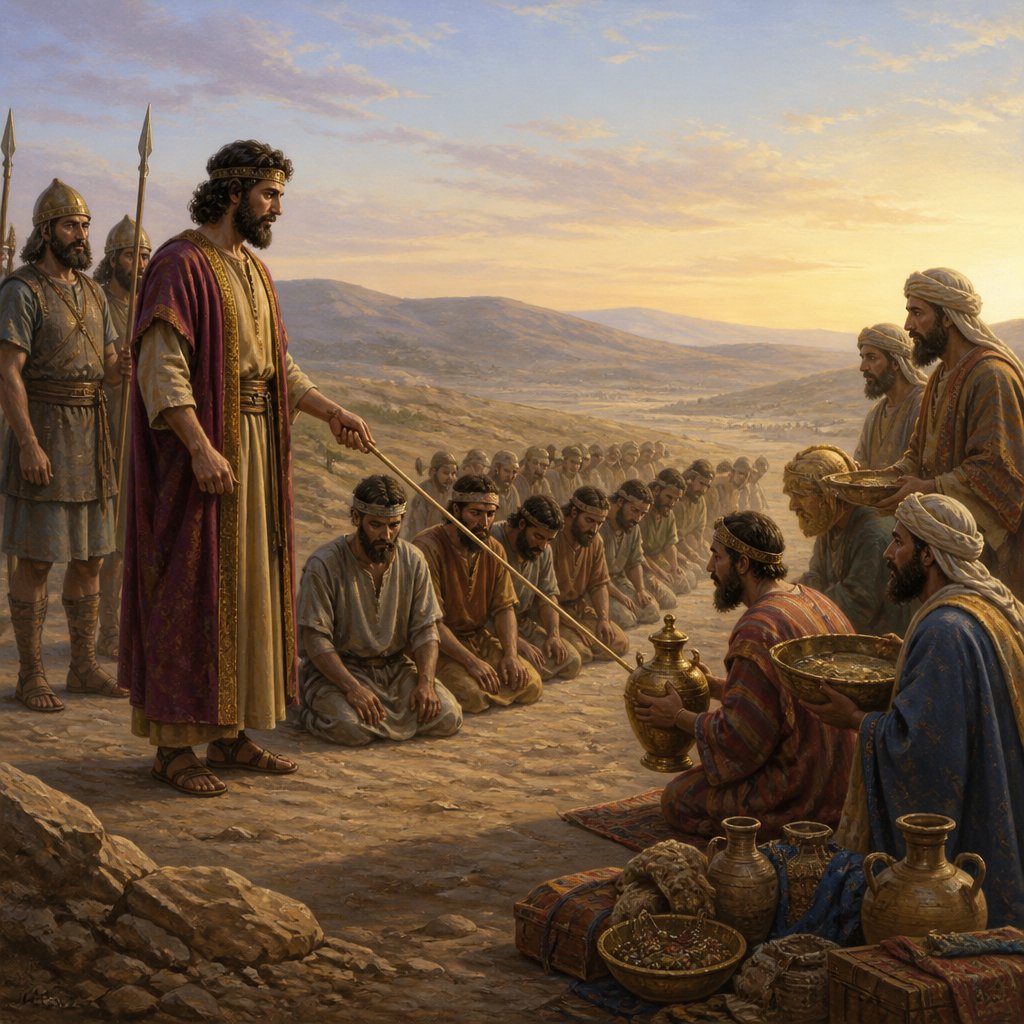
As we delve into the narrative of 2 Samuel 8:2, we encounter a moment of profound significance in King David's reign: “And he smote Moab, and measured them with a line, casting them down to the ground; even with two lines measured he to put to death, and with one full line to keep alive. And so the Moabites became David's servants, and brought gifts.” On the surface, this verse might sound harsh and violent, yet it is a gateway into understanding God's sovereignty, judgment, and mercy.
In this passage, David's actions may initially shock us. Here is a king engaged in a military campaign, employing what appears to be a ruthless method of measuring life and death. The imagery of measuring with lines symbolizes the very authority David wields—a king who determines the destiny of nations and the lives of people. Yet, we must look deeper into what this measurement signifies in the broader context of divine governance.
Firstly, we must recognize that David's victory over Moab was not merely a matter of human conquest. The Moabites were historically adversaries of Israel, having been antagonistic for generations, even to the point of opposing the people of God during their exodus. David's battle against Moab was a fulfillment of divine justice; it showcased the effect of sin and disobedience towards God. In God's kingdom, there are consequences to rebellion, both individually and as nations. In this light, we see God's holiness and justice manifest in David's actions.
However, the measurement described here also reveals a fascinating aspect about God's methods. The use of two lines and one line creates a distinction not just in judgment but in the preservation of life. Why one line to keep alive, while two lines were used for death? Throughout Scripture, we find that God is not merely a God of judgment but a God of mercy. The decision to spare some of the Moabites symbolizes the potential for grace even in the face of deserved punishment. This nuanced approach should remind us of the balance in God's character—He is righteous enough to judge sin but loving enough to offer mercy.
As followers of Christ, we are called to extend this principle of mercy in our lives. How often do we find ourselves caught in situations where we feel tempted to enact our own version of judgment? In a world where divisions and strife abound, it becomes easy to measure others based on our perceptions and allow our judgments to overwhelm our mercy. Yet, as illustrated in this passage, we cannot forget the importance of grace. Just as God provides us ample chances despite our failures, we too must strive to create spaces for reconciliation rather than condemnation.
Thus, when we reflect upon David's decision to spare some of the Moabites, we are reminded of God's overarching plan of redemption. The Moabites, once enemies, were incorporated into the history of Israel and, ultimately, played a role leading to the lineage of Jesus Christ—a powerful testament to how God can redeem any situation, transforming enmity into servitude and involvement in His divine narrative.
As we move through our lives, let us measure our actions with the lines of grace and mercy. Let us not become arbiters of judgment, casting others down, but instead be vehicles of love, calling forth the potential for life in all we encounter. This calls us to the profound truth that while we hold responsibility for our behavior, we also have a sacred duty to reflect the heart of Christ—a heart that desires all to come to repentance and exist within His mercy.
In conclusion, 2 Samuel 8:2 serves as a potent reminder of the line between judgment and mercy, urging us to embody Christ’s call to love in all our interactions. Let us pray for wisdom to carry out this measure of grace, honoring God as we navigate the complexities of our own lives.
Want to reflect more on 2 Samuel 8:2?
Continue your spiritual journey with Bible Chat — an AI-powered tool for exploring God's Word through conversation. Ask questions, discover connections, and deepen your understanding.
Get Our Apps


2 Samuel 8:2 Artwork

2 Samuel 8:2 - "And he smote Moab, and measured them with a line, casting them down to the ground; even with two lines measured he to put to death, and with one full line to keep alive. And so the Moabites became David's servants, and brought gifts."
"And he smote Moab, and measured them with a line, casting them down to the ground; even with two lines measured he to put to death, and with one full line to keep alive. And so the Moabites became David's servants, and brought gifts." - 2 Samuel 8:2

2 Samuel 19:8

2 Samuel 19:8

2 Samuel 19:8

2 Samuel 19:8

2 samuel 23:8-21

2 Samuel 2:8 - "¶ But Abner the son of Ner, captain of Saul's host, took Ish-bosheth the son of Saul, and brought him over to Mahanaim;"

2 Samuel 8:8 - "And from Betah, and from Berothai, cities of Hadadezer, king David took exceeding much brass."

2 Samuel 8:16 - "And Joab the son of Zeruiah was over the host; and Jehoshaphat the son of Ahilud was recorder;"

2 Samuel 22:8 - "Then the earth shook and trembled; the foundations of heaven moved and shook, because he was wroth."

2 Samuel 8:17 - "And Zadok the son of Ahitub, and Ahimelech the son of Abiathar, were the priests; and Seraiah was the scribe;"

2 Samuel 8:7 - "And David took the shields of gold that were on the servants of Hadadezer, and brought them to Jerusalem."

2 Samuel 8:9 - "¶ When Toi king of Hamath heard that David had smitten all the host of Hadadezer,"

2 Samuel 14:8 - "And the king said unto the woman, Go to thine house, and I will give charge concerning thee."

2 Samuel 8:12 - "Of Syria, and of Moab, and of the children of Ammon, and of the Philistines, and of Amalek, and of the spoil of Hadadezer, son of Rehob, king of Zobah."

2 Samuel 8:18 - "And Benaiah the son of Jehoiada was over both the Cherethites and the Pelethites; and David's sons were chief rulers."

1 Samuel 8:2 - "Now the name of his firstborn was Joel; and the name of his second, Abiah: they were judges in Beer-sheba."

2 Samuel 1:8 - "And he said unto me, Who art thou? And I answered him, I am an Amalekite."

2 Samuel 8:15 - "And David reigned over all Israel; and David executed judgment and justice unto all his people."

2 Samuel 24:8 - "So when they had gone through all the land, they came to Jerusalem at the end of nine months and twenty days."

2 Samuel 18:8 - "For the battle was there scattered over the face of all the country: and the wood devoured more people that day than the sword devoured."

2 Samuel 9:8 - "And he bowed himself, and said, What is thy servant, that thou shouldest look upon such a dead dog as I am?"

2 Samuel 8:5 - "And when the Syrians of Damascus came to succour Hadadezer king of Zobah, David slew of the Syrians two and twenty thousand men."

2 Samuel 8:3 - "¶ David smote also Hadadezer, the son of Rehob, king of Zobah, as he went to recover his border at the river Euphrates."

2 Samuel 8:1 - "And after this it came to pass, that David smote the Philistines, and subdued them: and David took Metheg-ammah out of the hand of the Philistines."

2 Samuel 8:13 - "And David gat him a name when he returned from smiting of the Syrians in the valley of salt, being eighteen thousand men."

2 Samuel 6:8 - "And David was displeased, because the LORD had made a breach upon Uzzah: and he called the name of the place Perez-uzzah to this day."

2 Samuel 8:6 - "Then David put garrisons in Syria of Damascus: and the Syrians became servants to David, and brought gifts. And the LORD preserved David whithersoever he went."

2 Samuel 10:8 - "And the children of Ammon came out, and put the battle in array at the entering in of the gate: and the Syrians of Zoba, and of Rehob, and Ish-tob, and Maacah, were by themselves in the field."