Victory in the Gutter: Confronting Our Giants
"And David said on that day, Whosoever getteth up to the gutter, and smiteth the Jebusites, and the lame and the blind, that are hated of David's soul, he shall be chief and captain. Wherefore they said, The blind and the lame shall not come into the house." - 2 Samuel 5:8
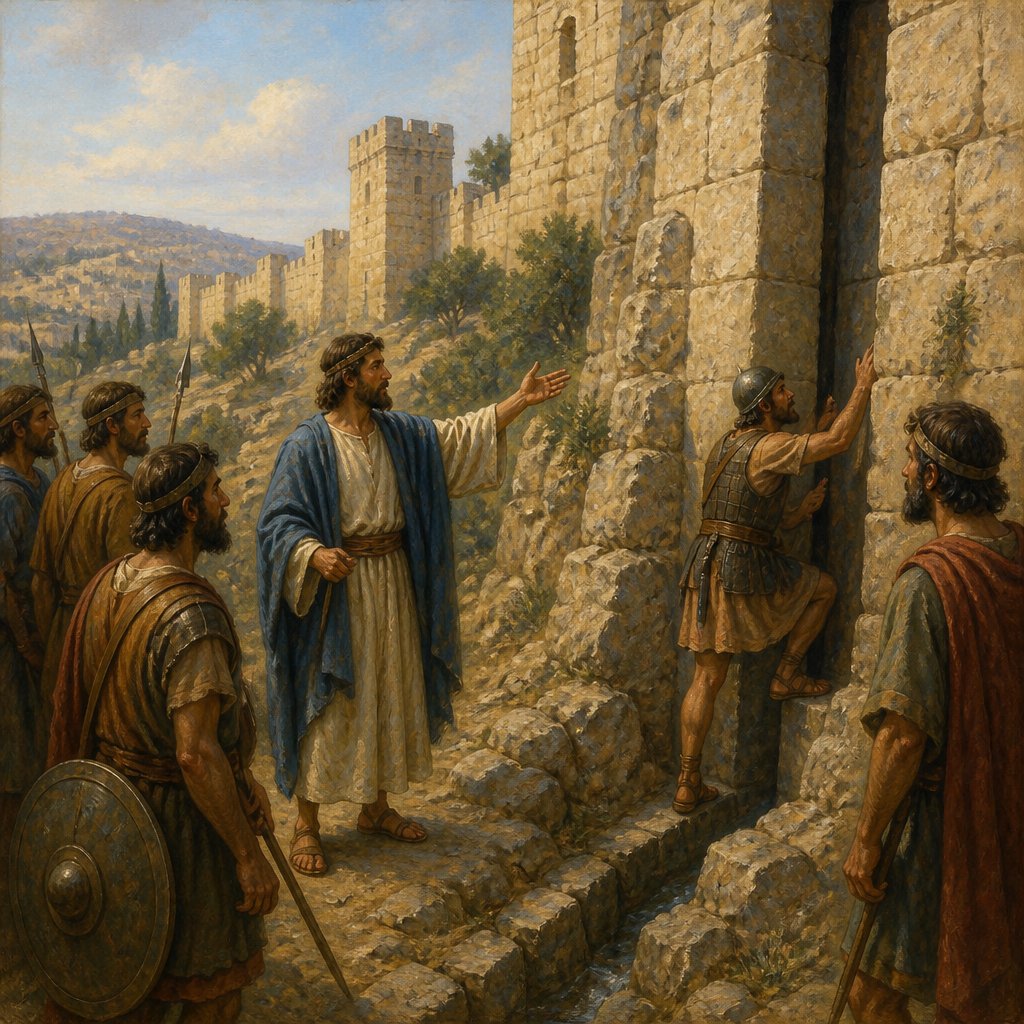
The verse from 2 Samuel 5:8 (KJV) reminds us of a momentous occasion in King David’s journey. The text reads: "And David said on that day, Whosoever getteth up to the gutter, and smiteth the Jebusites, and the lame and the blind, that are hated of David's soul, he shall be chief and captain. Wherefore they said, The blind and the lame shall not come into the house." In these lines, we find a profound challenge and a clarion call to honor and value courage amidst adversity.
In this narrative, David is speaking after he has become king over Israel and is setting his sights on the Jebusite stronghold of Jerusalem—a city that had remained unconquered. The Jebusites taunted David, claiming that even the blind and lame could defend the city. They believed themselves invincible because of their strong defenses and, perhaps, their status as long-time inhabitants of Jerusalem. Yet, David reverses their taunt into a challenge. He invokes a significant principle: victory often lies in confronting areas we perceive as unassailable, the very gutters of our challenges, where hope often seems lost.
The term "gutter" can be understood here as a lowly or dirty place, a metaphor for confronting the depths of our challenges or fears. David's directive to attack the Jebusites indicates that true bravery often resides in the willingness to address our lowest points rather than avoiding them. In our lives, this may translate into facing our fears, insecurities, or painful memories—all the 'gutters' where the 'lame and blind' reside, representing our weaknesses and vulnerabilities.
As David emphasized the worthiness of those who would rise against these foes, let us recognize that God calls each of us to confront our own Jebusites. The phrase "smiteth the Jebusites" can serve as a reminder that victory requires action. We cannot simply wait for change to come; we must rise and take up arms against whatever holds us captive. In terms of spiritual warfare, this means actively engaging in prayer, applying Scripture in our lives, and seeking accountability and support within our communities.
Consider the figures in the narrative—the Jebusites, the blind, and the lame. David despised their prideful defiance, but it is important to remember that his mention of the blind and lame symbolizes those who are looked down upon. In our society, we often overlook or belittle those who are weaker or struggling. David’s command, however, evokes a revolutionary spirit—it indicates that leadership is not solely reserved for the strong but also acknowledges the worth found in every person’s action against injustice.
We are called not only to rise in our battles but also to uplift those who feel voiceless, those who are perceived as less than worthy. The challenge thus extends beyond physical battles; it encompasses how we view and treat others. In modern contexts, the 'blind and lame' could symbolize marginalized groups or those in our ministries whom we tend to overlook.
Finally, when we acknowledge that every individual has a part to play in God’s plan—whether they appear strong or weak—we enrich our communities and deepen our faith. We heed David's rallying cry, reversing a culture that praises strength and champions those who rise from the ‘gutter’ to fight against the adversities of life. In this way, we forge paths of inclusion, restoring dignity to every life.
As we meditate on this verse, let us allow God to inspire bold action, to confront what needs to be addressed, and to bolster the spirit in those around us. Thus, with each encounter, we pave a way through the gutters of our struggles, empowered to emerge as conquerors in the name of our Savior. Let us echo David’s words, accepting that we, too, are called to be chief and captain—transforming our apparent weaknesses into vessels for divine victory.
Want to reflect more on 2 Samuel 5:8?
Continue your spiritual journey with Bible Chat — an AI-powered tool for exploring God's Word through conversation. Ask questions, discover connections, and deepen your understanding.
Get Our Apps


2 Samuel 5:8 Artwork

2 Samuel 5:8 - "And David said on that day, Whosoever getteth up to the gutter, and smiteth the Jebusites, and the lame and the blind, that are hated of David's soul, he shall be chief and captain. Wherefore they said, The blind and the lame shall not come into the house."
"And David said on that day, Whosoever getteth up to the gutter, and smiteth the Jebusites, and the lame and the blind, that are hated of David's soul, he shall be chief and captain. Wherefore they said, The blind and the lame shall not come into the house." - 2 Samuel 5:8

2 Samuel 8:5 - "And when the Syrians of Damascus came to succour Hadadezer king of Zobah, David slew of the Syrians two and twenty thousand men."

2 Samuel 5:12

2 Samuel 5:15 - "Ibhar also, and Elishua, and Nepheg, and Japhia,"

2 Samuel 19:8

2 Samuel 19:8

2 Samuel 19:8

2 Samuel 5:16 - "And Elishama, and Eliada, and Eliphalet."

2 Samuel 19:8

"And Elishama, and Eliada, and Eliphalet." - 2 Samuel 5:16

2 samuel 23:8-21

2 Samuel 8:8 - "And from Betah, and from Berothai, cities of Hadadezer, king David took exceeding much brass."

2 Samuel 5:18 - "The Philistines also came and spread themselves in the valley of Rephaim."

2 Samuel 5:7 - "Nevertheless David took the strong hold of Zion: the same is the city of David."

2 Samuel 5:22 - "¶ And the Philistines came up yet again, and spread themselves in the valley of Rephaim."

2 Samuel 5:21 - "And there they left their images, and David and his men burned them."

2 Samuel 2:8 - "¶ But Abner the son of Ner, captain of Saul's host, took Ish-bosheth the son of Saul, and brought him over to Mahanaim;"

"Ibhar also, and Elishua, and Nepheg, and Japhia," - 2 Samuel 5:15

2 Samuel 5:10 - "And David went on, and grew great, and the LORD God of hosts was with him."

"And when the Syrians of Damascus came to succour Hadadezer king of Zobah, David slew of the Syrians two and twenty thousand men." - 2 Samuel 8:5

2 Samuel 8:16 - "And Joab the son of Zeruiah was over the host; and Jehoshaphat the son of Ahilud was recorder;"

2 Samuel 5:4 - "¶ David was thirty years old when he began to reign, and he reigned forty years."

2 Samuel 11:5 - "And the woman conceived, and sent and told David, and said, I am with child."

2 Samuel 3:5 - "And the sixth, Ithream, by Eglah David's wife. These were born to David in Hebron."

2 Samuel 22:8 - "Then the earth shook and trembled; the foundations of heaven moved and shook, because he was wroth."

2 Samuel 8:17 - "And Zadok the son of Ahitub, and Ahimelech the son of Abiathar, were the priests; and Seraiah was the scribe;"

2 Samuel 8:7 - "And David took the shields of gold that were on the servants of Hadadezer, and brought them to Jerusalem."

1 Samuel 5:2 - "When the Philistines took the ark of God, they brought it into the house of Dagon, and set it by Dagon."

2 Samuel 8:9 - "¶ When Toi king of Hamath heard that David had smitten all the host of Hadadezer,"