Leadership Through Divine Appointment
"Also in time past, when Saul was king over us, thou wast he that leddest out and broughtest in Israel: and the LORD said to thee, Thou shalt feed my people Israel, and thou shalt be a captain over Israel." - 2 Samuel 5:2
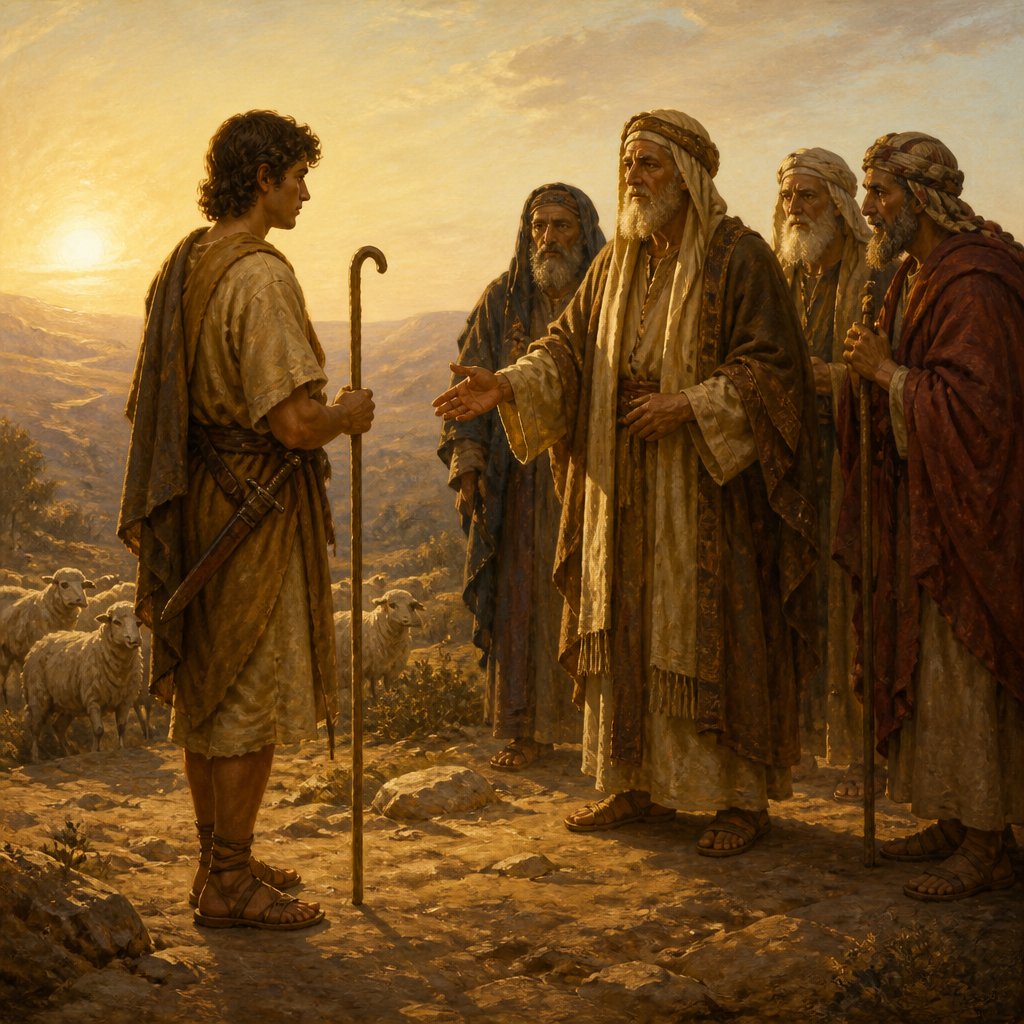
**Scripture Reference: 2 Samuel 5:2 (KJV)**
"Also in time past, when Saul was king over us, thou wast he that leddest out and broughtest in Israel: and the LORD said to thee, Thou shalt feed my people Israel, and thou shalt be a captain over Israel."
In this pivotal moment in the history of Israel, we find ourselves at a crossroads of leadership and divine purpose. David, who once wandered as a fugitive, is now being recognized by the tribes of Israel as their rightful king. The elders of Israel are not only acknowledging David’s past leadership, but they are also affirming the prophetic word from the Lord regarding his future. It is a profound reminder that God’s appointing is often accompanied by human recognition and communal acceptance.
David's journey as a leader was far from straightforward. When Saul was king, David was a commander in Saul's army, leading the people in battles and securing victories for the nation. Despite Saul’s erratic behaviour and his eventual rejection by God, David remained faithful. His leadership had a grace that stemmed from his deep understanding of his role as both a servant and a warrior. David did not seek power, yet God prepared him through hardship and the wilderness. In those challenging times, his character was forged, and his dependence on God was cultivated.
The verse illuminates a critical aspect of leadership; it emphasizes that true leadership is not merely about wielding authority but also about caring for the people one leads. God's calling involves a profound responsibility—"Thou shalt feed my people Israel, and thou shalt be a captain over Israel." Here lies the essence of David's leadership: to feed, to nurture, and to protect. This notion of feeding extends beyond physical sustenance; it encompasses spiritual nourishment, guidance, and shepherding. In our modern context, leaders are called not only to govern but to care for their followers' holistic wellbeing, providing wisdom, encouragement, and discipline where necessary.
This appointment by the elders reflects the direction that other leaders, especially in Christian contexts, should consider. Are they nurturing and feeding their congregations? Or has the pursuit of leadership slipped into the pitfalls of control and dominance? When we are in positions of influence, whether in churches, workplaces, or families, we must remember that our success is not measured by our ability to command but by our effectiveness in service.
Moreover, the reference to Saul's reign serves as a reminder of the mistakes leaders can make when they operate independently of God. Saul’s kingship ended in tragic failure because he became enamored with power and rejected God’s commands. In contrast, David’s success stemmed from his humble beginnings and reliance on God’s direction. The promise from the Lord, that David would be a leader over His people, must serve as a clarion call for Christians in leadership today. God's assurance is crucial: He prepares those He calls, equipping them with the necessary skills and spiritual fortitude to accomplish His will.
As we reflect on this scripture, we must examine our callings. Are we leading as David influenced God’s people? Are we willing to lay down our ambition and agenda to serve others? In our pursuit of leadership, may we also seek God’s wisdom and direction. Let us be reminded that true leadership is a divine appointment filled with responsibility, grace, and service to others.
Let us pray:
“Lord, thank You for the examples of leadership found in Your Word. Help us to lead humbly and faithfully, feeding and nurturing those entrusted to our care. May we always seek Your guidance in our actions, reflecting the care and love of Christ as we serve others. Amen.”
In this reflection on 2 Samuel 5:2, may we aspire to be like David, leading through service, guided by God’s will, and committed to the welfare of those we lead.
Want to reflect more on 2 Samuel 5:2?
Continue your spiritual journey with Bible Chat — an AI-powered tool for exploring God's Word through conversation. Ask questions, discover connections, and deepen your understanding.
Get Our Apps


2 Samuel 5:2 Artwork

2 Samuel 5:2 - "Also in time past, when Saul was king over us, thou wast he that leddest out and broughtest in Israel: and the LORD said to thee, Thou shalt feed my people Israel, and thou shalt be a captain over Israel."
"Also in time past, when Saul was king over us, thou wast he that leddest out and broughtest in Israel: and the LORD said to thee, Thou shalt feed my people Israel, and thou shalt be a captain over Israel." - 2 Samuel 5:2

2 Samuel 5:12

2 Samuel 5:16 - "And Elishama, and Eliada, and Eliphalet."

2 Samuel 5:15 - "Ibhar also, and Elishua, and Nepheg, and Japhia,"

2 Samuel 5:21 - "And there they left their images, and David and his men burned them."

2 Samuel 5:18 - "The Philistines also came and spread themselves in the valley of Rephaim."

2 Samuel 5:7 - "Nevertheless David took the strong hold of Zion: the same is the city of David."

2 Samuel 5:10 - "And David went on, and grew great, and the LORD God of hosts was with him."

2 Samuel 11:5 - "And the woman conceived, and sent and told David, and said, I am with child."

2 Samuel 5:22 - "¶ And the Philistines came up yet again, and spread themselves in the valley of Rephaim."

"And Elishama, and Eliada, and Eliphalet." - 2 Samuel 5:16

2 Samuel 3:5 - "And the sixth, Ithream, by Eglah David's wife. These were born to David in Hebron."

1 Samuel 5:2 - "When the Philistines took the ark of God, they brought it into the house of Dagon, and set it by Dagon."

2 Samuel 22:5 - "When the waves of death compassed me, the floods of ungodly men made me afraid;"

2 Samuel 5:14 - "And these be the names of those that were born unto him in Jerusalem; Shammua, and Shobab, and Nathan, and Solomon,"

2 Samuel 5:4 - "¶ David was thirty years old when he began to reign, and he reigned forty years."

2 Samuel 5:5 - "In Hebron he reigned over Judah seven years and six months: and in Jerusalem he reigned thirty and three years over all Israel and Judah."

2 Samuel 5:11 - "¶ And Hiram king of Tyre sent messengers to David, and cedar trees, and carpenters, and masons: and they built David an house."

2 Samuel 9:5 - "¶ Then king David sent, and fetched him out of the house of Machir, the son of Ammiel, from Lo-debar."

2 Samuel 1:5 - "And David said unto the young man that told him, How knowest thou that Saul and Jonathan his son be dead?"

2 Samuel 2:5 - "¶ And David sent messengers unto the men of Jabesh-gilead, and said unto them, Blessed be ye of the LORD, that ye have shewed this kindness unto your lord, even unto Saul, and have buried him."

"Ibhar also, and Elishua, and Nepheg, and Japhia," - 2 Samuel 5:15

2 Samuel 5:9 - "So David dwelt in the fort, and called it the city of David. And David built round about from Millo and inward."

2 Samuel 17:5 - "Then said Absalom, Call now Hushai the Archite also, and let us hear likewise what he saith."

2 Samuel 24:5 - "¶ And they passed over Jordan, and pitched in Aroer, on the right side of the city that lieth in the midst of the river of Gad, and toward Jazer:"

2 Samuel 5:25 - "And David did so, as the LORD had commanded him; and smote the Philistines from Geba until thou come to Gazer."

2 Samuel 7:5 - "Go and tell my servant David, Thus saith the LORD, Shalt thou build me an house for me to dwell in?"

2 Samuel 5:1 - "Then came all the tribes of Israel to David unto Hebron, and spake, saying, Behold, we are thy bone and thy flesh."

2 Samuel 8:5 - "And when the Syrians of Damascus came to succour Hadadezer king of Zobah, David slew of the Syrians two and twenty thousand men."