The Weight of Innocence: Understanding Guilt and Responsibility
"¶ And afterward when David heard it, he said, I and my kingdom are guiltless before the LORD for ever from the blood of Abner the son of Ner:" - 2 Samuel 3:28
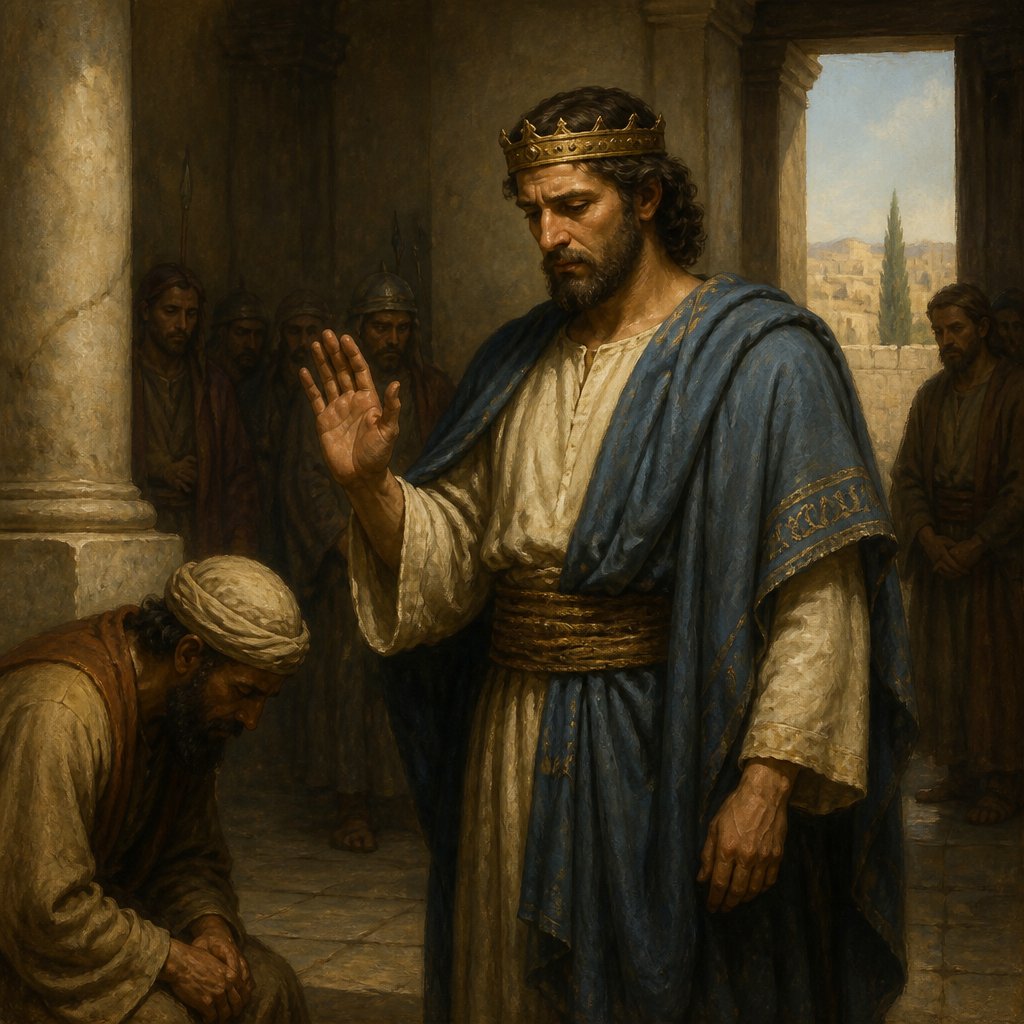
The verse 2 Samuel 3:28 states, "And afterward when David heard it, he said, I and my kingdom are guiltless before the LORD for ever from the blood of Abner the son of Ner." This moment in David's life is pivotal, capturing the complexity of leadership, justice, and the divine accountability we hold as followers of God.
To grasp the heart of this scripture, we must first reflect on the events surrounding Abner's death. Abner, the commander of Saul’s army, had shifted his allegiance to David during a tumultuous period of civil war between the house of Saul and the house of David. His seeking peace and uniting Israel under David's kingship was an act of profound significance. However, Abner's life was cut short through a treacherous act by Joab, David's own military commander, motivated by vengeance and personal rivalry.
Upon learning of Abner’s death, David understood the implications it had on his leadership and the potential blame that might be laid upon him. In declaring himself and his kingdom "guiltless before the LORD," David adamantly distinguishes himself from the actions of Joab, thus reaffirming his integrity. Despite the chaos lying beneath the political surface, David seeks to maintain a sense of justice and righteousness in his leadership. He understands that the blood of Abner, shed unjustly, could tarnish his reign if left unaddressed. By publicly disavowing the act, he sets a tone for accountability, acknowledging that the sins of the leader can lead to the suffering of the people.
David’s response reminds us that our actions, both as individuals and as part of the wider community, can carry immense consequences. While we may wish to shrug off the sins of those around us, we must recognize our tie to one another. Though David claimed innocence of Abner's death, he still bore the responsibility of leading with honor and conducting justice. It highlights a vital truth in Christian living; we are called not only to avoid sin ourselves but also to pursue justice and advocate for those treated unfairly within our communities.
Far too often, like Joab, we find ourselves caught in cycles of sin marked by personal grudges, bitterness, and acts of revenge. The struggle between power and righteousness has plagued humanity since the fall. We must ask ourselves, what blood is upon our hands? What actions or inactions have we allowed to persist in our communities that harm others? In this context, David’s proclamation serves as a moral compass; it is not simply the actions we take in our own interests, but how we uphold justice and righteousness in our sphere of influence that matters.
Furthermore, we are reminded of the character of God’s justice. Even as David sought to establish a kingdom based on peace and righteousness, he also recognized that God’s judgment surpasses human understanding. In declaring innocence, he acknowledged a higher standard set by the Almighty. As believers, we are constantly called into a relationship where we explore our own guilt and the grace available to us through Christ. In this intertwining of accountability and grace, we learn that while we may be innocent in our actions, we still heavily rely on God’s mercy and forgiveness.
As we meditate on this verse, let us commit to living lives where our integrity is never questioned, where we stand for justice, and where we continually seek to align our lives with the purpose and standard God has set forth. May we fortify our hearts against jealousy, revenge, and anger, and instead embody the values of compassion and righteousness. Like David, let us be leaders of peace, ever mindful that while we may claim innocence before men, it is ultimately the Lord before whom we must stand accountable.
Want to reflect more on 2 Samuel 3:28?
Continue your spiritual journey with Bible Chat — an AI-powered tool for exploring God's Word through conversation. Ask questions, discover connections, and deepen your understanding.
Get Our Apps


2 Samuel 3:28 Artwork

2 Samuel 3:28 - "¶ And afterward when David heard it, he said, I and my kingdom are guiltless before the LORD for ever from the blood of Abner the son of Ner:"
"¶ And afterward when David heard it, he said, I and my kingdom are guiltless before the LORD for ever from the blood of Abner the son of Ner:" - 2 Samuel 3:28

2 Samuel 23:28 - "Zalmon the Ahohite, Maharai the Netophathite,"

2 Chronicles 28:3

1 Samuel 28:3 - "¶ Now Samuel was dead, and all Israel had lamented him, and buried him in Ramah, even in his own city. And Saul had put away those that had familiar spirits, and the wizards, out of the land."

2 Samuel 14:28 - "¶ So Absalom dwelt two full years in Jerusalem, and saw not the king's face."

2 Samuel 2:28 - "So Joab blew a trumpet, and all the people stood still, and pursued after Israel no more, neither fought they any more."

"Zalmon the Ahohite, Maharai the Netophathite," - 2 Samuel 23:28

2 Samuel 15:28 - "See, I will tarry in the plain of the wilderness, until there come word from you to certify me."
2 Samuel 22:28 - "And the afflicted people thou wilt save: but thine eyes are upon the haughty, that thou mayest bring them down."

2 Samuel 17:28 - "Brought beds, and basons, and earthen vessels, and wheat, and barley, and flour, and parched corn, and beans, and lentiles, and parched pulse,"

2 Samuel 3:2 - "¶ And unto David were sons born in Hebron: and his firstborn was Amnon, of Ahinoam the Jezreelitess;"

2 Samuel 7:28 - "And now, O Lord GOD, thou art that God, and thy words be true, and thou hast promised this goodness unto thy servant:"

2 Samuel 4:3 - "And the Beerothites fled to Gittaim, and were sojourners there until this day.)"

2 Samuel 12:28 - "Now therefore gather the rest of the people together, and encamp against the city, and take it: lest I take the city, and it be called after my name."

2 Samuel 3:4 - "And the fourth, Adonijah the son of Haggith; and the fifth, Shephatiah the son of Abital;"

2 Samuel 3:3 - "And his second, Chileab, of Abigail the wife of Nabal the Carmelite; and the third, Absalom the son of Maacah the daughter of Talmai king of Geshur;"

2 Samuel 3:11 - "And he could not answer Abner a word again, because he feared him."

2 Samuel 3:33 - "And the king lamented over Abner, and said, Died Abner as a fool dieth?"

2 Samuel 3:5 - "And the sixth, Ithream, by Eglah David's wife. These were born to David in Hebron."

2 Samuel 2:3 - "And his men that were with him did David bring up, every man with his household: and they dwelt in the cities of Hebron."

2 Samuel 7:3 - "And Nathan said to the king, Go, do all that is in thine heart; for the LORD is with thee."

Matthew 28:2-3 – "There was a violent earthquake, for an angel of the Lord came down from heaven and, going to the tomb, rolled back the stone and sat on it."

1 Samuel 28:15

2 Samuel 3:37 - "For all the people and all Israel understood that day that it was not of the king to slay Abner the son of Ner."

1 Samuel 28:7

2 Samuel 3:15 - "And Ish-bosheth sent, and took her from her husband, even from Phaltiel the son of Laish."

1 Samuel 28:2 - "And David said to Achish, Surely thou shalt know what thy servant can do. And Achish said to David, Therefore will I make thee keeper of mine head for ever."

2 Samuel 14:3 - "And come to the king, and speak on this manner unto him. So Joab put the words in her mouth."

2 Samuel 3:36 - "And all the people took notice of it, and it pleased them: as whatsoever the king did pleased all the people."