The Pursuit of Leadership: Lessons from Abner and Ish-bosheth
"¶ But Abner the son of Ner, captain of Saul's host, took Ish-bosheth the son of Saul, and brought him over to Mahanaim;" - 2 Samuel 2:8
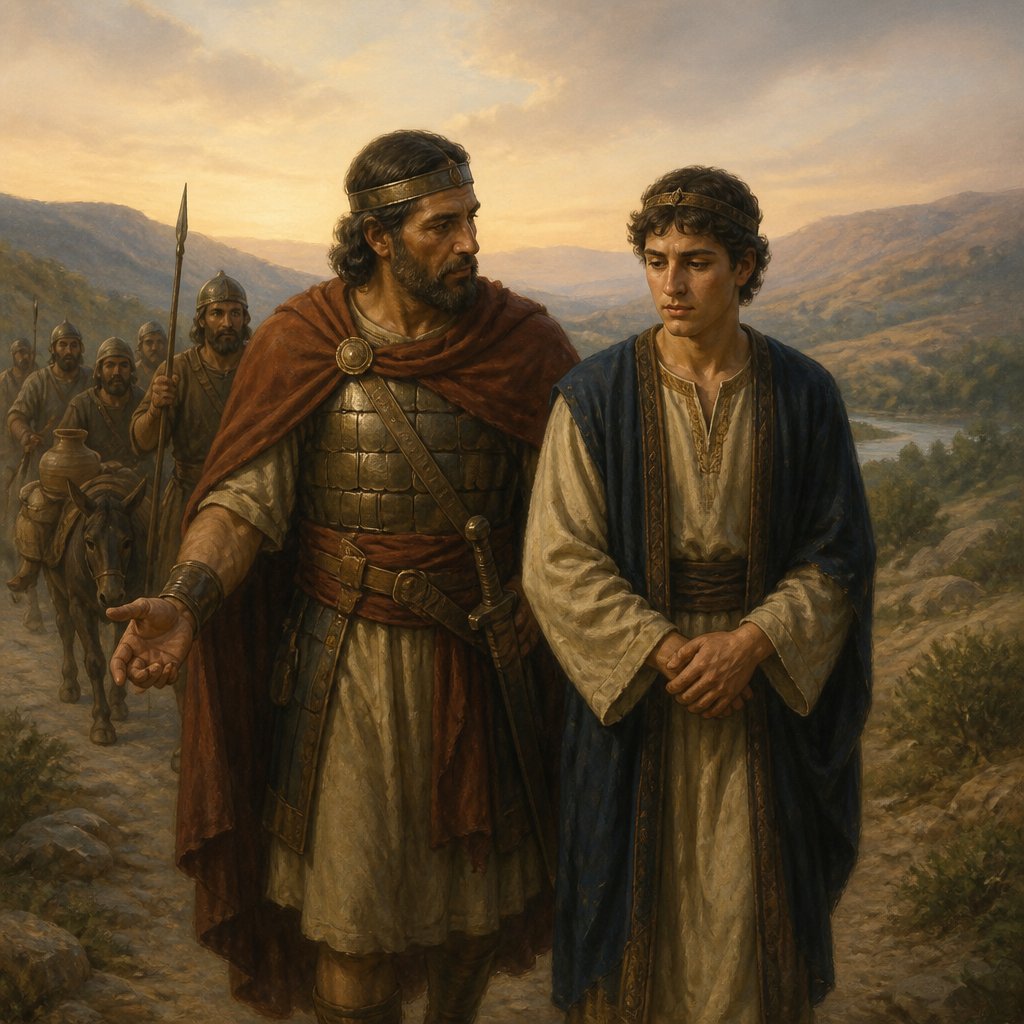
In the perplexing drama of Israel’s early monarchy, we find a poignant scene in 2 Samuel 2:8: "But Abner the son of Ner, captain of Saul's host, took Ish-bosheth the son of Saul, and brought him over to Mahanaim." This moment encapsulates a period rife with ambition, loyalty, and the quest for leadership amidst chaos. While seemingly a straightforward historical account, this verse approaches the heart of the human experience, reflecting our own pursuits of power, influence, and the responsibility that accompanies leadership.
### The Context of Leadership
To fully grasp the implications of Abner’s actions, we must delve into the surrounding context. King Saul had fallen in battle, leaving a power vacuum in Israel. Abner, the captain of Saul's army, found himself at a crossroads, having to choose a path forward. His allegiance to Saul compelled him to elevate Ish-bosheth, Saul’s son, to kingship despite the tragic situation that had unfolded. This act of bringing Ish-bosheth to Mahanaim reflects Abner’s desire to secure continuity of leadership, perhaps driven more by a sense of loyalty towards Saul’s lineage than by confidence in Ish-bosheth’s capabilities.
### The Weight of Responsibility
Abner’s decision raises profound questions about the nature of leadership. Is leadership merely a title or position, or does it encompass a deeper responsibility towards those one leads? In establishing Ish-bosheth as king, Abner undertakes a burden; he opts not for personal ambition, but for preserving the legacy of Saul’s family. However, this act also speaks volumes about the integrity of leadership. The choice to place someone on the throne who may not possess the character or wisdom needed to lead effectively is a moral quandary that often resonates in our own civic and personal spheres.
As Christians, we are called to lead in various capacities—be it within our families, communities, churches, or workplaces. The pursuit of leadership should not solely focus on gaining authority or influence but should reflect a commitment to serve and uplift others. Just as Abner was confronted with the challenge of choosing a leader, we too must evaluate our motivations and the implications of our leadership.
### The Dangers of Ambition
Indeed, Abner’s choice also epitomizes a dangerous, albeit common, temptation in leadership: the drive for power and control. Even with the intention of preserving order, Abner's support for Ish-bosheth could easily lead to a congregation of discontent among the people. Ish-bosheth’s eventual inability to sustain his reign emphasizes the risk of backing leaders unfit for the office. In our contemporary society, we witness similar dynamics repeatedly as leaders rise not necessarily for their capabilities, but through connection and manipulation. Regardless of our stark differences with Abner’s era, the temptation remains: to support those merely for the sake of personal gain, comfort, or influence.
### A Heart for True Leadership
When we reflect on the life of Jesus, we are reminded of the stark contrast to the notion of leadership depicted by Abner. Jesus, the ultimate servant leader, found glory not in power and dominance but in humility and sacrifice. As Christians, we ought to embody the traits of compassion, understanding, and selflessness that mark true leadership. Matthew 20:26 reminds us, "...whosoever will be great among you, let him be your minister." This wisdom calls us to consider how we might lead with integrity, empathy, and a desire to serve.
### Conclusion
In the unfolding drama surrounding Abner and Ish-bosheth, we perceive the intricate tapestry of human ambition, loyalty, and moral responsibility. Let us learn from this narrative that leadership is a privilege and a duty; it calls for discernment and a heart aligned with God’s purpose. As we navigate our domains—be it in the marketplace, family, or community—let us choose a path of integrity, seeking not to elevate ourselves, but to uplift and empower those entrusted to our care. In the end, let us reflect the heart of Jesus in our daily interactions, staying true to our call as leaders steeped in grace and truth.
Want to reflect more on 2 Samuel 2:8?
Continue your spiritual journey with Bible Chat — an AI-powered tool for exploring God's Word through conversation. Ask questions, discover connections, and deepen your understanding.
Get Our Apps


2 Samuel 2:8 Artwork

2 Samuel 2:8 - "¶ But Abner the son of Ner, captain of Saul's host, took Ish-bosheth the son of Saul, and brought him over to Mahanaim;"
"¶ But Abner the son of Ner, captain of Saul's host, took Ish-bosheth the son of Saul, and brought him over to Mahanaim;" - 2 Samuel 2:8

2 Samuel 19:8

2 Samuel 19:8

2 Samuel 19:8

2 Samuel 19:8

2 samuel 23:8-21

2 Samuel 8:8 - "And from Betah, and from Berothai, cities of Hadadezer, king David took exceeding much brass."

2 Samuel 8:16 - "And Joab the son of Zeruiah was over the host; and Jehoshaphat the son of Ahilud was recorder;"

2 Samuel 22:8 - "Then the earth shook and trembled; the foundations of heaven moved and shook, because he was wroth."

2 Samuel 8:17 - "And Zadok the son of Ahitub, and Ahimelech the son of Abiathar, were the priests; and Seraiah was the scribe;"

2 Samuel 8:7 - "And David took the shields of gold that were on the servants of Hadadezer, and brought them to Jerusalem."

2 Samuel 8:9 - "¶ When Toi king of Hamath heard that David had smitten all the host of Hadadezer,"

2 Samuel 8:12 - "Of Syria, and of Moab, and of the children of Ammon, and of the Philistines, and of Amalek, and of the spoil of Hadadezer, son of Rehob, king of Zobah."

2 Samuel 14:8 - "And the king said unto the woman, Go to thine house, and I will give charge concerning thee."

2 Samuel 8:18 - "And Benaiah the son of Jehoiada was over both the Cherethites and the Pelethites; and David's sons were chief rulers."

1 Samuel 8:2 - "Now the name of his firstborn was Joel; and the name of his second, Abiah: they were judges in Beer-sheba."

2 Samuel 1:8 - "And he said unto me, Who art thou? And I answered him, I am an Amalekite."

2 Samuel 8:15 - "And David reigned over all Israel; and David executed judgment and justice unto all his people."

2 Samuel 24:8 - "So when they had gone through all the land, they came to Jerusalem at the end of nine months and twenty days."

2 Samuel 18:8 - "For the battle was there scattered over the face of all the country: and the wood devoured more people that day than the sword devoured."

2 Samuel 9:8 - "And he bowed himself, and said, What is thy servant, that thou shouldest look upon such a dead dog as I am?"

2 Samuel 8:5 - "And when the Syrians of Damascus came to succour Hadadezer king of Zobah, David slew of the Syrians two and twenty thousand men."

2 Samuel 8:3 - "¶ David smote also Hadadezer, the son of Rehob, king of Zobah, as he went to recover his border at the river Euphrates."

2 Samuel 8:1 - "And after this it came to pass, that David smote the Philistines, and subdued them: and David took Metheg-ammah out of the hand of the Philistines."

2 Samuel 8:13 - "And David gat him a name when he returned from smiting of the Syrians in the valley of salt, being eighteen thousand men."

2 Samuel 6:8 - "And David was displeased, because the LORD had made a breach upon Uzzah: and he called the name of the place Perez-uzzah to this day."

2 Samuel 8:6 - "Then David put garrisons in Syria of Damascus: and the Syrians became servants to David, and brought gifts. And the LORD preserved David whithersoever he went."

2 Samuel 8:2 - "And he smote Moab, and measured them with a line, casting them down to the ground; even with two lines measured he to put to death, and with one full line to keep alive. And so the Moabites became David's servants, and brought gifts."

2 Samuel 10:8 - "And the children of Ammon came out, and put the battle in array at the entering in of the gate: and the Syrians of Zoba, and of Rehob, and Ish-tob, and Maacah, were by themselves in the field."