Restoration and the Waiting Heart
"And the king said, And where is thy master's son? And Ziba said unto the king, Behold, he abideth at Jerusalem: for he said, To day shall the house of Israel restore me the kingdom of my father." - 2 Samuel 16:3
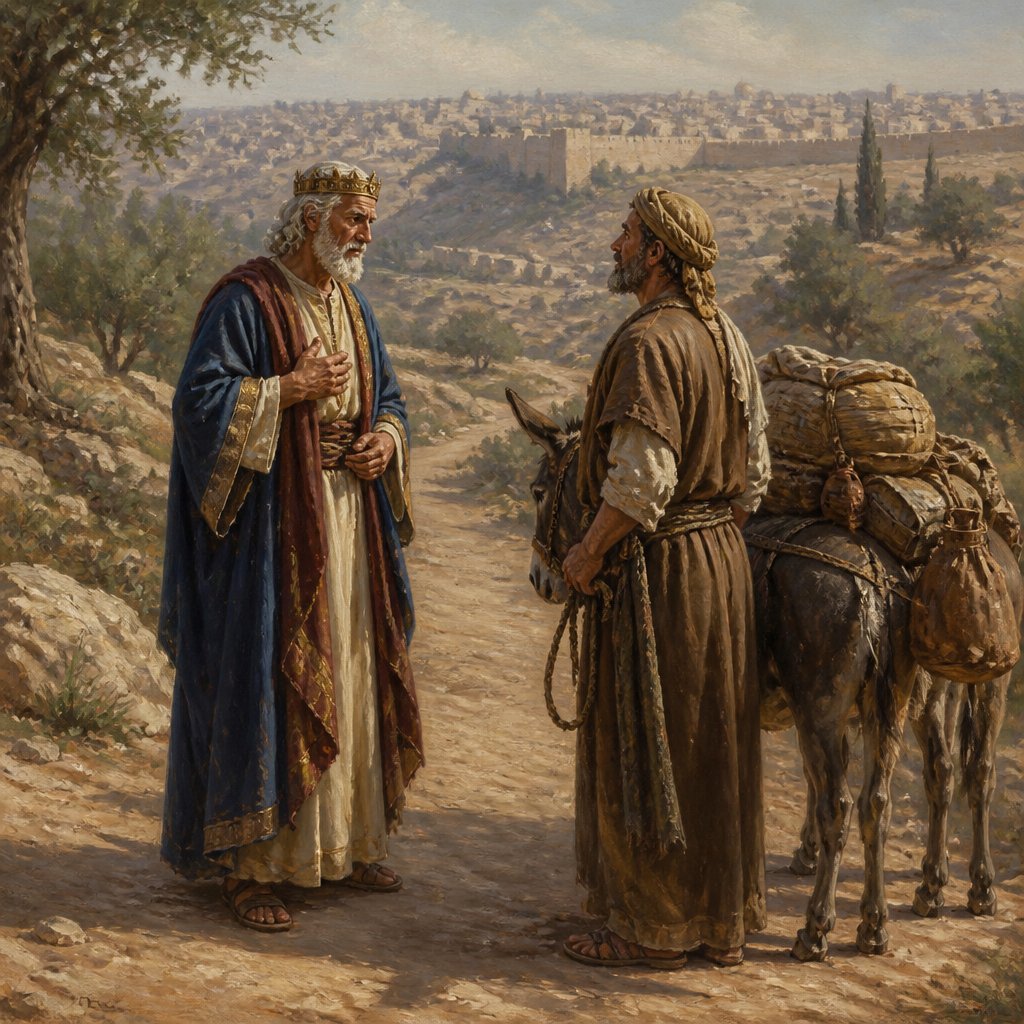
As we delve into the verse from 2 Samuel 16:3 in the King James Version, we come face to face with a moment in King David's life filled with complexities, the interplay of human emotions, and aspirations that reverberate through time. The text states, "And the king said, And where is thy master's son? And Ziba said unto the king, Behold, he abideth at Jerusalem: for he said, To day shall the house of Israel restore me the kingdom of my father."
This passage highlights a crucial moment within the tumultuous reign of David, particularly in relation to Mephibosheth, the son of Jonathan. When Ziba, the servant of Mephibosheth, informs David of his master's whereabouts, it is not merely a report; it speaks volumes about loyalty, expectation, betrayal, and the longing for inheritance—themes that resonate deeply within the human experience.
**The Context of the Situation**
David, once a beloved king, now finds himself on the run, fleeing from his son Absalom, who has risen in rebellion against him. Imagine the inner turmoil for David. On one hand, he holds his kingship with reverence; on the other, he’s faced with the shattering reality of familial betrayal. Mephibosheth, who is disabled, remains in Jerusalem, waiting for what he hopes will be the restoration of his rights. His presence symbolizes a waiting heart—a heart that holds onto hope despite the chaos surrounding it.
What does it mean to wait on the Lord? In the immediate context, Mephibosheth is confined physically and politically in a city that swirls with uncertainty and division. He clings to the promise made by David to honor Jonathan’s memory. But in waiting, there’s an inherent risk. How often do we find ourselves waiting, unsure of what the future holds? When we cry out to God in our struggles, are we prepared for the outcome?
**The Dynamics of Ziba’s Claim**
It’s essential to consider Ziba’s role in all of this. His words can be seen as self-serving. By portraying Mephibosheth as waiting in Jerusalem on the hope of restoration, Ziba may aim to gain favor with David. Ziba’s loyalty is questionable; he seems to speak with an agenda. This raises a pivotal question for us: Are we allowing others to dictate our understanding of our own journey? Do we sometimes lose sight of who we are in God’s eyes because of the narratives presented to us by others?
**Restoration and Its Implications**
The word "restore" is powerful. Restoration speaks of returning to a former state—a reclaiming of identity and purpose. For Mephibosheth, it meant the potential of reclaiming his father’s throne, which was rightfully his. Yet, anticipation can lead to disappointment. The trajectory of David’s response to Mephibosheth later in the story reveals the complexities of loyalty and perception. Waiting often tests our resolve and faith, compelling us to reassess our priorities and our understanding of divine justice.
The intricate dance of betrayal and loyalty serves as a reflection on our own lives. Are we Zibas, quick to judge others and elevate ourselves? Or are we Mephibosheths, waiting patiently for restoration, clinging to hope despite our struggles?
**Prayer and Reflection**
Thus, as we meditate on 2 Samuel 16:3, let us examine our own hearts. In times of waiting, may we not succumb to despair or envy. Instead, let us cultivate patience, truly believing that God has a sovereign plan for our lives. Pray for clarity, that we can distinguish between the Zibas and the Mephibosheths in our lives, and seek God’s narrative above all else. Remember, restoration and hope can flourish in the waiting, if we remain steadfast in our faith and anchored in His promises.
Want to reflect more on 2 Samuel 16:3?
Continue your spiritual journey with Bible Chat — an AI-powered tool for exploring God's Word through conversation. Ask questions, discover connections, and deepen your understanding.
Get Our Apps


2 Samuel 16:3 Artwork

2 Samuel 16:3 - "And the king said, And where is thy master's son? And Ziba said unto the king, Behold, he abideth at Jerusalem: for he said, To day shall the house of Israel restore me the kingdom of my father."
"And the king said, And where is thy master's son? And Ziba said unto the king, Behold, he abideth at Jerusalem: for he said, To day shall the house of Israel restore me the kingdom of my father." - 2 Samuel 16:3

2 Samuel 3:16 - "And her husband went with her along weeping behind her to Bahurim. Then said Abner unto him, Go, return. And he returned."

1 Samuel 3:16 - "Then Eli called Samuel, and said, Samuel, my son. And he answered, Here am I."

2 Samuel 5:16 - "And Elishama, and Eliada, and Eliphalet."

"Then Eli called Samuel, and said, Samuel, my son. And he answered, Here am I." - 1 Samuel 3:16

1 Samuel 16:3 - "And call Jesse to the sacrifice, and I will shew thee what thou shalt do: and thou shalt anoint unto me him whom I name unto thee."

2 Samuel 8:16 - "And Joab the son of Zeruiah was over the host; and Jehoshaphat the son of Ahilud was recorder;"

"And Elishama, and Eliada, and Eliphalet." - 2 Samuel 5:16

2 Samuel 16:15 - "¶ And Absalom, and all the people the men of Israel, came to Jerusalem, and Ahithophel with him."

2 Samuel 16:14 - "And the king, and all the people that were with him, came weary, and refreshed themselves there."

2 Timothy 3:16

2 Samuel 16:20 - "¶ Then said Absalom to Ahithophel, Give counsel among you what we shall do."

2 Samuel 3:2 - "¶ And unto David were sons born in Hebron: and his firstborn was Amnon, of Ahinoam the Jezreelitess;"

2 Samuel 16:16 - "And it came to pass, when Hushai the Archite, David's friend, was come unto Absalom, that Hushai said unto Absalom, God save the king, God save the king."

1 Samuel 16:2 - "And Samuel said, How can I go? if Saul hear it, he will kill me. And the LORD said, Take an heifer with thee, and say, I am come to sacrifice to the LORD."

2 Samuel 4:3 - "And the Beerothites fled to Gittaim, and were sojourners there until this day.)"

2 Kings 3:16-19

2 Samuel 16:12 - "It may be that the LORD will look on mine affliction, and that the LORD will requite me good for his cursing this day."

2 Samuel 16:17 - "And Absalom said to Hushai, Is this thy kindness to thy friend? why wentest thou not with thy friend?"

2 Samuel 3:4 - "And the fourth, Adonijah the son of Haggith; and the fifth, Shephatiah the son of Abital;"

2 Samuel 3:3 - "And his second, Chileab, of Abigail the wife of Nabal the Carmelite; and the third, Absalom the son of Maacah the daughter of Talmai king of Geshur;"

2 Samuel 12:16 - "David therefore besought God for the child; and David fasted, and went in, and lay all night upon the earth."

2 Samuel 22:16 - "And the channels of the sea appeared, the foundations of the world were discovered, at the rebuking of the LORD, at the blast of the breath of his nostrils."

2 Samuel 18:16 - "And Joab blew the trumpet, and the people returned from pursuing after Israel: for Joab held back the people."

2 Samuel 3:33 - "And the king lamented over Abner, and said, Died Abner as a fool dieth?"

2 Samuel 3:5 - "And the sixth, Ithream, by Eglah David's wife. These were born to David in Hebron."

2 Samuel 19:16 - "¶ And Shimei the son of Gera, a Benjamite, which was of Bahurim, hasted and came down with the men of Judah to meet king David."

2 Samuel 2:3 - "And his men that were with him did David bring up, every man with his household: and they dwelt in the cities of Hebron."
"And her husband went with her along weeping behind her to Bahurim. Then said Abner unto him, Go, return. And he returned." - 2 Samuel 3:16