The Consequences of Fire: A Devotional on 2 Samuel 14:30
"Therefore he said unto his servants, See, Joab's field is near mine, and he hath barley there; go and set it on fire. And Absalom's servants set the field on fire." - 2 Samuel 14:30
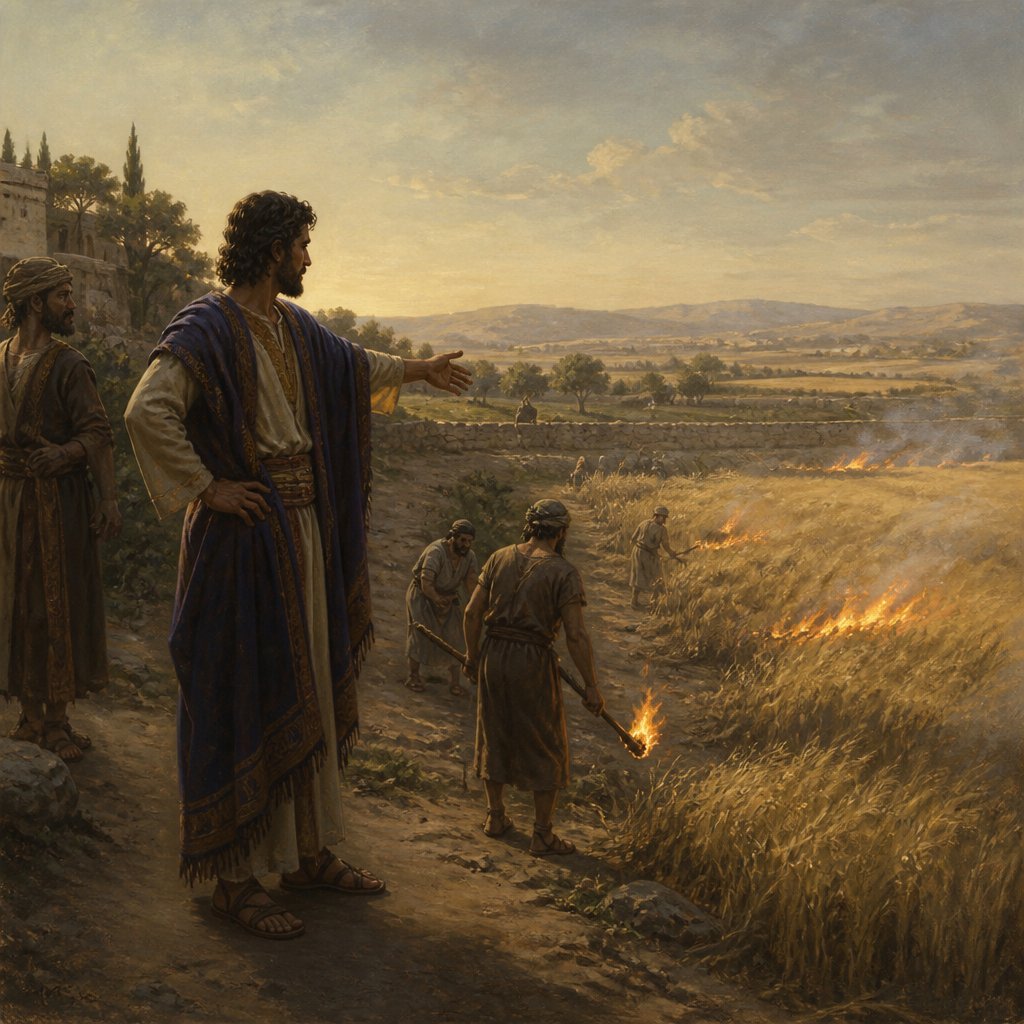
In the heart of the narrative recounted in 2 Samuel, we find a powerful message encapsulated in 2 Samuel 14:30, which says, "Therefore he said unto his servants, See, Joab's field is near mine, and he hath barley there; go and set it on fire. And Absalom's servants set the field on fire." This verse, while seemingly straightforward, is steeped in emotion, rebellion, and the human condition as we navigate our relationships and our quest for justice.
Absalom, son of King David, was embroiled in a situation filled with tension and unresolved conflict. The context leading to this fiery directive had been laden with personal grief and historical injustice. Absalom’s tale of familial strife is one that resonates deeply, serving as an eternal reminder of how unresolved feelings can lead to destructive actions. Joab's field was more than just a piece of land; it represented the divided loyalties and tensions within the heart of David's kingdom. It stood as a symbol of the alliances formed and broken, the political intrigues, and the personal vendettas that characterize human affairs.
When Absalom, in his quest for recognition and humane treatment after years of exile, orders the burning of Joab's barley field, it signifies an act of desperation. This act was not merely an assault on property but a proclamation of his suffering and a means to send a message to Joab—a reminder that he had a grievance that needed addressing. Absalom's decision reflects the all-too-human compulsion to lash out when feeling cornered or unjustly treated.
We are left to ponder the implications of this burning act in our own lives. How often do we react in anger or frustration, seeking immediate attention for our grievances without considering the broader consequences? When fueled by unresolved pain, we might find ourselves setting fire to fields that we may later regret having burned. The motivation behind our actions can, on occasion, be justified by our experiences, yet the consequences often ripple outward in ways we never anticipate.
As we explore this verse, we are invited to reflect on the nature of our responses to conflict. In our lives, there are moments when confrontation may appear to be the only path to resolution. Whether in our families, workplaces, or communities, we find ourselves embroiled in situations where we feel our voices are not heard. Yet, the choice of how to express that discontent rests solely with us. Will we choose to uplift and bring peace, or will we opt for destructive paths that might initially appear to gain attention?
Joab's field, once ignited, would not only bring loss to Joab but would also escalate tensions further, pushing divisions deeper within David's family and kingdom. The repercussions of our decisions extend beyond immediate reactions and affect relationships and communities on relational levels.
As we meditate on this scripture, let us seek wisdom in our approach to grievances. In moments of turmoil, consider how we can express our hurt without causing harm. We might reflect on the Bible’s teachings about reconciliation—Matthew 5:23-24 encourages us to seek peace with our brothers and sisters before coming to the altar of worship.
Let this verse serve as a stark reminder that our actions matter and that taking the high road, though more challenging, often yields a more fruitful outcome. In times of pain, may we be forthright in seeking dialogue rather than destruction, seeking restoration rather than retribution.
As we pray today, let’s ask for the grace to extinguish the fires of anger in our hearts and replace them with the light of understanding, patience, and ultimately, love.
Want to reflect more on 2 Samuel 14:30?
Continue your spiritual journey with Bible Chat — an AI-powered tool for exploring God's Word through conversation. Ask questions, discover connections, and deepen your understanding.
Get Our Apps


2 Samuel 14:30 Artwork

2 Samuel 14:30 - "Therefore he said unto his servants, See, Joab's field is near mine, and he hath barley there; go and set it on fire. And Absalom's servants set the field on fire."
"Therefore he said unto his servants, See, Joab's field is near mine, and he hath barley there; go and set it on fire. And Absalom's servants set the field on fire." - 2 Samuel 14:30

2 Samuel 23:30 - "Benaiah the Pirathonite, Hiddai of the brooks of Gaash,"

1 Samuel 30:14 - "We made an invasion upon the south of the Cherethites, and upon the coast which belongeth to Judah, and upon the south of Caleb; and we burned Ziklag with fire."

2 Samuel 6:14
1 Samuel 14:30 - "How much more, if haply the people had eaten freely to day of the spoil of their enemies which they found? for had there not been now a much greater slaughter among the Philistines?"

2 Samuel 6:14–22

2 Samuel 2:30 - "And Joab returned from following Abner: and when he had gathered all the people together, there lacked of David's servants nineteen men and Asahel."

"Benaiah the Pirathonite, Hiddai of the brooks of Gaash," - 2 Samuel 23:30

2 Samuel 18:30 - "And the king said unto him, Turn aside, and stand here. And he turned aside, and stood still."

2 Samuel 22:30 - "For by thee I have run through a troop: by my God have I leaped over a wall."

2 Samuel 23:14 - "And David was then in an hold, and the garrison of the Philistines was then in Beth-lehem."

2 Samuel 3:30 - "So Joab and Abishai his brother slew Abner, because he had slain their brother Asahel at Gibeon in the battle."

1 Samuel 30:2 - "And had taken the women captives, that were therein: they slew not any, either great or small, but carried them away, and went on their way."

2 Samuel 14:23 - "So Joab arose and went to Geshur, and brought Absalom to Jerusalem."

2 Samuel 22:14 - "The LORD thundered from heaven, and the most High uttered his voice."

2 Samuel 16:14 - "And the king, and all the people that were with him, came weary, and refreshed themselves there."

2 Samuel 14:1 - "Now Joab the son of Zeruiah perceived that the king's heart was toward Absalom."

2 Samuel 13:30 - "¶ And it came to pass, while they were in the way, that tidings came to David, saying, Absalom hath slain all the king's sons, and there is not one of them left."

2 Chronicles 30:14 - "And they arose and took away the altars that were in Jerusalem, and all the altars for incense took they away, and cast them into the brook Kidron."

2 Samuel 14:28 - "¶ So Absalom dwelt two full years in Jerusalem, and saw not the king's face."

2 Samuel 11:14 - "¶ And it came to pass in the morning, that David wrote a letter to Joab, and sent it by the hand of Uriah."

2 Samuel 2:14 - "And Abner said to Joab, Let the young men now arise, and play before us. And Joab said, Let them arise."

2 Samuel 5:14 - "And these be the names of those that were born unto him in Jerusalem; Shammua, and Shobab, and Nathan, and Solomon,"

2 Samuel 6:14 - "And David danced before the LORD with all his might; and David was girded with a linen ephod."

2 Samuel 19:30 - "And Mephibosheth said unto the king, Yea, let him take all, forasmuch as my lord the king is come again in peace unto his own house."

John 14:30

2 Samuel 14:3 - "And come to the king, and speak on this manner unto him. So Joab put the words in her mouth."

2 Samuel 14:8 - "And the king said unto the woman, Go to thine house, and I will give charge concerning thee."

1.samuel 15:30