The Weight of Responsibility: A Lesson from Absalom's Persistence
"And the king said to Absalom, Nay, my son, let us not all now go, lest we be chargeable unto thee. And he pressed him: howbeit he would not go, but blessed him." - 2 Samuel 13:25
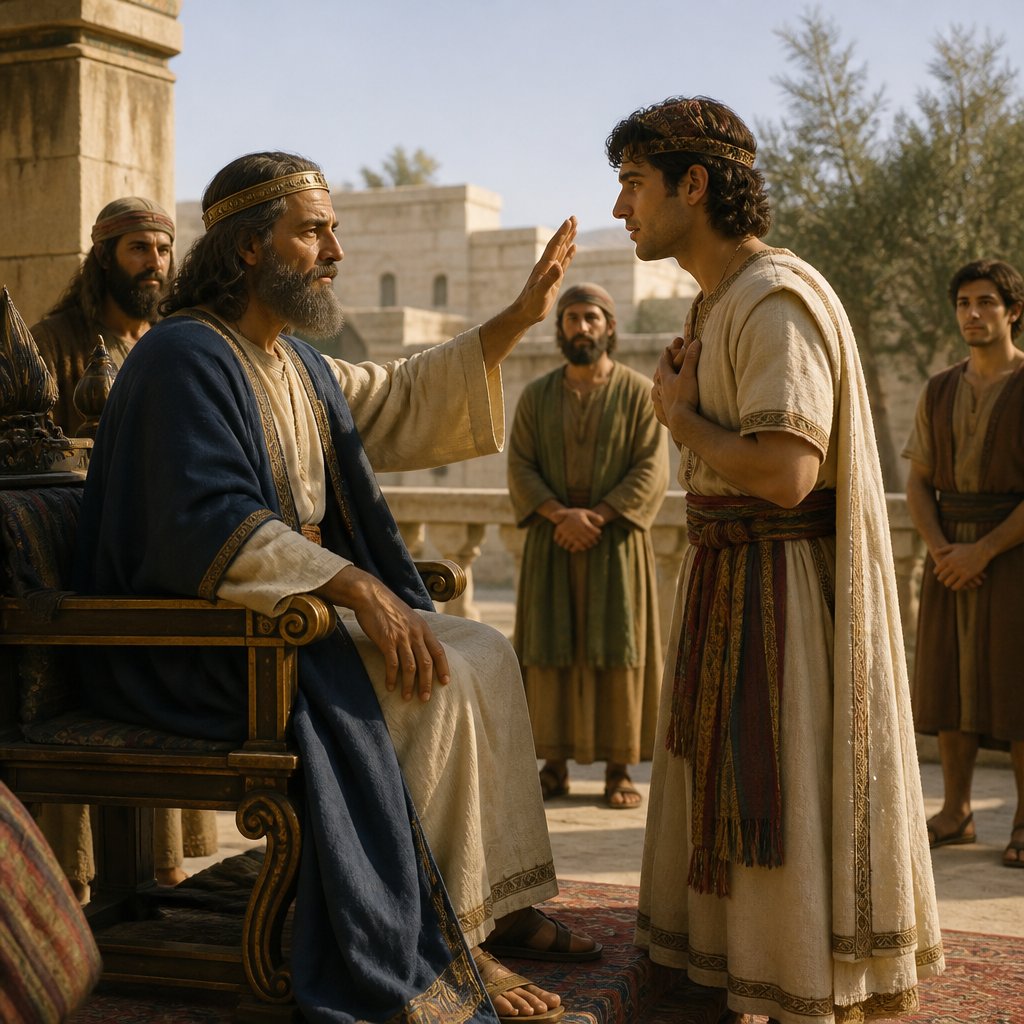
The complexity of familial relationships is a recurring theme throughout the Bible, and 2 Samuel 13:25 shines a light on the intricate dynamics between fathers and sons. This verse captures a significant moment between King David and his son Absalom: "And the king said to Absalom, Nay, my son, let us not all now go, lest we be chargeable unto thee. And he pressed him: howbeit he would not go, but blessed him." (2 Samuel 13:25, KJV).
At its surface, this verse reflects a father’s caution and love for his son amidst a tangle of emotions stemming from tragedy and betrayal within the family. Absalom had just orchestrated a feast and was eager for his father, the king, to join. This moment was crucial for Absalom, who was trying to navigate his place within a family riven by past wounds—both the rape of his sister Tamar and the ensuing murder of his brother Amnon. In his desire to have all the royal family present, Absalom was not merely seeking to celebrate; he longed for unity, for a sign that the family could transcend its tragic history. Yet, David's refusal to attend is laden with meaning that demands our attention.
David's response—"Nay, my son, let us not all now go, lest we be chargeable unto thee"—indicates a deep-seated concern, a hint of wisdom that arises from his own harrowing experiences. King David was fully aware of the potential consequences of gathering the family together in a festive atmosphere. He understood how quickly joy could turn to sorrow, how familial gatherings sometimes unearth unresolved conflicts. David’s reluctance also speaks to the burden of leadership; as king, he was not just a father but a figure whose presence and actions would impact not just his family but his kingdom. He was cautious of the weight he would place upon Absalom’s shoulders should the event be marred by further tragedy.
This scenario invites us to consider the balancing act of familial responsibilities. As parents, mentors, leaders, we often find ourselves at a crossroads where our desires for connection conflict with the awareness of consequences. David’s blessing of Absalom, even in his refusal to attend, signifies an important lesson—that love often requires restraint. True affection may sometimes mean withholding certain realities for the sake of another’s growth or peace.
Moreover, Absalom’s pressing nature presents an interesting perspective on desire and persistence. He was not one to take no for an answer. His determination to gather his family for the feast could be interpreted as a longing for reconciliation, or perhaps, an effort to project normalcy in the aftershock of family tragedy. Here, we are reminded that our desires can sometimes overshadow wisdom. We must be cautious in how we pursue what we want—even noble desires must align with the greater good and the well-being of others.
The conversation between David and Absalom reveals a powerful undercurrent of love intertwined with wisdom. David blesses his son, acknowledging his presence in both actions and words. This duality speaks to the importance of both affirmation and boundary-setting in our relationships. Sometimes, the greatest act of love we can extend is to redirect our loved ones gently, allowing them to grow while maintaining a protective stance.
In our lives, we must continually seek that balance. Are we truly listening to the needs and concerns of those we lead, or are we caught up in meeting every request, only to burden them further? Reflecting on David’s example provides food for thought: trust that love is not merely about presence but also about guiding with wisdom and grace. Today, let us strive to embody this balance, being not just a blessing in moments of joy, but a guiding support in times of complexity.
Want to reflect more on 2 Samuel 13:25?
Continue your spiritual journey with Bible Chat — an AI-powered tool for exploring God's Word through conversation. Ask questions, discover connections, and deepen your understanding.
Get Our Apps


2 Samuel 13:25 Artwork

2 Samuel 13:25 - "And the king said to Absalom, Nay, my son, let us not all now go, lest we be chargeable unto thee. And he pressed him: howbeit he would not go, but blessed him."
"And the king said to Absalom, Nay, my son, let us not all now go, lest we be chargeable unto thee. And he pressed him: howbeit he would not go, but blessed him." - 2 Samuel 13:25

2 Samuel 23:25 - "Shammah the Harodite, Elika the Harodite,"

2 Samuel 20:25 - "And Sheva was scribe: and Zadok and Abiathar were the priests:"

2 Samuel 2:25 - "¶ And the children of Benjamin gathered themselves together after Abner, and became one troop, and stood on the top of an hill."

"Shammah the Harodite, Elika the Harodite," - 2 Samuel 23:25

2 Samuel 12:25 - "And he sent by the hand of Nathan the prophet; and he called his name Jedidiah, because of the LORD."

2 Samuel 13:38 - "So Absalom fled, and went to Geshur, and was there three years."

2 Samuel 1:25 - "How are the mighty fallen in the midst of the battle! O Jonathan, thou wast slain in thine high places."

2 Samuel 22:13 - "Through the brightness before him were coals of fire kindled."

2 Samuel 22:25 - "Therefore the LORD hath recompensed me according to my righteousness; according to my cleanness in his eye sight."

2 Samuel 15:13 - "¶ And there came a messenger to David, saying, The hearts of the men of Israel are after Absalom."

2 Samuel 13:21 - "¶ But when king David heard of all these things, he was very wroth."

2 Samuel 5:25 - "And David did so, as the LORD had commanded him; and smote the Philistines from Geba until thou come to Gazer."

"And Sheva was scribe: and Zadok and Abiathar were the priests:" - 2 Samuel 20:25

2 Samuel 18:25 - "And the watchman cried, and told the king. And the king said, If he be alone, there is tidings in his mouth. And he came apace, and drew near."

2 Samuel 19:25 - "And it came to pass, when he was come to Jerusalem to meet the king, that the king said unto him, Wherefore wentest not thou with me, Mephibosheth?"

2 Samuel 13:27 - "But Absalom pressed him, that he let Amnon and all the king's sons go with him."

2 Samuel 13:35 - "And Jonadab said unto the king, Behold, the king's sons come: as thy servant said, so it is."

2 Samuel 24:25 - "And David built there an altar unto the LORD, and offered burnt offerings and peace offerings. So the LORD was intreated for the land, and the plague was stayed from Israel."

2 Samuel 7:13 - "He shall build an house for my name, and I will stablish the throne of his kingdom for ever."

2 Samuel 10:13 - "And Joab drew nigh, and the people that were with him, unto the battle against the Syrians: and they fled before him."

2 Samuel 3:25 - "Thou knowest Abner the son of Ner, that he came to deceive thee, and to know thy going out and thy coming in, and to know all that thou doest."

2 Samuel 14:25 - "¶ But in all Israel there was none to be so much praised as Absalom for his beauty: from the sole of his foot even to the crown of his head there was no blemish in him."

2 Samuel 6:13 - "And it was so, that when they that bare the ark of the LORD had gone six paces, he sacrificed oxen and fatlings."

2 Samuel 13:31 - "Then the king arose, and tare his garments, and lay on the earth; and all his servants stood by with their clothes rent."

2 Samuel 6:13 - "And it was so, that when they that bare the ark of the LORD had gone six paces, he sacrificed oxen and fatlings."

2 Samuel 6:13 - "And it was so, that when they that bare the ark of the LORD had gone six paces, he sacrificed oxen and fatlings."
2 Samuel 7:25 - "And now, O LORD God, the word that thou hast spoken concerning thy servant, and concerning his house, establish it for ever, and do as thou hast said."

2 Samuel 13:7 - "Then David sent home to Tamar, saying, Go now to thy brother Amnon's house, and dress him meat."