The Depths of Desolation: A Reflection on Tamar's Grief
"¶ And Tamar put ashes on her head, and rent her garment of divers colours that was on her, and laid her hand on her head, and went on crying." - 2 Samuel 13:19
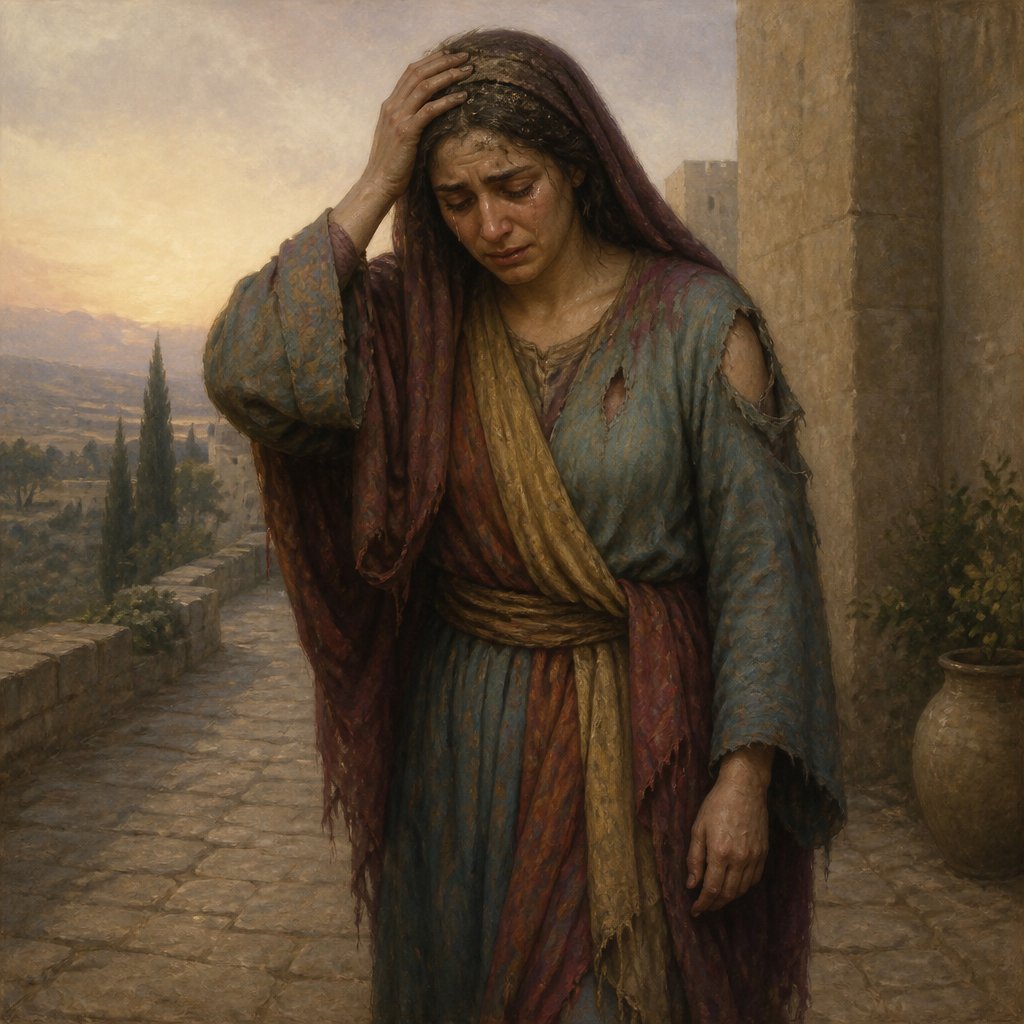
As we delve into the story of Tamar, the daughter of King David, we find ourselves confronted with a moment of profound sorrow and deep injustice. In 2 Samuel 13:19, we read, "And Tamar put ashes on her head, and rent her garment of divers colours that was on her, and laid her hand on her head, and went on crying." This single verse encapsulates a world of suffering, sorrow, and the weight of trauma, suggesting a deeper exploration of grief, dignity, and the complexities of human relationships.
Tamar’s act of putting ashes on her head is a traditional sign of mourning and repentance in biblical times. Ashes symbolize humility, recognition of our frailties, and the acknowledgement of the gravity of our circumstances. In Tamar’s case, this mourning is particularly poignant, as she is not merely mourning the loss of her innocence, but the shattering of her identity and place within her own family. The ashes on her head signify her profound sorrow, yet they also highlight the cultural norms that dictate how one should respond to trauma.
The act of rending her garment of many colors is rich in symbolism. This colorful garment, a piece of her identity filled with beauty and promise, now lies torn and in disarray. Tamar, as a woman of royal lineage, was likely accustomed to a life of privilege and dignity, attached to her father's legacy. However, in a moment of deep betrayal, this garment represents the loss of her purity and the despair that follows such a violation. In the context of her story, it is a physical manifestation of her inner turmoil, reflecting the chaotic emotions that follow trauma. The colorful clothing we once wore may now stand as a stark contrast to the grayness of grief that envelops her heart.
Her laying of the hand on her head, coupled with her cries, seals the image of despair. It is a powerful reminder that sorrow is not just a fleeting emotion; it can consume our very being, prompting physical expressions that are often beyond our control. Through Tamar’s anguish, we get a glimpse into the devastating effects of violence and betrayal, particularly within the family structure. Her cries echo an emotional pain that is shared by many who have faced betrayal, loss, or trauma at the hands of those they love.
As we reflect on Tamar's situation, we may find parallels in our lives. Each of us has faced moments where our sense of agency and dignity has felt stripped away, where the grief feels insurmountable. Tamar’s story invites us to acknowledge our feelings of abandonment, as she faced the silence of her father and the societal expectations that marginalized her experience. It serves as a reminder that out of the depths of despair, God hears our cries, even when our voices are drowned in sorrow.
In our own moments of grief, let us lay our burdens before God, understanding that we are seen and heard. Just as Tamar’s cries did not echo in vain, we are assured that our cries are met with divine compassion rather than judgment. In bringing our ashes to God, we reclaim our identity—not as victims of our circumstances but as beloved children of God who are worthy of love and restoration.
Tamar’s legacy offers us a vital message about resilience and the necessity of seeking justice in the face of pain. The tragic trajectory of her story doesn’t end there; it calls upon us to confront the injustices in our world, to uplift those who suffer in silence, and to become advocates for those who cannot voice their plight. In this, we honor Tamar’s journey from grief to empowerment and remind ourselves that through our shared experiences of sorrow, we cultivate a deeper understanding of empathy, community, and the transformative power of grace.
May we take this moment of reflection to embrace our own griefs and allow them to guide us towards healing and action, fostering a spirit of hope that echoes within the chambers of our hearts.
Want to reflect more on 2 Samuel 13:19?
Continue your spiritual journey with Bible Chat — an AI-powered tool for exploring God's Word through conversation. Ask questions, discover connections, and deepen your understanding.
Get Our Apps


2 Samuel 13:19 Artwork

2 Samuel 13:19 - "¶ And Tamar put ashes on her head, and rent her garment of divers colours that was on her, and laid her hand on her head, and went on crying."
"¶ And Tamar put ashes on her head, and rent her garment of divers colours that was on her, and laid her hand on her head, and went on crying." - 2 Samuel 13:19
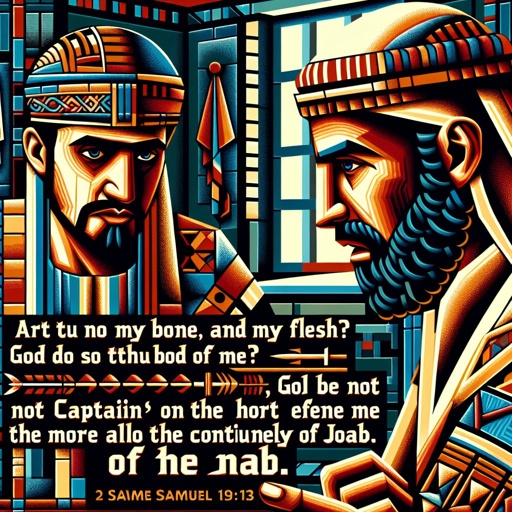
2 Samuel 19:13 - "And say ye to Amasa, Art thou not of my bone, and of my flesh? God do so to me, and more also, if thou be not captain of the host before me continually in the room of Joab."

2 Samuel 19:8

2 Samuel 19:8

2 Samuel 19:8

2 Samuel 19:8

2 Samuel 19:24

1 Samuel 19:13 - "And Michal took an image, and laid it in the bed, and put a pillow of goats' hair for his bolster, and covered it with a cloth."

2 Samuel 19:1 - "And it was told Joab, Behold, the king weepeth and mourneth for Absalom."

1 Samuel 13:19 - "¶ Now there was no smith found throughout all the land of Israel: for the Philistines said, Lest the Hebrews make them swords or spears:"

2 Samuel 22:19 - "They prevented me in the day of my calamity: but the LORD was my stay."

2 Samuel 24:19 - "And David, according to the saying of Gad, went up as the LORD commanded."

2 Samuel 13:38 - "So Absalom fled, and went to Geshur, and was there three years."

2 Samuel 2:19 - "And Asahel pursued after Abner; and in going he turned not to the right hand nor to the left from following Abner."

2 Samuel 1:19 - "The beauty of Israel is slain upon thy high places: how are the mighty fallen!"

2 Samuel 22:13 - "Through the brightness before him were coals of fire kindled."

2 Samuel 19:2 - "And the victory that day was turned into mourning unto all the people: for the people heard say that day how the king was grieved for his son."

2 Samuel 15:13 - "¶ And there came a messenger to David, saying, The hearts of the men of Israel are after Absalom."

2 Samuel 13:21 - "¶ But when king David heard of all these things, he was very wroth."

2 Samuel 19:23 - "Therefore the king said unto Shimei, Thou shalt not die. And the king sware unto him."

2 Samuel 11:19 - "And charged the messenger, saying, When thou hast made an end of telling the matters of the war unto the king,"

2 Samuel 23:19 - "Was he not most honourable of three? therefore he was their captain: howbeit he attained not unto the first three."

2 Samuel 17:19 - "And the woman took and spread a covering over the well's mouth, and spread ground corn thereon; and the thing was not known."

2 Samuel 19:33 - "And the king said unto Barzillai, Come thou over with me, and I will feed thee with me in Jerusalem."

2 Kings 19:13 - "Where is the king of Hamath, and the king of Arpad, and the king of the city of Sepharvaim, of Hena, and Ivah?"

2 Samuel 13:27 - "But Absalom pressed him, that he let Amnon and all the king's sons go with him."

2 Samuel 19:36 - "Thy servant will go a little way over Jordan with the king: and why should the king recompense it me with such a reward?"

2 Samuel 19:16 - "¶ And Shimei the son of Gera, a Benjamite, which was of Bahurim, hasted and came down with the men of Judah to meet king David."

2 Samuel 19:21 - "But Abishai the son of Zeruiah answered and said, Shall not Shimei be put to death for this, because he cursed the LORD'S anointed?"