The Courage to Move Forward: Lessons from Four Leprous Men
"¶ And there were four leprous men at the entering in of the gate: and they said one to another, Why sit we here until we die?" - 2 Kings 7:3
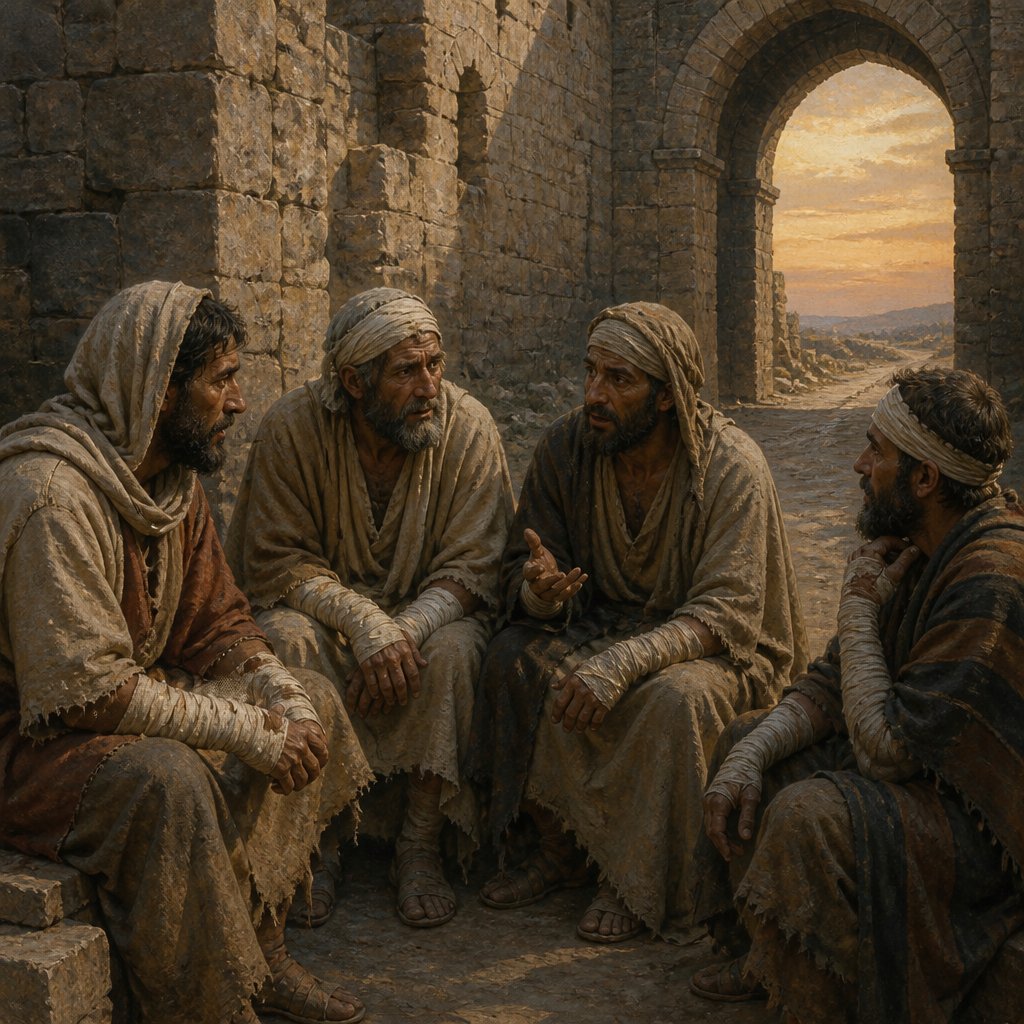
In the narratives of the Old Testament, we often find moments that resonate deeply with our own struggles and dilemmas. Second Kings 7:3 presents us with a striking scene involving four leprous men. They sit at the entrance of the city gate, physically marginalized and spiritually drained, perhaps contemplating their dire situation. The King James Version states, "And there were four leprous men at the entering in of the gate: and they said one to another, Why sit we here until we die?"
This verse encapsulates not only their physical state but also a deep existential question that echoes through the annals of time—an inquiry into the futility of inaction. As we embark on a deeper exploration of this narrative, we will uncover several lessons that emerge from their plight, each resounding with prophetic urgency in our lives today.
**1. Acknowledging Our Reality**
The first critical insight from our leprous men is the importance of acknowledging our reality. The men dared to assess their situation honestly. They were not deluded by optimism nor blinded by despair; they simply recognized a truth—they were sick, starving, and trapped by societal norms that rendered them invisible. In our own lives, we might find ourselves in situations that feel hopeless. Perhaps we face financial instability, breakdowns in relationships, or spiritual dryness. Just as these men did, we must confront our circumstances head-on and understand their implications. Denial will keep us stagnant; acknowledgment can ignite the ember of change.
**2. The Choice of Action**
Next comes their remarkable decision: "Why sit we here until we die?" This pivotal question reveals not only their desperation but a flicker of hope that drives them toward action. They knew that by remaining idle, death was a certainty, but by taking action, even if the outcome was uncertain, they retained a glimmer of hope. This teaches us that proactivity is a critical component of navigating challenges. Whether we are dealing with mental health struggles, an unfulfilling job, or family dysfunction, inaction will only prolong our suffering.
**3. Embracing Risk and Uncertainty**
The leprous men knew that approaching the enemy camp held the potential for death, yet they chose to risk it. This is a tremendous lesson for us: to move forward, we may need to embrace uncertainty and take risks. In our scripture, the lepers could have stayed in the safety of their familiarity even if it meant certain death. However, true progress often involves stepping out of our comfort zones. God calls us to faith-filled action, encouraging us to tread boldly into the unknown, trusting that He will provide.
**4. The Power of Collective Courage**
What is remarkable about their journey is that it is not undertaken alone. These four men discuss their fate together, symbolizing the importance of community in times of struggle. Faith can be daunting on our own, but when shared with others, it becomes more potent. The Bible encourages us to bear one another’s burdens (Galatians 6:2). In our communal endeavors, we draw strength, wisdom, and support, embodying God’s intention for us to thrive together.
**5. The Unexpected Provision of God**
Finally, when the leprous men took that brave step and moved towards the Syrian camp, they were met with unexpected provision; the enemy had fled, leaving behind food, treasures, and opportunity. God’s provision often comes when we take that first step of faith. He rewards our courage—just as He did for these men—though it may not look like what we anticipated. This is a powerful reminder that God is always working ahead of us, ready to bless our efforts when we choose to act in faith.
In conclusion, the story of the four leprous men teaches us about facing reality, choosing action, embracing risk, valuing community, and trusting in divine provision. As we reflect upon their courageous question, let us ask ourselves, what are we waiting for? With God's guidance and empowerment, we can move beyond our uncertainties into victorious living.
Want to reflect more on 2 Kings 7:3?
Continue your spiritual journey with Bible Chat — an AI-powered tool for exploring God's Word through conversation. Ask questions, discover connections, and deepen your understanding.
Get Our Apps


2 Kings 7:3 Artwork

2 Kings 7:3 - "¶ And there were four leprous men at the entering in of the gate: and they said one to another, Why sit we here until we die?"
"¶ And there were four leprous men at the entering in of the gate: and they said one to another, Why sit we here until we die?" - 2 Kings 7:3

1 Kings 7:3 - "And it was covered with cedar above upon the beams, that lay on forty five pillars, fifteen in a row."

2 Kings 7:2

2 Kings 3:15

2 Kings 3:15

2 Kings 3:15

2 Kings 7:11 - "And he called the porters; and they told it to the king's house within."

2 Kings 7:7 - "Wherefore they arose and fled in the twilight, and left their tents, and their horses, and their asses, even the camp as it was, and fled for their life."

2 Kings 3:16-19

2 Kings 3:10 - "And the king of Israel said, Alas! that the LORD hath called these three kings together, to deliver them into the hand of Moab!"

2 Kings 3:23 - "And they said, This is blood: the kings are surely slain, and they have smitten one another: now therefore, Moab, to the spoil."

"And it was covered with cedar above upon the beams, that lay on forty five pillars, fifteen in a row." - 1 Kings 7:3

2 Kings 2:7 - "And fifty men of the sons of the prophets went, and stood to view afar off: and they two stood by Jordan."

2 Kings 3:7 - "And he went and sent to Jehoshaphat the king of Judah, saying, The king of Moab hath rebelled against me: wilt thou go with me against Moab to battle? And he said, I will go up: I am as thou art, my people as thy people, and my horses as thy horses."

2 Kings 3:3 - "Nevertheless he cleaved unto the sins of Jeroboam the son of Nebat, which made Israel to sin; he departed not therefrom."

2 Kings 3:6 - "¶ And king Jehoram went out of Samaria the same time, and numbered all Israel."

2 Thessalonians 3:6-7

2 Kings 22:7 - "Howbeit there was no reckoning made with them of the money that was delivered into their hand, because they dealt faithfully."

2 Kings 20:7 - "And Isaiah said, Take a lump of figs. And they took and laid it on the boil, and he recovered."

2 Kings 3:5 - "But it came to pass, when Ahab was dead, that the king of Moab rebelled against the king of Israel."

2 Kings 3:16 - "And he said, Thus saith the LORD, Make this valley full of ditches."

2 Kings 7:14 - "They took therefore two chariot horses; and the king sent after the host of the Syrians, saying, Go and see."

2 Kings 3:18 - "And this is but a light thing in the sight of the LORD: he will deliver the Moabites also into your hand."

2 Kings 25:3 - "And on the ninth day of the fourth month the famine prevailed in the city, and there was no bread for the people of the land."

2 Kings 3:21 - "¶ And when all the Moabites heard that the kings were come up to fight against them, they gathered all that were able to put on armour, and upward, and stood in the border."

2 Kings 6:7 - "Therefore said he, Take it up to thee. And he put out his hand, and took it."

2 Timothy 3:7 - "Ever learning, and never able to come to the knowledge of the truth."

2 Kings 7:20 - "And so it fell out unto him: for the people trode upon him in the gate, and he died."

2 Kings 7:6 - "For the Lord had made the host of the Syrians to hear a noise of chariots, and a noise of horses, even the noise of a great host: and they said one to another, Lo, the king of Israel hath hired against us the kings of the Hittites, and the kings of the Egyptians, to come upon us."