The Cost of Disobedience: Lessons from Mesha, King of Moab
"¶ And Mesha king of Moab was a sheepmaster, and rendered unto the king of Israel an hundred thousand lambs, and an hundred thousand rams, with the wool." - 2 Kings 3:4
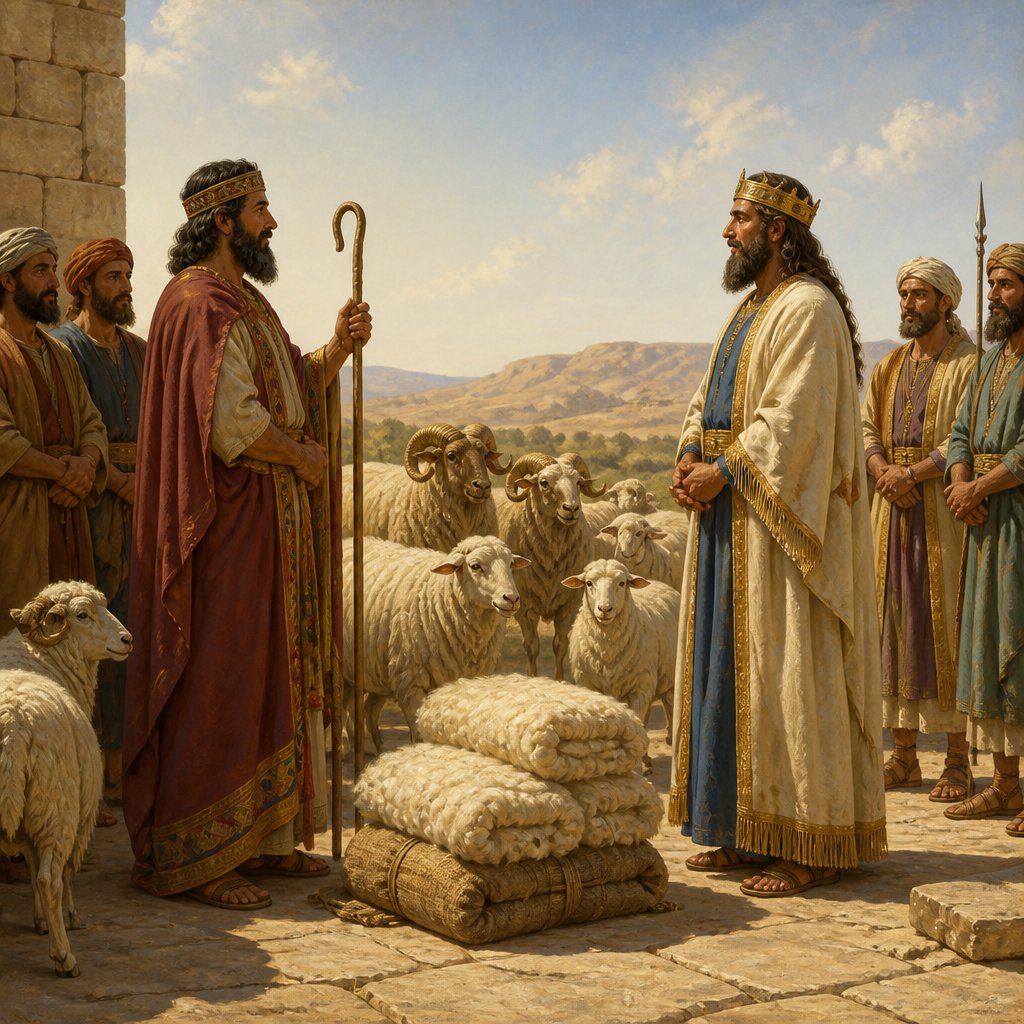
In the historical narrative of 2 Kings 3, we encounter a compelling insight into the dynamics of power, sacrifice, and the consequences of disobedience before God. The specific verse, "And Mesha king of Moab was a sheepmaster, and rendered unto the king of Israel an hundred thousand lambs, and an hundred thousand rams, with the wool" (2 Kings 3:4, KJV), serves as a profound examination of what it means to be caught in the web of obligation and rebellion against God’s ordained authority.
Mesha, the king of Moab, is depicted as a wealthy sheepmaster, which highlights his prosperity and the economy of his kingdom. The lambs and rams he offers to the king of Israel signify not just a tribute but also a recognition of Israel's dominance over Moab at that time. It was a form of tribute that reflected both reverence and obligation. Yet, it also foreshadows a deeper narrative about loyalty, covert rebellion, and the repercussions of straying from God’s ways.
From a broader biblical context, we understand that Mesha's gift was not simply a gesture of goodwill; it was an essential component of the political and social fabric of the time. Mesha’s payment of tribute could be seen as an acknowledgment of Israel’s power. However, it is vital to note that after the death of King Ahab of Israel, Mesha would soon rebel against the very kingdom he was subservient to. It is in this light that we evaluate Mesha's actions: they were dictated not only by the current political climate, but also by a heart that was rebellious against the rightful king.
With these reflections, a critical question arises: What motivates our offerings? Are we, too, sometimes giving merely out of obligation or fear rather than from a genuine heart of worship? Mesha’s initial act of tribute was not enough to secure his place in God’s favor. Like Mesha, many of us may find ourselves in positions where we outwardly conform to expectations, but internally we harbor discontent or rebellion. The act of rendering something to God or authority figures should stem from a true desire to honor and obey rather than a mere transactional expectation.
Furthermore, this narrative is a cautionary tale about the dangers of self-reliance and pride. Mesha's wealth as a sheepmaster might have led him to believe he could stand on his own, apart from the will of God and the authority of Israel. This self-sufficiency often leads to a spiritual disconnect. When we lean on our own understanding, we may also be tempted to take matters into our own hands, resisting God’s call on our lives. Herein lies the danger: a heart that does not recognize its dependence upon God is a heart veering toward destruction.
The significance of offerings in the Bible often extends beyond the mere act of giving; it reflects the condition of our hearts. In bringing our “lambs” and “rams” to God, are we offering the best of ourselves, or are we trying to meet a quota? Mesha’s act offers a glaring reminder that it's not the volume of our sacrifices but the intent behind them that holds eternal value. Jesus poignantly illustrated this principle through the poignant example of the widow’s mite. It is the heart of sincerity in giving that is most pleasing to God.
In closing, let us take a moment to reflect upon our own offerings—be they of time, talent, or treasure. Are we like Mesha, caught up in the ritual while neglecting the heart of worship? May we strive for authenticity in our service to the King, for it is only with attentive hearts that our offerings will ever truly satisfy Him. Let our hearts be made ready to give freely, out of gratitude and love, always acknowledging our dependence upon Him.
Thus, as we reflect on the humility befitting a servant, let us remember that what we render unto God should reflect the fullness of our hearts—a true and living sacrifice, holy and acceptable.
Want to reflect more on 2 Kings 3:4?
Continue your spiritual journey with Bible Chat — an AI-powered tool for exploring God's Word through conversation. Ask questions, discover connections, and deepen your understanding.
Get Our Apps


2 Kings 3:4 Artwork

2 Kings 3:4 - "¶ And Mesha king of Moab was a sheepmaster, and rendered unto the king of Israel an hundred thousand lambs, and an hundred thousand rams, with the wool."
"¶ And Mesha king of Moab was a sheepmaster, and rendered unto the king of Israel an hundred thousand lambs, and an hundred thousand rams, with the wool." - 2 Kings 3:4

2 Kings 4:3 - "Then he said, Go, borrow thee vessels abroad of all thy neighbours, even empty vessels; borrow not a few."

2 Kings 3:15

2 Kings 3:15

2 Kings 3:15

2 Kings 3:16-19

2 Kings 4:4-5

1 Kings 4:3 - "Elihoreph and Ahiah, the sons of Shisha, scribes; Jehoshaphat the son of Ahilud, the recorder."

1 Kings 3:4 - "And the king went to Gibeon to sacrifice there; for that was the great high place: a thousand burnt offerings did Solomon offer upon that altar."

2 Kings 3:10 - "And the king of Israel said, Alas! that the LORD hath called these three kings together, to deliver them into the hand of Moab!"

2 Kings 3:23 - "And they said, This is blood: the kings are surely slain, and they have smitten one another: now therefore, Moab, to the spoil."

2 Kings 3:6 - "¶ And king Jehoram went out of Samaria the same time, and numbered all Israel."

2 Kings 10:4 - "But they were exceedingly afraid, and said, Behold, two kings stood not before him: how then shall we stand?"

2 Kings 3:16 - "And he said, Thus saith the LORD, Make this valley full of ditches."

Matthew 2:3-4

Matthew 2:3-4

Matthew 2:3-4

Matthew 2:3-4

2 Kings 3:3 - "Nevertheless he cleaved unto the sins of Jeroboam the son of Nebat, which made Israel to sin; he departed not therefrom."

"Then he said, Go, borrow thee vessels abroad of all thy neighbours, even empty vessels; borrow not a few." - 2 Kings 4:3

2 Kings 3:5 - "But it came to pass, when Ahab was dead, that the king of Moab rebelled against the king of Israel."

2 Kings 4:11 - "And it fell on a day, that he came thither, and he turned into the chamber, and lay there."

1 Kings 4:2 - "And these were the princes which he had; Azariah the son of Zadok the priest,"

2 Corinthians 1:3-4

2 Kings 9:4 - "¶ So the young man, even the young man the prophet, went to Ramoth-gilead."

2 Kings 6:4 - "So he went with them. And when they came to Jordan, they cut down wood."

2 Kings 3:18 - "And this is but a light thing in the sight of the LORD: he will deliver the Moabites also into your hand."

2 Kings 25:3 - "And on the ninth day of the fourth month the famine prevailed in the city, and there was no bread for the people of the land."

2 Kings 3:21 - "¶ And when all the Moabites heard that the kings were come up to fight against them, they gathered all that were able to put on armour, and upward, and stood in the border."