A Legacy of Faith: The Ascension of Elijah
"¶ And Elisha saw it, and he cried, My father, my father, the chariot of Israel, and the horsemen thereof. And he saw him no more: and he took hold of his own clothes, and rent them in two pieces." - 2 Kings 2:12
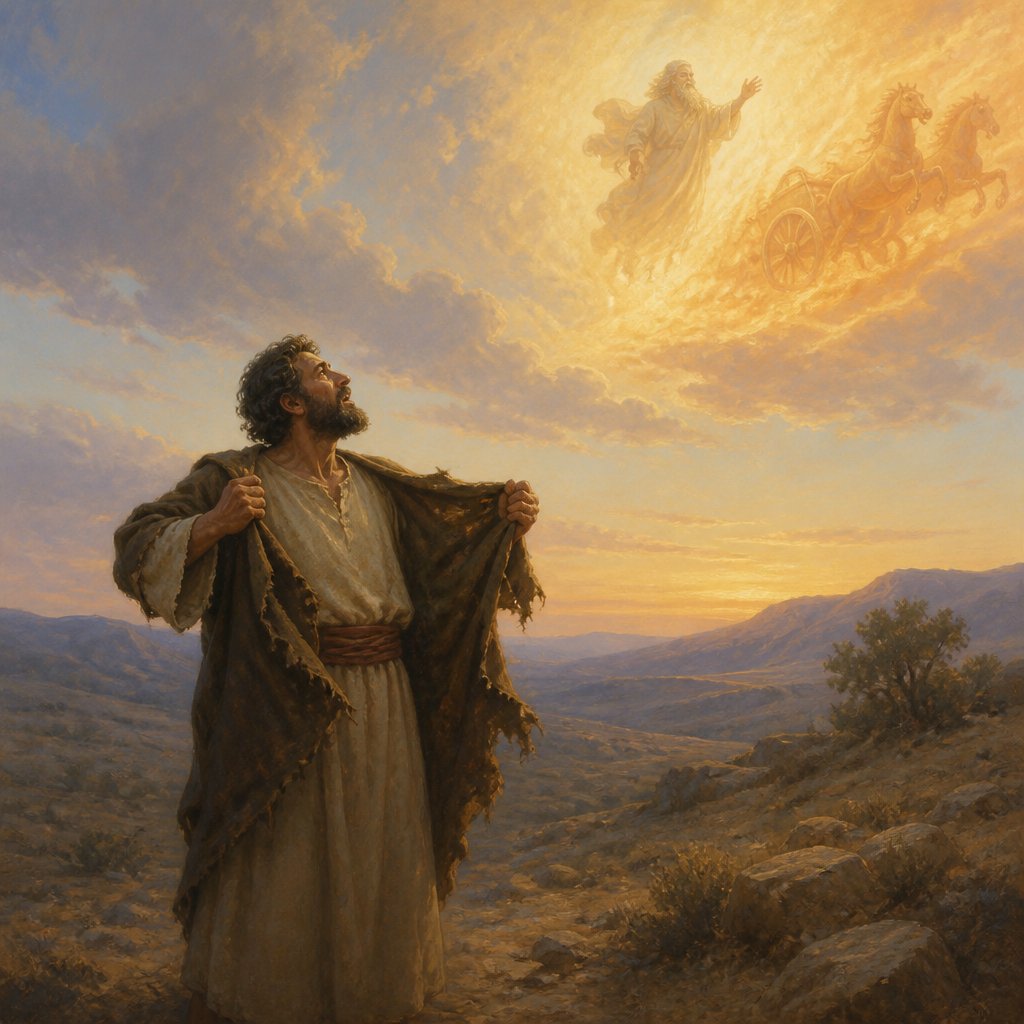
The moment captured in 2 Kings 2:12 is one filled with deep emotion and significance. "And Elisha saw it, and he cried, My father, my father, the chariot of Israel, and the horsemen thereof. And he saw him no more: and he took hold of his own clothes, and rent them in two pieces." Here, we witness the moment of Elijah's departure, a pivotal instance that marks not only a personal loss for Elisha but also a monumental transition in the leadership of Israel.
Elisha’s urgent cry, “My father, my father,” encapsulates the profound bond between the prophet Elijah and his protégé, Elisha. This was not merely a mentor-mentee relationship; it was one of spiritual fatherhood, where Elijah had poured his life, wisdom, and God’s anointing into Elisha. We can almost hear the weight of Elisha's heartbreak in his words. The phrase exemplifies his deep reverence for Elijah and signifies the loss of more than just a mentor; it heralded a void in spiritual guidance for Israel.
The imagery of “the chariot of Israel, and the horsemen thereof” is striking and instructive. In ancient Israel, chariots and horsemen represented strength, military might, and divine protection. Elisha’s acknowledgment that these served as symbols of Israel’s power reflects a profound understanding of who Elijah was—a figure of strength and divine authority. Yet, he is calling forth the heavenly assistance that Elijah had evoked throughout his ministry. Elisha recognized that Elijah was not just a prophet but rather a divine instrument through which God had manifested His power among His people.
In times of transition, the emotions of loss and change can feel overwhelming, causing us to question our own faith and the plans of God. Elisha’s response, rending his own clothes, signifies grief—a visible expression of his sorrow over the earthly loss of Elijah. It also illustrates the deep, internal transformation that often accompanies such pivotal moments. The tearing of garments in biblical times was a common practice when mourning, and it represents the letting go of the past to embrace the future that God had for him.
This moment in Elisha's life serves as a reminder that while we may experience loss and heartache from the departure of significant figures in our lives—be they family members, mentors, or spiritual leaders—God's work continues forward. As we mourn, we must also remember to look ahead, recognizing God’s ongoing purpose. The baton was passing from Elijah to Elisha, a divine succession of prophetic leadership. God was not finished with His people.
Moreover, this passage encourages us to consider how we embrace the legacies left by those who have influenced us spiritually. What have we learned from our spiritual fathers and mothers? How do their actions and teachings shape our faith lives today? Just as Elisha learned from Elijah, we are called to learn, to grow, and eventually to pass on that knowledge and faith to others.
As Elisha stood there, watching the whirlwind take Elijah away, he was also standing on the cusp of his own ministry. The very next verse, 2 Kings 2:13, illustrates that Elisha took up Elijah's mantle—a powerful symbol of authority and prophetic ministry. This act conveys that as we honor those who have gone before us, we must also step into our own callings; we are tasked with carrying on the legacy of faith.
In conclusion, Elisha's lament serves as both a tribute and a challenge. It asks us to recognize the impact of those who have gone before us while compelling us to embrace our own journey of faith. In our times of grief, may we find solace in the knowledge that God is still in control, continuing to work in and through us, just as He did with Elisha. Let us honor our mentors, grieve our losses, and prepare to take up our own mantles, boldly stepping into the future God has planned for us.
Want to reflect more on 2 Kings 2:12?
Continue your spiritual journey with Bible Chat — an AI-powered tool for exploring God's Word through conversation. Ask questions, discover connections, and deepen your understanding.
Get Our Apps


2 Kings 2:12 Artwork

2 kings 2:12 in which elisha is kneeling down while receiving brown old cloak

2 Kings 2:12 - "¶ And Elisha saw it, and he cried, My father, my father, the chariot of Israel, and the horsemen thereof. And he saw him no more: and he took hold of his own clothes, and rent them in two pieces."
"¶ And Elisha saw it, and he cried, My father, my father, the chariot of Israel, and the horsemen thereof. And he saw him no more: and he took hold of his own clothes, and rent them in two pieces." - 2 Kings 2:12

2 Kings 12:19 - "¶ And the rest of the acts of Joash, and all that he did, are they not written in the book of the chronicles of the kings of Judah?"

2 Kings 12:2 - "And Jehoash did that which was right in the sight of the LORD all his days wherein Jehoiada the priest instructed him."

2 Kings 12:14 - "But they gave that to the workmen, and repaired therewith the house of the LORD."

2 Kings 25:12 - "But the captain of the guard left of the poor of the land to be vinedressers and husbandmen."

2 Kings 12:16 - "The trespass money and sin money was not brought into the house of the LORD: it was the priests'."

2 Kings 10:12 - "¶ And he arose and departed, and came to Samaria. And as he was at the shearing house in the way,"

2 Kings 14:12 - "And Judah was put to the worse before Israel; and they fled every man to their tents."

2 Kings 12:6 - "But it was so, that in the three and twentieth year of king Jehoash the priests had not repaired the breaches of the house."

2 Kings 12:12 - "And to masons, and hewers of stone, and to buy timber and hewed stone to repair the breaches of the house of the LORD, and for all that was laid out for the house to repair it."

2 Kings 12:8 - "And the priests consented to receive no more money of the people, neither to repair the breaches of the house."

2 Kings 16:12 - "And when the king was come from Damascus, the king saw the altar: and the king approached to the altar, and offered thereon."

2 Kings 13:12 - "And the rest of the acts of Joash, and all that he did, and his might wherewith he fought against Amaziah king of Judah, are they not written in the book of the chronicles of the kings of Israel?"

1 Kings 2:12 - "¶ Then sat Solomon upon the throne of David his father; and his kingdom was established greatly."

2 Kings 12:15 - "Moreover they reckoned not with the men, into whose hand they delivered the money to be bestowed on workmen: for they dealt faithfully."

2 Kings 12:3 - "But the high places were not taken away: the people still sacrificed and burnt incense in the high places."

2 Kings 17:12 - "For they served idols, whereof the LORD had said unto them, Ye shall not do this thing."

2 Kings 3:12 - "And Jehoshaphat said, The word of the LORD is with him. So the king of Israel and Jehoshaphat and the king of Edom went down to him."

2 Kings 22:12 - "And the king commanded Hilkiah the priest, and Ahikam the son of Shaphan, and Achbor the son of Michaiah, and Shaphan the scribe, and Asahiah a servant of the king's, saying,"

2 Kings 12:20 - "And his servants arose, and made a conspiracy, and slew Joash in the house of Millo, which goeth down to Silla."

2 Kings 12:17 - "¶ Then Hazael king of Syria went up, and fought against Gath, and took it: and Hazael set his face to go up to Jerusalem."

"But they gave that to the workmen, and repaired therewith the house of the LORD." - 2 Kings 12:14

2 Kings 2:11-12 (11) ... behold, there appeared a chariot of fire, and horses of fire, and parted them both asunder; and Elijah went up by a whirlwind into heaven.
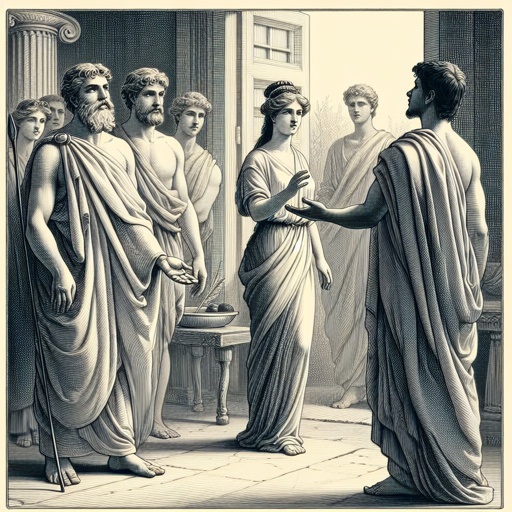
2 Kings 4:12 - "And he said to Gehazi his servant, Call this Shunammite. And when he had called her, she stood before him."
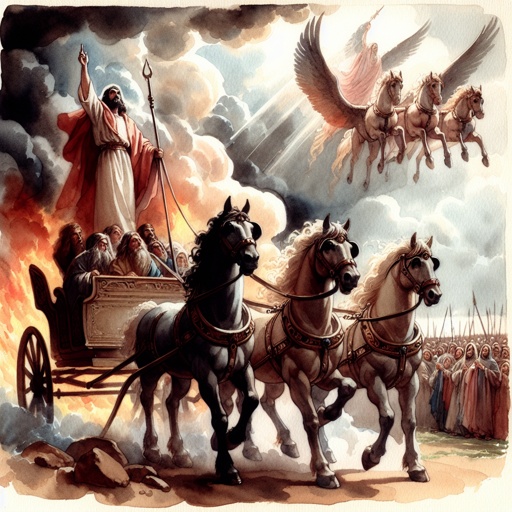
2 Kings 2:11

2 Kings 2:21

2 Kings 12:1 - "In the seventh year of Jehu Jehoash began to reign; and forty years reigned he in Jerusalem. And his mother's name was Zibiah of Beer-sheba."

"¶ And the rest of the acts of Joash, and all that he did, are they not written in the book of the chronicles of the kings of Judah?" - 2 Kings 12:19