The Sorrow of Sight: Lessons from Zedekiah's Captivity
"And they slew the sons of Zedekiah before his eyes, and put out the eyes of Zedekiah, and bound him with fetters of brass, and carried him to Babylon." - 2 Kings 25:7

The verse 2 Kings 25:7 presents a haunting image of defeat and despair: "And they slew the sons of Zedekiah before his eyes, and put out the eyes of Zedekiah, and bound him with fetters of brass, and carried him to Babylon." In this single verse, we encounter the tragic climax of Zedekiah’s life—a king who was once full of promise but ultimately failed to lead his people faithfully.
To journey through this verse is to step into a profound narrative of loss and judgment. Zedekiah, the last king of Judah, represents the culmination of Israel's repeated disobedience to God. He is a poignant figure, caught between the pressures of Babylonian conquest and the spiritual expectations set forth by God. Zedekiah had been given the opportunity to act with righteousness but chose to follow a path of defiance against God's decrees. His tragic end serves as a sober reminder that choices have consequences, and those consequences can extend beyond the individual to affect generations.
The first part of the verse describes the grim fate of his sons. Their slaughter before Zedekiah's eyes is not merely an act of violence; it signifies the complete obliteration of hope. In ancient times, a king’s lineage was critical—a symbol of continuity and legitimacy. Zedekiah’s sons represented the future of Judah, the promise of a restored nation. Yet witnessing their demise must have been torture for Zedekiah, a man already burdened by the weight of his own failures.
How often do we, like Zedekiah, watch as our poor choices bring suffering to those we love? The consequence of unchecked pride and rebellion against God can lead not just to our own despair but also to the trampling of the hopes of others. In the moment of our own captivity (whether spiritual, emotional, or relational), we must consider how our actions inadvertently impact those around us. The pain of witnessing loss is magnified when it stems from our inaction or rebellion.
As the story unfolds, Zedekiah's eyes are put out. This act is not just a punishment; it is a metaphor for spiritual blindness. Zedekiah had failed to see the truth that God had revealed time and again—that adherence to His commandments was the path to prosperity and peace. By allowing himself to be swayed by false prophets and political pressures, he lost his spiritual clarity.
In our lives, how often do we allow distractions to cloud our judgment? How easily we become blind to the truth when we neglect God’s Word or when we surround ourselves with voices that do not speak to our true purpose. The futility of sight without insight becomes painfully evident in Zedekiah's fate.
The fetters of brass symbolize the heavy chains of captivity that bind Zedekiah, both physically and spiritually. It serves as a stark reminder of how sin can entrap us. These chains do not merely hold us captive; they limit our ability to fulfill our God-given purpose. Zedekiah was taken to Babylon, a foreign land, far from God’s promises and blessings, representing a life lived apart from divine fellowship. The chains we wear due to sin and disobedience can lead us to places far removed from God’s intended plans for us.
Zedekiah’s story warns us of the importance of obedience and the reality of consequences. Yet, even in this darkness, the hope of redemption is never extinguished. It calls us to reflect on our own lives, to repent where necessary, and to seek God’s guidance fervently. We may still experience loss, suffering, and consequences from our choices, but unlike Zedekiah, we have Christ as our Savior—who unlocks the chains that bind us and restores sight to the blind (John 9:39).
May we not only learn from Zedekiah’s mistakes but also strive to guide those we love away from the snares of disobedience. In Jesus, we find the promise of a new vision—one where our decisions reflect His love and truth, guiding us towards a future filled with hope and life.
Want to reflect more on 2 Kings 25:7?
Continue your spiritual journey with Bible Chat — an AI-powered tool for exploring God's Word through conversation. Ask questions, discover connections, and deepen your understanding.
Get Our Apps


2 Kings 25:7 Artwork

2 Kings 25:7 - "And they slew the sons of Zedekiah before his eyes, and put out the eyes of Zedekiah, and bound him with fetters of brass, and carried him to Babylon."

"And they slew the sons of Zedekiah before his eyes, and put out the eyes of Zedekiah, and bound him with fetters of brass, and carried him to Babylon." - 2 Kings 25:7

2 Kings 25:2 - "And the city was besieged unto the eleventh year of king Zedekiah."

2 Kings 25:1 show King Nebuchadnezzar in war zone

2 Kings 21:25 - "Now the rest of the acts of Amon which he did, are they not written in the book of the chronicles of the kings of Judah?"

2 Kings 7:2

2 Kings 25:28 - "And he spake kindly to him, and set his throne above the throne of the kings that were with him in Babylon;"

2 Kings 2:25 - "And he went from thence to mount Carmel, and from thence he returned to Samaria."

2 Kings 25:1 show King Nebuchadnezzar and the army and the Temple

2 Kings 25:12 - "But the captain of the guard left of the poor of the land to be vinedressers and husbandmen."

Proverbs 25:2 - "It is the glory of God to conceal a thing: but the honour of kings is to search out a matter."

2 Kings 25:20 - "And Nebuzar-adan captain of the guard took these, and brought them to the king of Babylon to Riblah:"

Jehoiachin is released from Babylonian jail 2 kings 25: 27
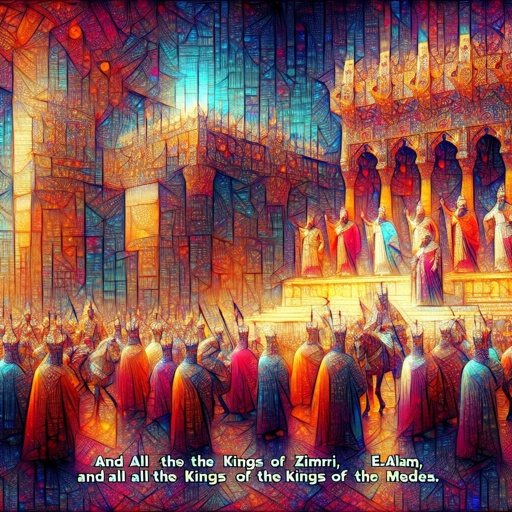
Jeremiah 25:25 - "And all the kings of Zimri, and all the kings of Elam, and all the kings of the Medes,"

Luke 7:25 - "But what went ye out for to see? A man clothed in soft raiment? Behold, they which are gorgeously apparelled, and live delicately, are in kings' courts."

"And the city was besieged unto the eleventh year of king Zedekiah." - 2 Kings 25:2

2 Kings 25:3 - "And on the ninth day of the fourth month the famine prevailed in the city, and there was no bread for the people of the land."

2 Kings 25:6 - "So they took the king, and brought him up to the king of Babylon to Riblah; and they gave judgment upon him."

2 Kings 25:14 - "And the pots, and the shovels, and the snuffers, and the spoons, and all the vessels of brass wherewith they ministered, took they away."

1 Kings 2:25 - "And king Solomon sent by the hand of Benaiah the son of Jehoiada; and he fell upon him that he died."

2 Kings 25:10 - "And all the army of the Chaldees, that were with the captain of the guard, brake down the walls of Jerusalem round about."

2 Kings 25:18 - "¶ And the captain of the guard took Seraiah the chief priest, and Zephaniah the second priest, and the three keepers of the door:"

2 Chronicles 25:26 - "Now the rest of the acts of Amaziah, first and last, behold, are they not written in the book of the kings of Judah and Israel?"

2 Kings 25:15 - "And the firepans, and the bowls, and such things as were of gold, in gold, and of silver, in silver, the captain of the guard took away."

2 Kings 7:11 - "And he called the porters; and they told it to the king's house within."

2 Kings 8:25 - "¶ In the twelfth year of Joram the son of Ahab king of Israel did Ahaziah the son of Jehoram king of Judah begin to reign."

2 Kings 7:7 - "Wherefore they arose and fled in the twilight, and left their tents, and their horses, and their asses, even the camp as it was, and fled for their life."

2 Kings 25:26 - "And all the people, both small and great, and the captains of the armies, arose, and came to Egypt: for they were afraid of the Chaldees."

2 Kings 25:30 - "And his allowance was a continual allowance given him of the king, a daily rate for every day, all the days of his life."

2 Kings 25:25 - "But it came to pass in the seventh month, that Ishmael the son of Nethaniah, the son of Elishama, of the seed royal, came, and ten men with him, and smote Gedaliah, that he died, and the Jews and the Chaldees that were with him at Mizpah."