Breaking Down Walls: The Cost of Compromise
"And all the army of the Chaldees, that were with the captain of the guard, brake down the walls of Jerusalem round about." - 2 Kings 25:10

In 2 Kings 25:10, we witness a devastating moment in biblical history: "And all the army of the Chaldees, that were with the captain of the guard, brake down the walls of Jerusalem round about." This verse encapsulates the collapse of Jerusalem, a symbol of God's covenant with His people, and serves as a poignant reminder of the consequences of disobedience, the effects of spiritual decay, and the sobering reality of judgment.
Jerusalem was not just any city; it was the heart of Israel, the seat of God's presence among His people, and the location of the Temple where the Ark of the Covenant dwelt. Its walls were not merely physical barriers but symbols of protection, strength, and divine favor. The destruction of these walls represented not only a military defeat but a failure of faith and a rejection of God's sovereignty.
As we reflect upon this historical moment, we must ask ourselves what led to such a catastrophic outcome. The answer lies in the preceding chapters of 2 Kings, where we find a nation that had forsaken their God. Time and again, Israel turned away from the commandments of the Lord, aligning themselves with the practices of the nations around them. They indulged in idolatry, failed to honor God's statutes, and ultimately, they embraced a cultural compromise that made them vulnerable to external threats. The wall that was designed to protect their identity and covenant relationship with God had been progressively weakened by their own choices.
The context of this destruction provides a significant warning for us today. What spiritual walls have we allowed to crumble? In our own lives, we often construct barriers to protect our faith and moral integrity, yet how easily can they be breached by the influences of the world around us? Just as Jerusalem's inhabitants allowed pagan practices and foreign alliances to infiltrate their society, we too can be seduced by secular ideologies, materialism, or even complacency in our spiritual walk.
When the Chaldeans divided the walls, it was not merely an act of war; it was a reflection of a deeper spiritual reality—the removal of divine protection. In our lives, when we choose to compromise our devotion to God, we risk allowing the enemy access to our hearts and minds. The walls we build through prayer, scripture, and community are critical defenses against spiritual attack. Yet, when they are allowed to decay, we leave ourselves vulnerable.
Furthermore, the imagery of broken walls is not just about loss but also about what can arise from such devastation. We might find ourselves feeling desolate, as if our hope has been shattered, and our dreams of security crushed. But in this moment of despair, we are reminded of Lamentations 3:22-23: "It is of the Lord’s mercies that we are not consumed, because his compassions fail not. They are new every morning: great is thy faithfulness." While the physical walls of Jerusalem were broken down, God’s faithfulness was not. There remained a remnant, and in God’s perfect timing, He would restore what was lost.
As we navigate through life’s challenges and observe the crumbling structures around us—be it societal values, personal integrity, or spiritual commitments—we are invited to do more than mourn the loss; we are called to rebuild. The ultimate architect is God Himself, and through sincere repentance and reliance on Him, we can fortify the walls of our faith, ensuring that they stand firm against the tides of cultural erosion.
Let us be vigilant and proactive in our spiritual lives, recognizing that every small compromise can lead to a significant breach. May the lessons from Jerusalem's fall galvanize our determination to restore and rebuild our own walls through prayer, scripture, and fellowship, ever trusting in God’s faithfulness to renew and restore.
Want to reflect more on 2 Kings 25:10?
Continue your spiritual journey with Bible Chat — an AI-powered tool for exploring God's Word through conversation. Ask questions, discover connections, and deepen your understanding.
Get Our Apps


2 Kings 25:10 Artwork

2 Kings 25:10 - "And all the army of the Chaldees, that were with the captain of the guard, brake down the walls of Jerusalem round about."

"And all the army of the Chaldees, that were with the captain of the guard, brake down the walls of Jerusalem round about." - 2 Kings 25:10

2 Kings 25:2 - "And the city was besieged unto the eleventh year of king Zedekiah."

2 Kings 25:1 show King Nebuchadnezzar in war zone

2 Kings 21:25 - "Now the rest of the acts of Amon which he did, are they not written in the book of the chronicles of the kings of Judah?"

2 Kings 25:28 - "And he spake kindly to him, and set his throne above the throne of the kings that were with him in Babylon;"

2 Kings 2:25 - "And he went from thence to mount Carmel, and from thence he returned to Samaria."

2 Kings 25:1 show King Nebuchadnezzar and the army and the Temple

2 Kings 25:12 - "But the captain of the guard left of the poor of the land to be vinedressers and husbandmen."

Proverbs 25:2 - "It is the glory of God to conceal a thing: but the honour of kings is to search out a matter."

2 Kings 10:25 - "And it came to pass, as soon as he had made an end of offering the burnt offering, that Jehu said to the guard and to the captains, Go in, and slay them; let none come forth. And they smote them with the edge of the sword; and the guard and the captains cast them out, and went to the city of the house of Baal."

2 Kings 25:20 - "And Nebuzar-adan captain of the guard took these, and brought them to the king of Babylon to Riblah:"

Jehoiachin is released from Babylonian jail 2 kings 25: 27
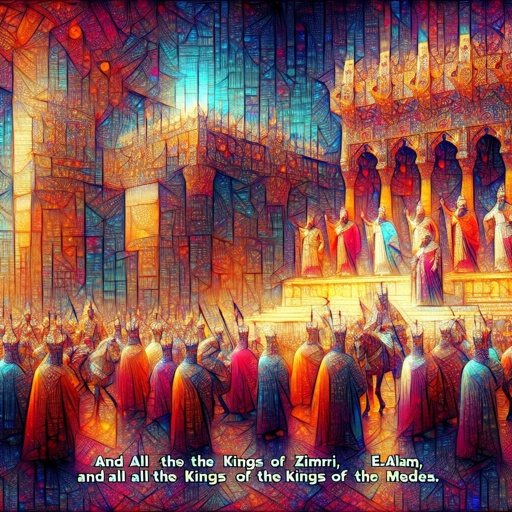
Jeremiah 25:25 - "And all the kings of Zimri, and all the kings of Elam, and all the kings of the Medes,"

1 Kings 10:25 - "And they brought every man his present, vessels of silver, and vessels of gold, and garments, and armour, and spices, horses, and mules, a rate year by year."

"And the city was besieged unto the eleventh year of king Zedekiah." - 2 Kings 25:2

2 Kings 25:3 - "And on the ninth day of the fourth month the famine prevailed in the city, and there was no bread for the people of the land."

2 Kings 25:6 - "So they took the king, and brought him up to the king of Babylon to Riblah; and they gave judgment upon him."

2 Kings 25:14 - "And the pots, and the shovels, and the snuffers, and the spoons, and all the vessels of brass wherewith they ministered, took they away."

1 Kings 2:25 - "And king Solomon sent by the hand of Benaiah the son of Jehoiada; and he fell upon him that he died."

2 Kings 3:10 - "And the king of Israel said, Alas! that the LORD hath called these three kings together, to deliver them into the hand of Moab!"

2 Kings 25:18 - "¶ And the captain of the guard took Seraiah the chief priest, and Zephaniah the second priest, and the three keepers of the door:"

2 Chronicles 25:26 - "Now the rest of the acts of Amaziah, first and last, behold, are they not written in the book of the kings of Judah and Israel?"

2 Kings 25:15 - "And the firepans, and the bowls, and such things as were of gold, in gold, and of silver, in silver, the captain of the guard took away."

2 Kings 8:25 - "¶ In the twelfth year of Joram the son of Ahab king of Israel did Ahaziah the son of Jehoram king of Judah begin to reign."

2 Kings 21:10 - "¶ And the LORD spake by his servants the prophets, saying,"

2 Kings 10:28 - "Thus Jehu destroyed Baal out of Israel."

2 Kings 10:4 - "But they were exceedingly afraid, and said, Behold, two kings stood not before him: how then shall we stand?"

2 Kings 25:26 - "And all the people, both small and great, and the captains of the armies, arose, and came to Egypt: for they were afraid of the Chaldees."

2 Kings 25:30 - "And his allowance was a continual allowance given him of the king, a daily rate for every day, all the days of his life."