The Courage to Remove Idols: A Devotional on 2 Kings 18:4
"¶ He removed the high places, and brake the images, and cut down the groves, and brake in pieces the brasen serpent that Moses had made: for unto those days the children of Israel did burn incense to it: and he called it Nehushtan." - 2 Kings 18:4
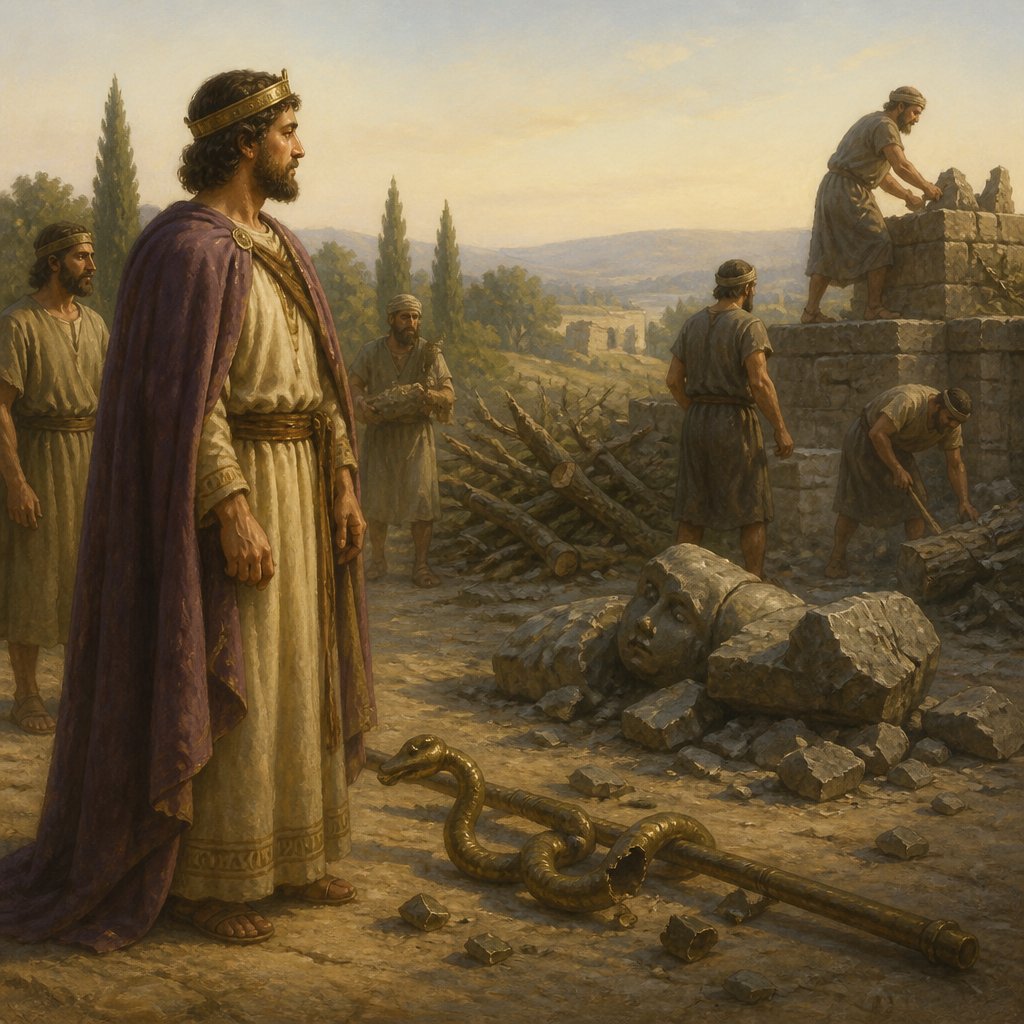
As we delve into the rich tapestry of 2 Kings 18:4, we come across a pivotal moment in the history of Israel, embodied in the reign of King Hezekiah. The verse states, "He removed the high places, and brake the images, and cut down the groves, and brake in pieces the brasen serpent that Moses had made: for unto those days the children of Israel did burn incense to it: and he called it Nehushtan." This passage is deeply significant, as it reveals the spiritual reform that Hezekiah enacted in his kingdom, a reform that resonates with our own spiritual lives today.
The first action of Hezekiah was the removal of the high places. These were locations on elevated ground where idolatrous worship had taken place. Although initially established for the worship of Yahweh, over time these sites became synonymous with the worship of foreign gods. By removing these high places, Hezekiah was decisively turning away from the syncretism that had marred the faith of his people. He recognized that true worship requires exclusivity. As believers today, we must also assess our own spiritual lives for 'high places'—those areas where we might be compromising our devotion to God by allowing false idols to take root.
Next, Hezekiah "brake the images" and "cut down the groves"—these actions signify the dismantling of physical idols that had been erected in defiance of God's commandments. Images were tangible representations of deities, and groves often served as sacred places for illicit worship. The act of destruction was not merely a physical act but a declaration of allegiance to the one true God. Likewise, we are called to identify and dismantle the idols in our lives; whatever it may be that takes our attention and devotion away from God. It could be our careers, relationships, or even our possessions. We must ask ourselves: what are the groves in our lives that need to be cut down? What images do we need to break?
Perhaps the most intriguing part of this verse is the mention of the brazen serpent made by Moses. Initially, this serpent served a powerful purpose during the Exodus, being the instrument by which God healed the afflicted. However, over time, it became an object of worship—a reminder of the people’s idolatry. Hezekiah didn’t shy away from addressing even this cherished relic; he broke it into pieces, calling it Nehushtan, a play on words that implies 'a piece of bronze'. This action teaches us a profound lesson about how even good things can become dangerous when taken out of context and worshiped inappropriately.
In our modern context, there are many things that are considered "good" or "holy"—traditions, rituals, and even scripture—and yet, if they become the objects of our worship instead of conduits to the Living God, they must be addressed. Are there aspects of our faith that we elevate improperly, allowing them to distract from our relationship with God? Just as Hezekiah called the serpent 'Nehushtan' to diminish its elevated status, we must re-evaluate our priorities and practices, ensuring they point us toward Christ.
The fearlessness and leadership exhibited by Hezekiah calls for our own courage to act. In a world where the lines of devotion can easily blur, we must be prepared to take decisive action against anything that threatens to usurp the place of God in our hearts and lives. This may require difficult conversations, painful sacrifices, and a deep confrontation with the idols we have unwittingly nurtured.
Let us draw inspiration and strength from Hezekiah’s example, recognizing that true worship requires not only the removal of idols but also a commitment to wholeheartedly following God. May we hear His voice today, urging us to remove what stands between Him and us, so we can draw closer in faith and experience the fullness of His presence in our lives.
Want to reflect more on 2 Kings 18:4?
Continue your spiritual journey with Bible Chat — an AI-powered tool for exploring God's Word through conversation. Ask questions, discover connections, and deepen your understanding.
Get Our Apps


2 Kings 18:4 Artwork

2 Kings 18:4 - "¶ He removed the high places, and brake the images, and cut down the groves, and brake in pieces the brasen serpent that Moses had made: for unto those days the children of Israel did burn incense to it: and he called it Nehushtan."
"¶ He removed the high places, and brake the images, and cut down the groves, and brake in pieces the brasen serpent that Moses had made: for unto those days the children of Israel did burn incense to it: and he called it Nehushtan." - 2 Kings 18:4

2 Kings 4:18 - "¶ And when the child was grown, it fell on a day, that he went out to his father to the reapers."

1 Kings 4:18 - "Shimei the son of Elah, in Benjamin:"

2 Kings 14:18 - "And the rest of the acts of Amaziah, are they not written in the book of the chronicles of the kings of Judah?"

"¶ And when the child was grown, it fell on a day, that he went out to his father to the reapers." - 2 Kings 4:18

2 Kings 4:4-5

2 Kings 1:18 - "Now the rest of the acts of Ahaziah which he did, are they not written in the book of the chronicles of the kings of Israel?"

"Shimei the son of Elah, in Benjamin:" - 1 Kings 4:18

2 Corinthians 4:18

1 Kings 2:18 - "And Bath-sheba said, Well; I will speak for thee unto the king."

2 Kings 8:18 - "And he walked in the way of the kings of Israel, as did the house of Ahab: for the daughter of Ahab was his wife: and he did evil in the sight of the LORD."

2 Kings 18:18 - "And when they had called to the king, there came out to them Eliakim the son of Hilkiah, which was over the household, and Shebna the scribe, and Joah the son of Asaph the recorder."

1 Kings 18:2 - "And Elijah went to shew himself unto Ahab. And there was a sore famine in Samaria."

2 Kings 18:15 - "And Hezekiah gave him all the silver that was found in the house of the LORD, and in the treasures of the king's house."

2 Kings 18:36 - "But the people held their peace, and answered him not a word: for the king's commandment was, saying, Answer him not."

"And the rest of the acts of Amaziah, are they not written in the book of the chronicles of the kings of Judah?" - 2 Kings 14:18

2 Kings 3:18 - "And this is but a light thing in the sight of the LORD: he will deliver the Moabites also into your hand."

2 Kings 18:33 - "Hath any of the gods of the nations delivered at all his land out of the hand of the king of Assyria?"

2 Kings 18:5 - "He trusted in the LORD God of Israel; so that after him was none like him among all the kings of Judah, nor any that were before him."

2 Kings 10:4 - "But they were exceedingly afraid, and said, Behold, two kings stood not before him: how then shall we stand?"

2 Kings 16:18 - "And the covert for the sabbath that they had built in the house, and the king's entry without, turned he from the house of the LORD for the king of Assyria."

2 Kings 2:18 - "And when they came again to him, (for he tarried at Jericho,) he said unto them, Did I not say unto you, Go not?"

2 Kings 18:3 - "And he did that which was right in the sight of the LORD, according to all that David his father did."

2 Kings 25:18 - "¶ And the captain of the guard took Seraiah the chief priest, and Zephaniah the second priest, and the three keepers of the door:"

2 Kings 18:28 - "Then Rabshakeh stood and cried with a loud voice in the Jews' language, and spake, saying, Hear the word of the great king, the king of Assyria:"

2 Kings 18:10 - "And at the end of three years they took it: even in the sixth year of Hezekiah, that is the ninth year of Hoshea king of Israel, Samaria was taken."

2 Kings 18:7 - "And the LORD was with him; and he prospered whithersoever he went forth: and he rebelled against the king of Assyria, and served him not."

2 Kings 18:8 - "He smote the Philistines, even unto Gaza, and the borders thereof, from the tower of the watchmen to the fenced city."

1 Kings 18:4 - "For it was so, when Jezebel cut off the prophets of the LORD, that Obadiah took an hundred prophets, and hid them by fifty in a cave, and fed them with bread and water.)"