From a Dissolving Tent to an Eternal House
"For we know that if our earthly house of this tabernacle were dissolved, we have a building of God, an house not made with hands, eternal in the heavens." - 2 Corinthians 5:1
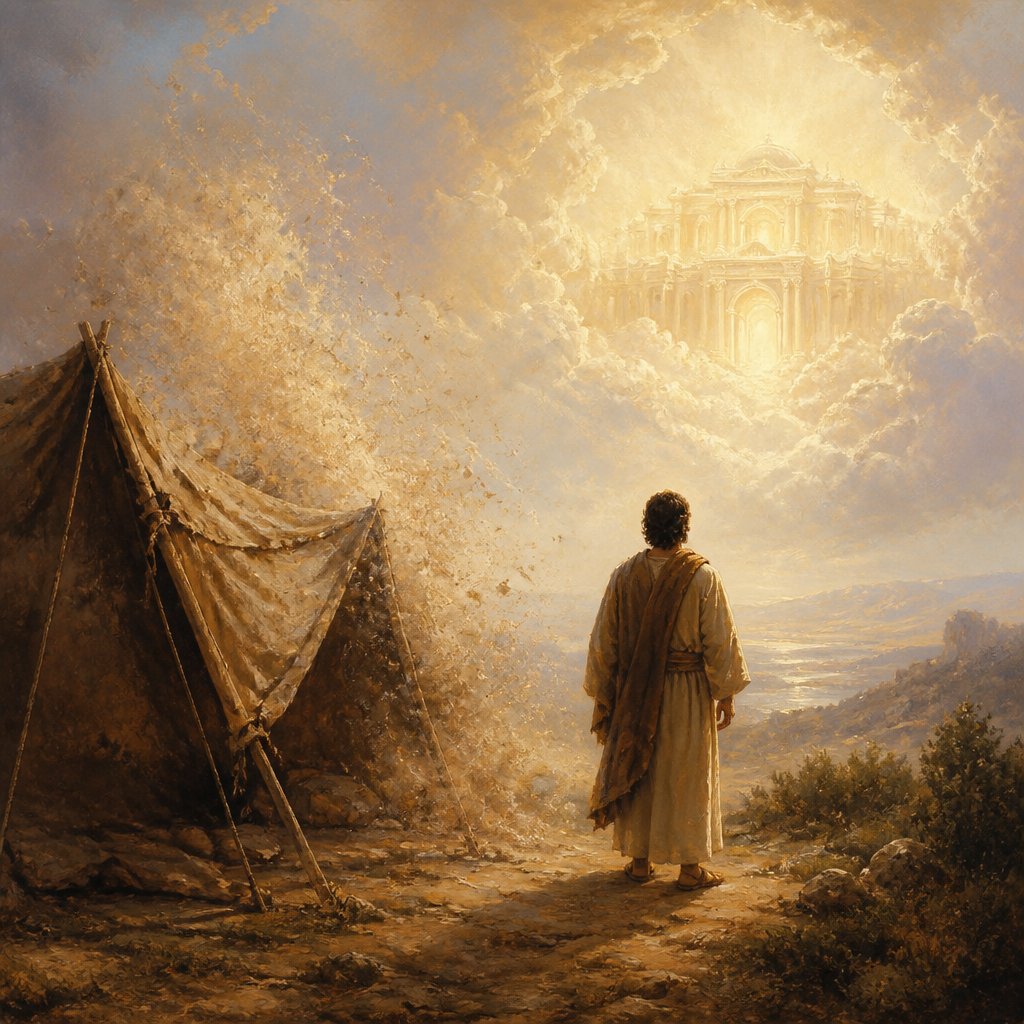
“For we know that if our earthly house of this tabernacle were dissolved, we have a building of God, an house not made with hands, eternal in the heavens.” (2 Corinthians 5:1, KJV)
There is a steady strength in the opening words: “For we know.” Paul does not say, “For we hope,” or “For we suspect,” but “For we know.” This is not the confidence of denial—pretending pain, sickness, aging, and death are not real—but the confidence of faith grounded in God’s promise. The Christian’s certainty is not built on how sturdy the body feels today, but on what God has prepared for those who are in Christ.
Paul calls the body “our earthly house of this tabernacle.” A tabernacle is a tent—useful, necessary, and even sacred in its purpose, but not permanent. Tents are exposed to weather. Stakes loosen. Fabric thins. The point is not that the body is worthless; rather, it is temporary. Scripture does not invite us to despise our “earthly house,” but it does warn us not to confuse temporary shelter with our final home. If we build our identity entirely on health, appearance, productivity, or strength, then every ache becomes a threat and every limitation feels like a loss of self. But Paul offers a truer measure of reality: this tent was never meant to last forever.
Then comes the sobering phrase: “if our earthly house of this tabernacle were dissolved.” Dissolved is an honest word. It suggests undoing, a loosening, a coming apart. Death is not portrayed as a gentle upgrade that requires no grief. Bodies fail. Life in this world has an end. The gospel does not require us to pretend otherwise; it meets us in that hard truth. Yet Paul does not stop at dissolution. He places it inside a larger certainty: “we have a building of God.”
Notice the shift: from a tent to a building, from the earthly to the divine, from the dissolving to the enduring. A “building of God” speaks of something designed, established, and secure—something not propped up by human effort. It is “an house not made with hands.” Everything we can build here—careers, reputations, savings, even the ways we try to protect ourselves—has “hands” on it. It is shaped by human limitation and exposed to sudden change. But what God gives is not handmade, not fragile, not dependent upon our ability to maintain it. It is His work, and therefore it will stand.
Paul adds the word that stretches comfort into worship: “eternal.” Not temporary relief, not a short-lived improvement, not a few more good years—“eternal.” Many of our fears about loss are rooted in the idea that what we love is slipping away for good. But the gospel answers with a promise that outlasts every ending. For the believer, death is not the erasing of home but the passage into it. The final phrase anchors this promise beyond the reach of decay: “in the heavens.” Not because heaven is distant in a way that makes God absent, but because it is the realm where nothing corrupts, where no thief breaks through, where no illness returns, where no sorrow has the last word.
This verse also confronts a quieter struggle: the pressure to treat this life as if it must satisfy every longing. If this tent is all we have, then every disappointment becomes catastrophic and every suffering becomes meaningless. But if we truly “know” we “have a building of God,” then suffering, while still painful, is not purposeless. It becomes, in God’s hands, a reminder not to cling too tightly to what cannot last and an invitation to set our affection where Christ is.
Today, you may feel the frailty of the “earthly house”—fatigue you cannot shake, anxiety that tightens your chest, a diagnosis that changed your plans, or grief that makes ordinary tasks feel heavy. God does not ask you to minimize any of that. He offers something stronger than denial: a sure promise. If the tent is taken down, the home remains. If the earthly house is dissolved, “we have a building of God.” This is not wishful thinking. It is the settled provision of the Lord who raises the dead and keeps His word.
Prayer: Lord, teach me to live with the calm confidence of “For we know.” When I feel my weakness, remind me that You have prepared “an house not made with hands, eternal in the heavens.” Help me to honor You with my life in this earthly tabernacle while I set my hope firmly on the building You provide. Amen.
Want to reflect more on 2 Corinthians 5:1?
Continue your spiritual journey with Bible Chat — an AI-powered tool for exploring God's Word through conversation. Ask questions, discover connections, and deepen your understanding.
Get Our Apps


2 Corinthians 5:1 Artwork
2 Corinthians 5:1 - "For we know that if our earthly house of this tabernacle were dissolved, we have a building of God, an house not made with hands, eternal in the heavens."
!["For we know that if our earthly house of [this] tabernacle were dissolved, we have a building of God, an house not made with hands, eternal in the heavens." - 2 Corinthians 5:1](https://media.bible.art/f452bb93-936b-4365-8cfe-74ac8fdc4ea5-thumbnail.jpg)
"For we know that if our earthly house of [this] tabernacle were dissolved, we have a building of God, an house not made with hands, eternal in the heavens." - 2 Corinthians 5:1
"For we know that if our earthly house of this tabernacle were dissolved, we have a building of God, an house not made with hands, eternal in the heavens." - 2 Corinthians 5:1

1 Corinthians 2:5 - "That your faith should not stand in the wisdom of men, but in the power of God."

2 Corinthians 5:17

2 Corinthians 5:17

2 Corinthians 5:17

2 Corinthians 5:17

2 Corinthians 5:17

The old has gone, the new is here. — 2 Corinthians 5:17

2 Corinthians 5:17

2 Corinthians 5:17

2 Corinthians 5:17

2 Corinthians 5:17

2 Corinthians 5:17

2 Corinthians 5:17

2 corinthians 10:3-5

2 corinthians 10:3-5

2 corinthians 10:3-5

2 corinthians 10:3-5

2 corinthians 10:3-5

2 corinthians 10:3-5

2 corinthians 10:3-5

2 corinthians 10:3-5

2 corinthians 10:3-5

2 corinthians 10:3-5

2 corinthians 10:3-5

2 corinthians 10:3-5

1 Corinthians 5:2 - "And ye are puffed up, and have not rather mourned, that he that hath done this deed might be taken away from among you."

2 Corinthians 5:7 - "(For we walk by faith, not by sight:)"