Building a Legacy: The Heart of Service and Collaboration
"¶ And Solomon sent to Huram the king of Tyre, saying, As thou didst deal with David my father, and didst send him cedars to build him an house to dwell therein, even so deal with me." - 2 Chronicles 2:3
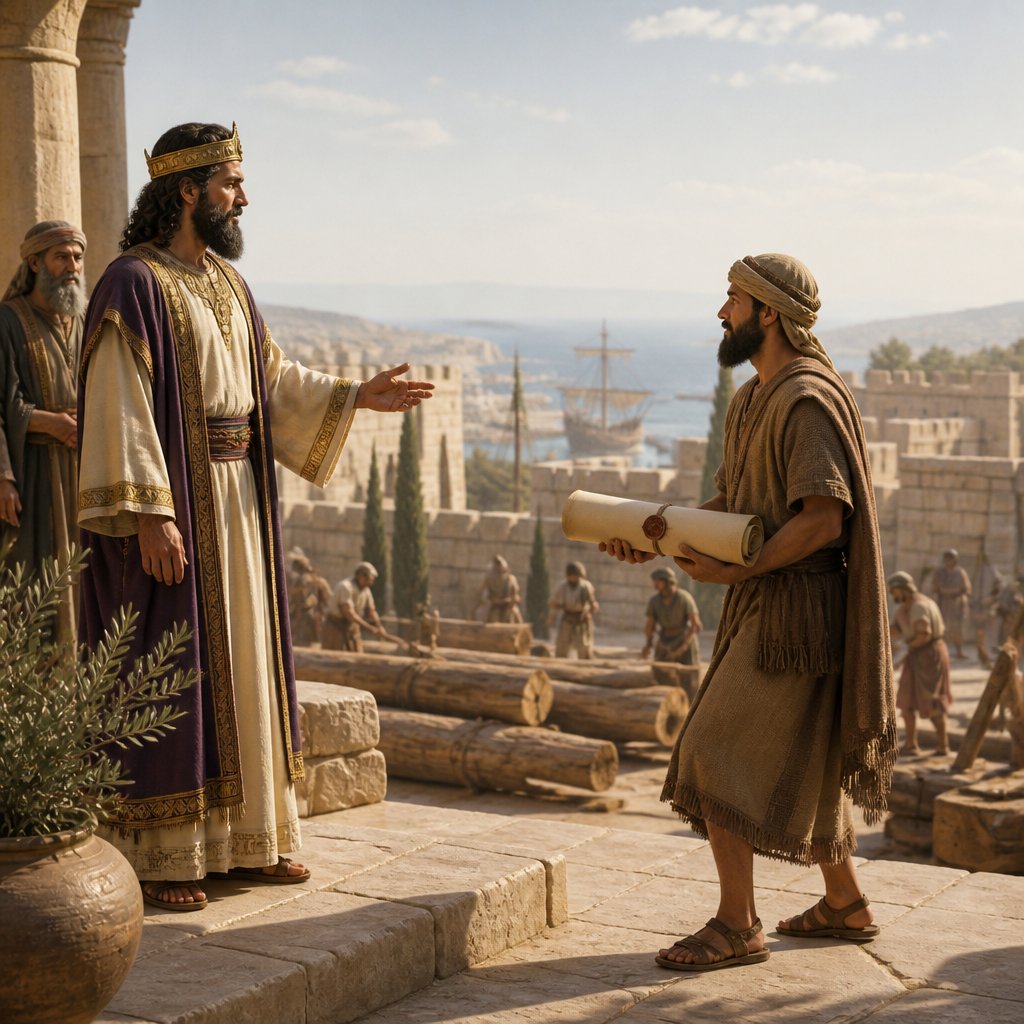
In 2 Chronicles 2:3, we read Solomon's heartfelt message to Huram, the king of Tyre: "And Solomon sent to Huram the king of Tyre, saying, As thou didst deal with David my father, and didst send him cedars to build him an house to dwell therein, even so deal with me." This verse highlights not only the practical request of Solomon for materials to build the Temple but also the profound underlying themes of legacy, collaboration, and the divine purpose behind monumental achievements.
**Understanding Solomon’s Request**
Solomon's request to Huram resonates deeply with the essence of leadership. It reflects Solomon’s awareness of the weighty task at hand—building a temple worthy of the God of Israel. Solomon recognizes the significance of continuity; he reaches back to the assistance that his father received from Huram, showing an understanding of the importance of alliances in accomplishing great tasks.
In our own lives, the forces of collaboration and unity are as relevant today as they were in ancient times. No monumental endeavor is truly accomplished in isolation. Just as Solomon turned to Huram, seeking his support and the resources of Tyre, so too are we called to reach out to those around us, embracing community and seeking collective strength in our ambitions.
**Legacy and Learning**
Solomon's reference to his father, David, is a reminder of the legacies we inherit and the legacies we leave behind. David was a man after God's own heart, and Solomon, as his son and successor, is a testament to the values imparted through generations.
This passage invites us to reflect on the spiritual and moral legacies in our lives. What principles have been passed down to us? How can we build on those principles to serve those who come after us? In our families, churches, and communities, we participate in a continuous cycle of legacy building—what we learn and build today will shape the future. Solomon's acknowledgment of his father's relationships reminds us to honor those who have paved the way for us, by continuing their work with integrity and commitment.
**A Model for Our Requests**
When we look closely, Solomon’s way of approaching Huram is remarkably respectful and humble. He did not assume cooperation; rather, he asked for it. In our relationships, whether in leadership roles or personal spheres, humility and appreciation can foster stronger bonds. This reminds us to approach our requests to others with respect, acknowledging the past contributions of those we seek help from.
Furthermore, Solomon’s strategy shows the importance of being specific and clear in our requests. In our prayers and interactions, are we specific about what we need from God or others? This verse encourages us to articulate our needs while building upon the foundations laid by those who came before us—a thoughtful and respectful outreach can bring surprising results.
**Divine Purpose in Our Endeavors**
Lastly, let us not overlook the divine aspect of Solomon’s endeavor. He knew that building the Temple was not just a matter of wood and stone; it was a sacred task destined to be a dwelling place for the presence of God. Every time we embark on a significant task, whether it be in our careers, church, or community, we should remember that our work has a divine purpose. It’s not merely the end product but how we honor God throughout the process that matters most.
In summary, 2 Chronicles 2:3 teaches us profound lessons about legacy, collaboration, humility, and divine purpose. As we engage in our own building projects—whether they be physical, relational, or spiritual—let us approach them with the heart of Solomon, honoring those who have come before us, seeking help with respect, and always remembering that our greatest endeavors should reflect the glory of our God.
Want to reflect more on 2 Chronicles 2:3?
Continue your spiritual journey with Bible Chat — an AI-powered tool for exploring God's Word through conversation. Ask questions, discover connections, and deepen your understanding.
Get Our Apps


2 Chronicles 2:3 Artwork

2 Chronicles 2:3 - "¶ And Solomon sent to Huram the king of Tyre, saying, As thou didst deal with David my father, and didst send him cedars to build him an house to dwell therein, even so deal with me."
"¶ And Solomon sent to Huram the king of Tyre, saying, As thou didst deal with David my father, and didst send him cedars to build him an house to dwell therein, even so deal with me." - 2 Chronicles 2:3

2 Chronicles 28:3

2 Chronicles 3:2 - "And he began to build in the second day of the second month, in the fourth year of his reign."

2 Chronicles 8:3 - "And Solomon went to Hamath-zobah, and prevailed against it."

2 Chronicles 3:6 - "And he garnished the house with precious stones for beauty: and the gold was gold of Parvaim."

2 Chronicles 24:3 - "And Jehoiada took for him two wives; and he begat sons and daughters."

2 Chronicles 3:9 - "And the weight of the nails was fifty shekels of gold. And he overlaid the upper chambers with gold."

2 Chronicles 27:3 - "He built the high gate of the house of the LORD, and on the wall of Ophel he built much."

2 Chronicles 10:3 - "And they sent and called him. So Jeroboam and all Israel came and spake to Rehoboam, saying,"

2 Chronicles 9:3 - "And when the queen of Sheba had seen the wisdom of Solomon, and the house that he had built,"

2 Chronicles 3:14 - "¶ And he made the vail of blue, and purple, and crimson, and fine linen, and wrought cherubims thereon."

2 Chronicles 20:3 - "And Jehoshaphat feared, and set himself to seek the LORD, and proclaimed a fast throughout all Judah."

2 Chronicles 5:3 - "Wherefore all the men of Israel assembled themselves unto the king in the feast which was in the seventh month."

2 Chronicles 11:3 - "Speak unto Rehoboam the son of Solomon, king of Judah, and to all Israel in Judah and Benjamin, saying,"

2 Chronicles 3:3 - "¶ Now these are the things wherein Solomon was instructed for the building of the house of God. The length by cubits after the first measure was threescore cubits, and the breadth twenty cubits."

1 Chronicles 3:2 - "The third, Absalom the son of Maachah the daughter of Talmai king of Geshur: the fourth, Adonijah the son of Haggith:"

2 Chronicles 6:3 - "And the king turned his face, and blessed the whole congregation of Israel: and all the congregation of Israel stood."

2 Chronicles 3:13 - "The wings of these cherubims spread themselves forth twenty cubits: and they stood on their feet, and their faces were inward."

2 Chronicles 22:3 - "He also walked in the ways of the house of Ahab: for his mother was his counsellor to do wickedly."

2 Chronicles 3:10 - "And in the most holy house he made two cherubims of image work, and overlaid them with gold."

2 Chronicles 36:3 - "And the king of Egypt put him down at Jerusalem, and condemned the land in an hundred talents of silver and a talent of gold."

2 Chronicles 17:3 - "And the LORD was with Jehoshaphat, because he walked in the first ways of his father David, and sought not unto Baalim;"

2 Chronicles 29:3 - "¶ He in the first year of his reign, in the first month, opened the doors of the house of the LORD, and repaired them."

2 Chronicles 15:3 - "Now for a long season Israel hath been without the true God, and without a teaching priest, and without law."

2 Chronicles 3:16 - "And he made chains, as in the oracle, and put them on the heads of the pillars; and made an hundred pomegranates, and put them on the chains."

2 Chronicles 3:7 - "He overlaid also the house, the beams, the posts, and the walls thereof, and the doors thereof, with gold; and graved cherubims on the walls."

2 Chronicles 14:3 - "For he took away the altars of the strange gods, and the high places, and brake down the images, and cut down the groves:"

"And he began to build in the second day of the second month, in the fourth year of his reign." - 2 Chronicles 3:2

2 Chronicles 30:3 - "For they could not keep it at that time, because the priests had not sanctified themselves sufficiently, neither had the people gathered themselves together to Jerusalem."