The Cost of Compromise: A Devotional on 2 Chronicles 28:25
"And in every several city of Judah he made high places to burn incense unto other gods, and provoked to anger the LORD God of his fathers." - 2 Chronicles 28:25
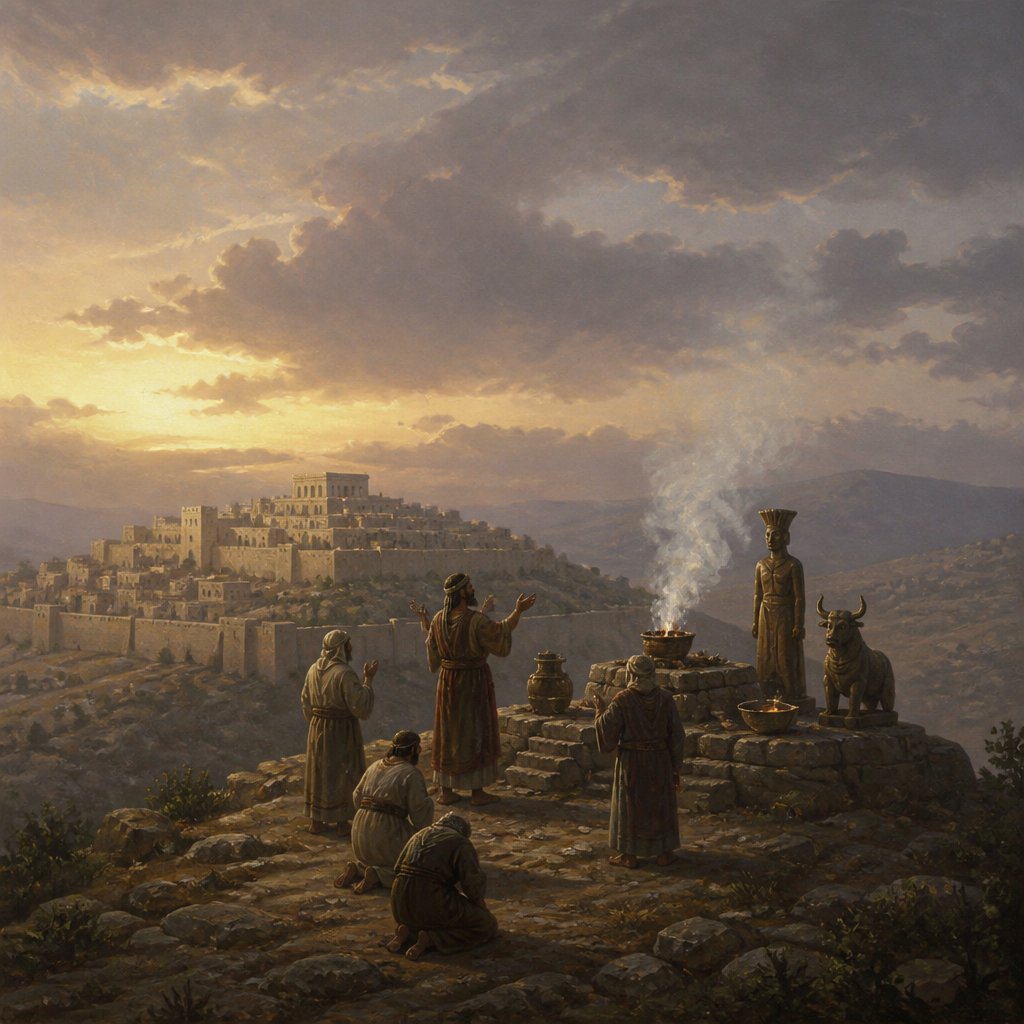
In the rich tapestry of biblical history, the reign of King Ahaz stands out as a poignant reminder of the consequences of turning away from God. Our focal verse, 2 Chronicles 28:25, states, "And in every several city of Judah he made high places to burn incense unto other gods, and provoked to anger the LORD God of his fathers." This verse encapsulates a critical moment in the life of a king who chose to align himself with the practices of the nations surrounding him, thus provoking the very wrath of the God who had revealed Himself to his forefathers.
Ahaz, the king of Judah, faced immense pressures as he ruled amidst enemies and instability. His choice to construct high places for idol worship reflects a desperate attempt to seek favor from foreign gods, perhaps as a misguided strategy to ensure his safety and prosperity. However, in this pivotal action, Ahaz failed to recognize the profound covenant that his ancestors had established with the Lord, one founded on faithfulness and obedience. His actions serve as a warning to us about the dangers of straying from the path ordained by God for short-term gains.
Even today, we find ourselves at a crossroads in a culture that often promotes the worship of modern idols—whether it be materialism, power, or personal aspirations. Ahaz’s transformation of Judah into a land of idol worship dismisses the historical relationship Judah had with God, expressing a blatant disregard for the divine heritage entrusted to him. As we reflect on this passage, we must ask ourselves: what are the ‘high places’ our society constructs?
Worship in ancient Israel was integral to the community's identity and spirituality. To burn incense at high places was more than a ceremonial act; it was a declaration of allegiance to foreign gods and a rejection of the one true God. Each high place erected by Ahaz symbolized not just a physical structure, but a spiritual compromise. Today, are we not guilty of erecting our own high places? Are there practices or beliefs that we give precedence over our commitment to God? The world offers countless distractions and false promises, often leading us astray from righteous living.
Ahaz’s actions provoked the Lord to anger, resulting in a deteriorated relationship between the people of Judah and their God. This reflects a key principle in our relationship with God—He is not indifferent to our choices. When we violate our covenants with Him, the repercussions can be severe. The anger of God is not like human anger; it embodies justice and the sorrow of a Father whose children choose to abandon Him for superficial gratifications. As our spiritual leader, Ahaz had a responsibility not just to rule, but to guide his people into deeper commitment with their God.
The truth we must internalize from Ahaz's narrative is the importance of seeking God with undivided hearts. In James 4:4, we are reminded that "the friendship of the world is enmity with God." Compromise can lead to a slow fade in our relationship with God, and every high place we build creates a distance between us and His divine presence. If we allow the allure of other gods to capture our hearts, we too risk provoking God unto anger.
To conclude, let us take a moment to reflect on our own lives. Are there high places we've constructed in our hearts or our communities? Let us actively seek to tear down these altars to modern idols and restore our devotion to God. We must foster an environment of worship that honors Him alone, not just as individuals but as a unified body of believers. The legacy we choose to leave, like that of our forefathers, should be one marked by faithfulness, drawing nearer to God rather than provoking Him to anger. In these choices, we find not just accountability but the grace that restores us to Him when we seek forgiveness and turn back to our true source of strength.
Want to reflect more on 2 Chronicles 28:25?
Continue your spiritual journey with Bible Chat — an AI-powered tool for exploring God's Word through conversation. Ask questions, discover connections, and deepen your understanding.
Get Our Apps


2 Chronicles 28:25 Artwork

2 Chronicles 28:25 - "And in every several city of Judah he made high places to burn incense unto other gods, and provoked to anger the LORD God of his fathers."
"And in every several city of Judah he made high places to burn incense unto other gods, and provoked to anger the LORD God of his fathers." - 2 Chronicles 28:25

2 Chronicles 25:28 - "And they brought him upon horses, and buried him with his fathers in the city of Judah."

"And they brought him upon horses, and buried him with his fathers in the city of Judah." - 2 Chronicles 25:28

1 Chronicles 25:28 - "The one and twentieth to Hothir, he, his sons, and his brethren, were twelve:"

2 Chronicles 28:3

2 Chronicles 20:28

2 Chronicles 25:2 - "And he did that which was right in the sight of the LORD, but not with a perfect heart."

2 Chronicles 28:2 - "For he walked in the ways of the kings of Israel, and made also molten images for Baalim."

2 Chronicles 25:25 - "¶ And Amaziah the son of Joash king of Judah lived after the death of Joash son of Jehoahaz king of Israel fifteen years."

2 Chronicles 20:28 - "And they came to Jerusalem with psalteries and harps and trumpets unto the house of the LORD."

2 Chronicles 9:28 - "And they brought unto Solomon horses out of Egypt, and out of all lands."

1 Chronicles 2:28 - "And the sons of Onam were, Shammai, and Jada. And the sons of Shammai; Nadab, and Abishur."

2 Chronicles 28:17 - "For again the Edomites had come and smitten Judah, and carried away captives."

2 Chronicles 28:14 - "So the armed men left the captives and the spoil before the princes and all the congregation."

2 Chronicles 18:28 - "So the king of Israel and Jehoshaphat the king of Judah went up to Ramoth-gilead."

2 Chronicles 28:16 - "¶ At that time did king Ahaz send unto the kings of Assyria to help him."

2 Kings 25:28 - "And he spake kindly to him, and set his throne above the throne of the kings that were with him in Babylon;"

"The one and twentieth to Hothir, he, his sons, and his brethren, were twelve:" - 1 Chronicles 25:28

2 Chronicles 28:20 - "And Tilgath-pilneser king of Assyria came unto him, and distressed him, but strengthened him not."

2 Chronicles 25:22 - "And Judah was put to the worse before Israel, and they fled every man to his tent."

2 Chronicles 28:22 - "¶ And in the time of his distress did he trespass yet more against the LORD: this is that king Ahaz."

2 Chronicles 28:4 - "He sacrificed also and burnt incense in the high places, and on the hills, and under every green tree."

2 Kings 23:28 - "Now the rest of the acts of Josiah, and all that he did, are they not written in the book of the chronicles of the kings of Judah?"

2 Chronicles 32:28 - "Storehouses also for the increase of corn, and wine, and oil; and stalls for all manner of beasts, and cotes for flocks."

1 Chronicles 2:25 - "¶ And the sons of Jerahmeel the firstborn of Hezron were, Ram the firstborn, and Bunah, and Oren, and Ozem, and Ahijah."

2 Chronicles 29:28 - "And all the congregation worshipped, and the singers sang, and the trumpeters sounded: and all this continued until the burnt offering was finished."

2 Chronicles 25:26 - "Now the rest of the acts of Amaziah, first and last, behold, are they not written in the book of the kings of Judah and Israel?"

2 Kings 21:25 - "Now the rest of the acts of Amon which he did, are they not written in the book of the chronicles of the kings of Judah?"

2 Chronicles 28:7 - "And Zichri, a mighty man of Ephraim, slew Maaseiah the king's son, and Azrikam the governor of the house, and Elkanah that was next to the king."