The Weight of Love: Lessons from Rehoboam and Maachah
"And Rehoboam loved Maachah the daughter of Absalom above all his wives and his concubines: (for he took eighteen wives, and threescore concubines; and begat twenty and eight sons, and threescore daughters.)" - 2 Chronicles 11:21
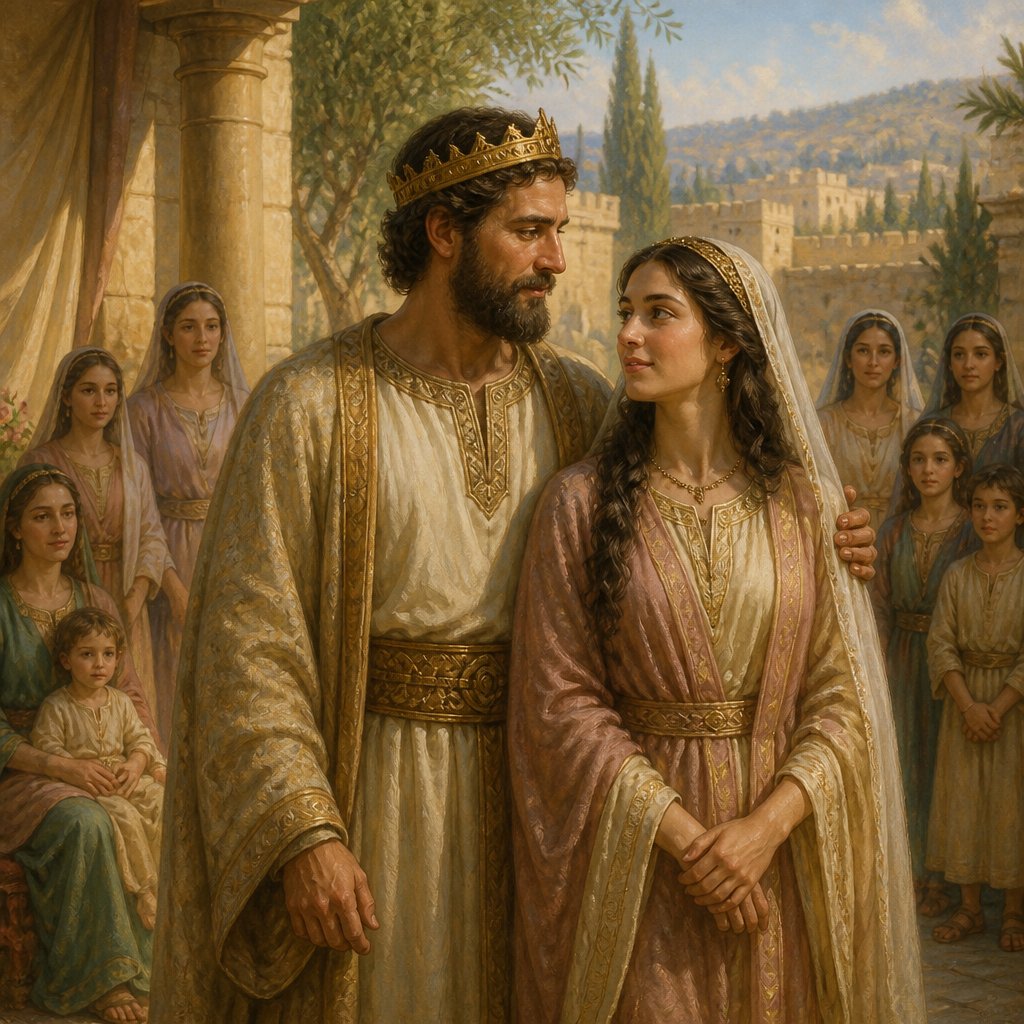
As we delve into the life of Rehoboam, the son of Solomon, we encounter a verse that unfurls the complex tapestry of love, relationships, and the consequences of our choices. 2 Chronicles 11:21 provides not only a glimpse into Rehoboam's family life but also reflects deeper themes of loyalty and priority in our allegiances.
The verse states, "And Rehoboam loved Maachah the daughter of Absalom above all his wives and his concubines: (for he took eighteen wives, and threescore concubines; and begat twenty and eight sons, and threescore daughters.)" This simple recounting reveals much about the man and the king, serving as a fertile ground for reflection.
Rehoboam's love for Maachah raises significant questions. What does it mean to truly love someone? In his case, we see a man who had many relationships yet chose to prioritize one above all others. The Bible tells us he had eighteen wives and sixty concubines—relationships that suggest a lifestyle of indulgence, power, and perhaps instability. In this context, Maachah stood out not only as a singled-out affection but also as a beacon of significance amidst a sea of choices. Could we reflect upon our lives and ask ourselves: Who or what do we love above all? Are those priorities guiding our actions and decisions towards righteousness and purpose?
It's crucial to recognize that love, as presented here, is an action-laden commitment. Despite having many wives and concubines, Rehoboam's love for Maachah indicates that what we truly love will invariably shape our lives and govern our decisions. This echoes the biblical principle found in Matthew 6:21—"For where your treasure is, there will your heart be also." If our heart's treasure is misplaced, we risk chaos and division in our lives.
Rehoboam's love for Maachah also signifies the fallout of favoritism. Throughout the Scriptures, we witness instances where favoritism breeds jealousy and unrest—consider Jacob and Esau, or even Isaac and Rebekah with their sons. Rehoboam, arguably, had his relational priorities skewed, which might lead to detrimental effects on his family dynamics, likely stirring friction among his many children and those wives not favored. As a leader and king, he needed to be a unifier, guiding his family towards harmony rather than division.
Furthermore, it is important to observe the heritage upon which Rehoboam existed. Maachah was the daughter of Absalom, whose legacy was marked by rebellion against King David, Rehoboam's grandfather. Loving Maachah may not have just been a personal affection but could symbolize a connection to a heritage filled with conflict and discontent. Rehoboam, unknowingly, may have invited the struggle encapsulated in Absalom's legacy into his own reign. How often do we find ourselves caught in the cycles of our backgrounds, our families, or our relationships that steer our choices toward the same patterns of failure and conflict?
In our daily lives, we too must keep vigilant watch over whom we cherish and how we express our love. Our affections must not only uplift us personally but must also lead us toward constructive outcomes. Are we placing our marital relationships or friendships in high regard? Is our love marked by loyalty and mutual respect? These reflections necessitate deep introspection as we seek to avoid the pitfalls that come with misplaced love and priorities.
In closing, let Rehoboam's affection for Maachah prompt each of us to reflect on our own affections. May we strive to devote our love to those who uplift, support, and challenge us in our walk with God. Let us also seek to build relationships not steeped in division but in unity, seeking wisdom to navigate our priorities with grace and purpose, honoring the true relationships God has placed in our lives.
Want to reflect more on 2 Chronicles 11:21?
Continue your spiritual journey with Bible Chat — an AI-powered tool for exploring God's Word through conversation. Ask questions, discover connections, and deepen your understanding.
Get Our Apps


2 Chronicles 11:21 Artwork

2 Chronicles 11:21 - "And Rehoboam loved Maachah the daughter of Absalom above all his wives and his concubines: (for he took eighteen wives, and threescore concubines; and begat twenty and eight sons, and threescore daughters.)"
"And Rehoboam loved Maachah the daughter of Absalom above all his wives and his concubines: (for he took eighteen wives, and threescore concubines; and begat twenty and eight sons, and threescore daughters.)" - 2 Chronicles 11:21

2 Chronicles 21:11 - "Moreover he made high places in the mountains of Judah, and caused the inhabitants of Jerusalem to commit fornication, and compelled Judah thereto."

2 Chronicles 20:21

2 Chronicles 21:9

2 Chronicles 11:20

1 Chronicles 21:11 - "So Gad came to David, and said unto him, Thus saith the LORD, Choose thee"

1 Chronicles 11:21 - "Of the three, he was more honourable than the two; for he was their captain: howbeit he attained not to the first three."

2 Chronicles 35:11

2 Chronicles 11:2 - "But the word of the LORD came to Shemaiah the man of God, saying,"

2 Chronicles 11:8 - "And Gath, and Mareshah, and Ziph,"

2 Chronicles 11:9 - "And Adoraim, and Lachish, and Azekah,"

2 Chronicles 11:7 - "And Beth-zur, and Shoco, and Adullam,"

2 Chronicles 11:11 - "And he fortified the strong holds, and put captains in them, and store of victual, and of oil and wine."

2 Chronicles 4:21 - "And the flowers, and the lamps, and the tongs, made he of gold, and that perfect gold;"

"Moreover he made high places in the mountains of Judah, and caused the inhabitants of Jerusalem to commit fornication, and compelled Judah thereto." - 2 Chronicles 21:11

2 Chronicles 21:18 - "¶ And after all this the LORD smote him in his bowels with an incurable disease."

1 Chronicles 2:11 - "And Nahshon begat Salma, and Salma begat Boaz,"

2 Chronicles 11:19 - "Which bare him children; Jeush, and Shamariah, and Zaham."

2 Chronicles 11:5 - "¶ And Rehoboam dwelt in Jerusalem, and built cities for defence in Judah."

2 Chronicles 11:6 - "He built even Beth-lehem, and Etam, and Tekoa,"

2 Kings 15:21 - "¶ And the rest of the acts of Menahem, and all that he did, are they not written in the book of the chronicles of the kings of Israel?"

2 Chronicles 24:21 - "And they conspired against him, and stoned him with stones at the commandment of the king in the court of the house of the LORD."

2 Chronicles 23:21 - "And all the people of the land rejoiced: and the city was quiet, after that they had slain Athaliah with the sword."

2 Chronicles 21:8 - "¶ In his days the Edomites revolted from under the dominion of Judah, and made themselves a king."

2 Kings 11:21 - "Seven years old was Jehoash when he began to reign."

2 Chronicles 21:2 - "And he had brethren the sons of Jehoshaphat, Azariah, and Jehiel, and Zechariah, and Azariah, and Michael, and Shephatiah: all these were the sons of Jehoshaphat king of Israel."

2 Chronicles 31:11 - "¶ Then Hezekiah commanded to prepare chambers in the house of the LORD; and they prepared them,"

2 Chronicles 11:10 - "And Zorah, and Aijalon, and Hebron, which are in Judah and in Benjamin fenced cities."

2 Chronicles 13:21 - "¶ But Abijah waxed mighty, and married fourteen wives, and begat twenty and two sons, and sixteen daughters."