The Weight of Kingship: Lessons from 1 Samuel 8:12
"And he will appoint him captains over thousands, and captains over fifties; and will set them to ear his ground, and to reap his harvest, and to make his instruments of war, and instruments of his chariots." - 1 Samuel 8:12
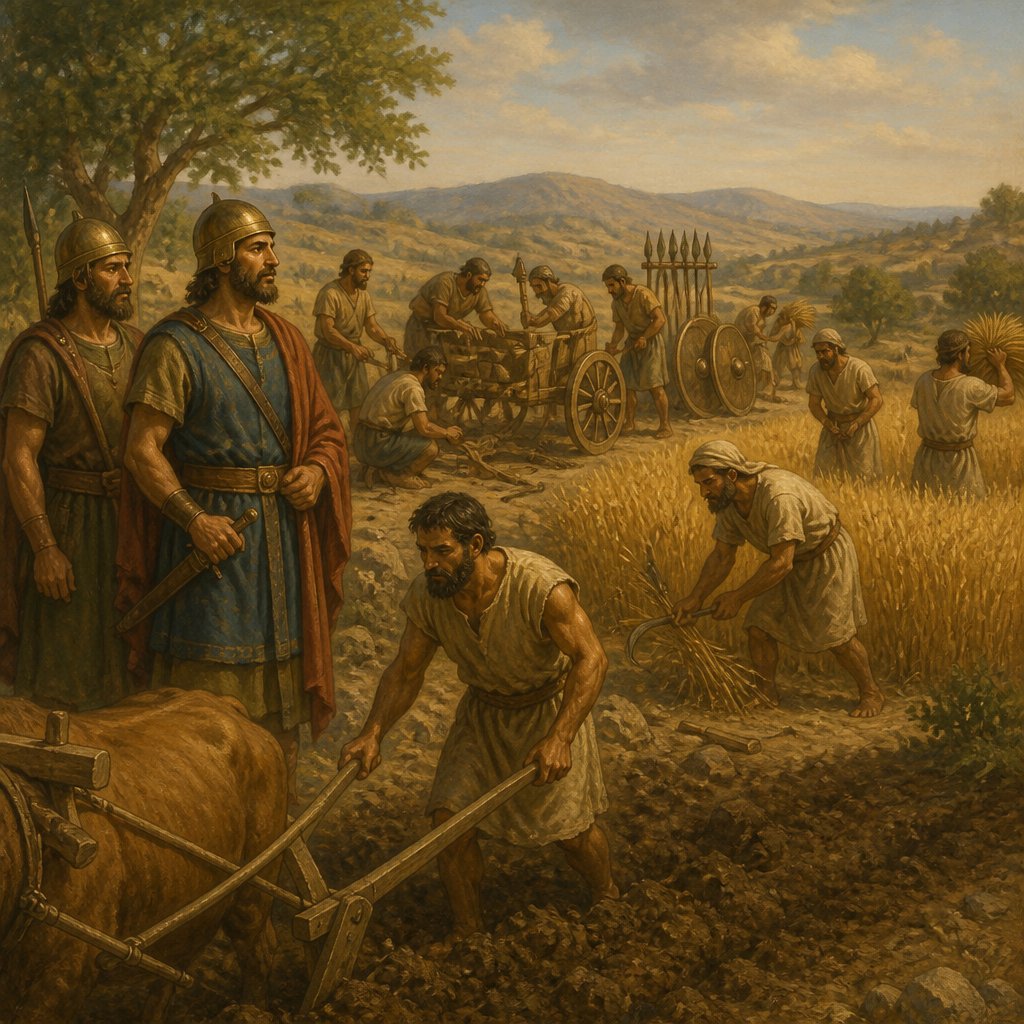
In the ancient narrative of Israel's transition from theocracy to monarchy, 1 Samuel 8:12 presents a profound glimpse into the dynamics of human governance and divine sovereignty. The verse reads: "And he will appoint him captains over thousands, and captains over fifties; and will set them to ear his ground, and to reap his harvest, and to make his instruments of war, and instruments of his chariots." This declaration marks a pivotal moment in the history of Israel, where the people’s desire for a king—a desire born out of fear and a yearning for worldly security—comes to fruition.
When the Israelites requested a king, they were expressing their dissatisfaction with God’s established leadership through judges. Though God had been their ultimate king, they longed for the visible security of a human ruler, one who could lead them into battle and ensure their safety against formidable foes. However, in doing so, they gravitated towards the tangible and the familiar, placing their trust in the wisdom of men rather than the omnipotent guidance of God Himself.
In 1 Samuel 8:12, we witness the ramifications of their choice. The reference to captains over thousands and fifties illustrates the structured hierarchy that comes with human leadership. While structure and organization are essential for any community, the warning embedded in this structure is that it often leads to increased burdens on the people. The appointed leaders may administer power, but they also become agents of the king's desires, whose primary focus might be expansion and warfare rather than the well-being of the citizens.
The tasks they are assigned—"to ear his ground, and to reap his harvest, and to make his instruments of war"—reflect a king’s need for resources and control, showcasing that the people’s labor and produce would predominantly serve the interests of the throne. Herein lies a profound spiritual lesson: when we seek human leadership above divine guidance, we risk becoming mere instruments of human ambition.
The contrast between the divine hierarchy and the human system also speaks volumes about our own lives. In seeking worldly solutions to our problems, do we often find ourselves laboring for goals that do not align with God’s will? Are our efforts spent harvesting fruits that do not nourish our souls? This passage invites us to reflect on whom we are ultimately serving in our everyday lives. Is our work contributing to the Kingdom of God or just to the worldly systems that vie for our attention?
Moreover, the necessity of "instruments of war, and instruments of his chariots" symbolizes the heavy cost of security when we place our faith in human strength. Wars often necessitate sacrifices, and this is no different when we fortify ourselves with human authority instead of spiritual truth. By aligning with a king who perceives strength through military prowess, the Israelites inevitably chose a path of conflict rather than one of peace—a choice that symbolizes the ongoing struggle between reliance on human ability versus divine providence.
As believers in a contemporary context, we too must wrestle with the allure of external security offered by modern 'kings'—be they financial stability, societal recognition, or political influence. This scripture encourages us to remember that true leadership and security come from surrendering our ambitions and concerns to the Lord. He is the ultimate King who desires to reign in our hearts, bestowing true peace that surpasses all understanding. In Jesus, we find the shepherd who lays down His life for His sheep, contrasting sharply with the demands that worldly rulers often place upon their followers.
In conclusion, 1 Samuel 8:12 challenges us to evaluate who we elevate as leaders in our lives and what systems of governance or values we align ourselves with. Are we serving a God who liberates, or a king who demands? As we commit our lives to Christ, let us seek His kingship, reminding ourselves that in partnership with Him, our harvest will not be for a mere human agenda but for the eternal glory of God’s Kingdom.
Want to reflect more on 1 Samuel 8:12?
Continue your spiritual journey with Bible Chat — an AI-powered tool for exploring God's Word through conversation. Ask questions, discover connections, and deepen your understanding.
Get Our Apps


1 Samuel 8:12 Artwork

1 Samuel 8:12 - "And he will appoint him captains over thousands, and captains over fifties; and will set them to ear his ground, and to reap his harvest, and to make his instruments of war, and instruments of his chariots."
"And he will appoint him captains over thousands, and captains over fifties; and will set them to ear his ground, and to reap his harvest, and to make his instruments of war, and instruments of his chariots." - 1 Samuel 8:12

1 Samuel 8:7

1 Samuel 12:8 - "When Jacob was come into Egypt, and your fathers cried unto the LORD, then the LORD sent Moses and Aaron, which brought forth your fathers out of Egypt, and made them dwell in this place."

1 Samuel 12

1 Samuel 4:12

1 Samuel 8:1 - "And it came to pass, when Samuel was old, that he made his sons judges over Israel."

2 Samuel 8:12 - "Of Syria, and of Moab, and of the children of Ammon, and of the Philistines, and of Amalek, and of the spoil of Hadadezer, son of Rehob, king of Zobah."

1 Samuel 2:12

1 Samuel 12:13

1 Samuel 12:13

1 Samuel 8:6 - "¶ But the thing displeased Samuel, when they said, Give us a king to judge us. And Samuel prayed unto the LORD."

1 Samuel 8:21 - "And Samuel heard all the words of the people, and he rehearsed them in the ears of the LORD."

1 Samuel 8:10 - "¶ And Samuel told all the words of the LORD unto the people that asked of him a king."

1 Samuel 8:4 - "Then all the elders of Israel gathered themselves together, and came to Samuel unto Ramah,"

1 Samuel 12:18 - "So Samuel called unto the LORD; and the LORD sent thunder and rain that day: and all the people greatly feared the LORD and Samuel."

1 Samuel 13:8 - "¶ And he tarried seven days, according to the set time that Samuel had appointed: but Samuel came not to Gilgal; and the people were scattered from him."

1 Samuel 8:19 - "¶ Nevertheless the people refused to obey the voice of Samuel; and they said, Nay; but we will have a king over us;"

1 Samuel 16:8 - "Then Jesse called Abinadab, and made him pass before Samuel. And he said, Neither hath the LORD chosen this."

1 Samuel 12:6 - "¶ And Samuel said unto the people, It is the LORD that advanced Moses and Aaron, and that brought your fathers up out of the land of Egypt."

1 Samuel 13:12 Saul's disobedience

1 Samuel 13:12 No face of persons

1 Samuel 1:12 - "And it came to pass, as she continued praying before the LORD, that Eli marked her mouth."

1 Samuel 12:1 - "And Samuel said unto all Israel, Behold, I have hearkened unto your voice in all that ye said unto me, and have made a king over you."

1 Samuel 8:22 - "And the LORD said to Samuel, Hearken unto their voice, and make them a king. And Samuel said unto the men of Israel, Go ye every man unto his city."

1 Samuel 18:12 - "¶ And Saul was afraid of David, because the LORD was with him, and was departed from Saul."
Leviticus 8:1-12

ecclesiastes 12:1-8

1 chronicles 12:8

1 Samuel 15:12 - "And when Samuel rose early to meet Saul in the morning, it was told Samuel, saying, Saul came to Carmel, and, behold, he set him up a place, and is gone about, and passed on, and gone down to Gilgal."