The Power of Humility and Intercession
"And fell at his feet, and said, Upon me, my lord, upon me let this iniquity be: and let thine handmaid, I pray thee, speak in thine audience, and hear the words of thine handmaid." - 1 Samuel 25:24
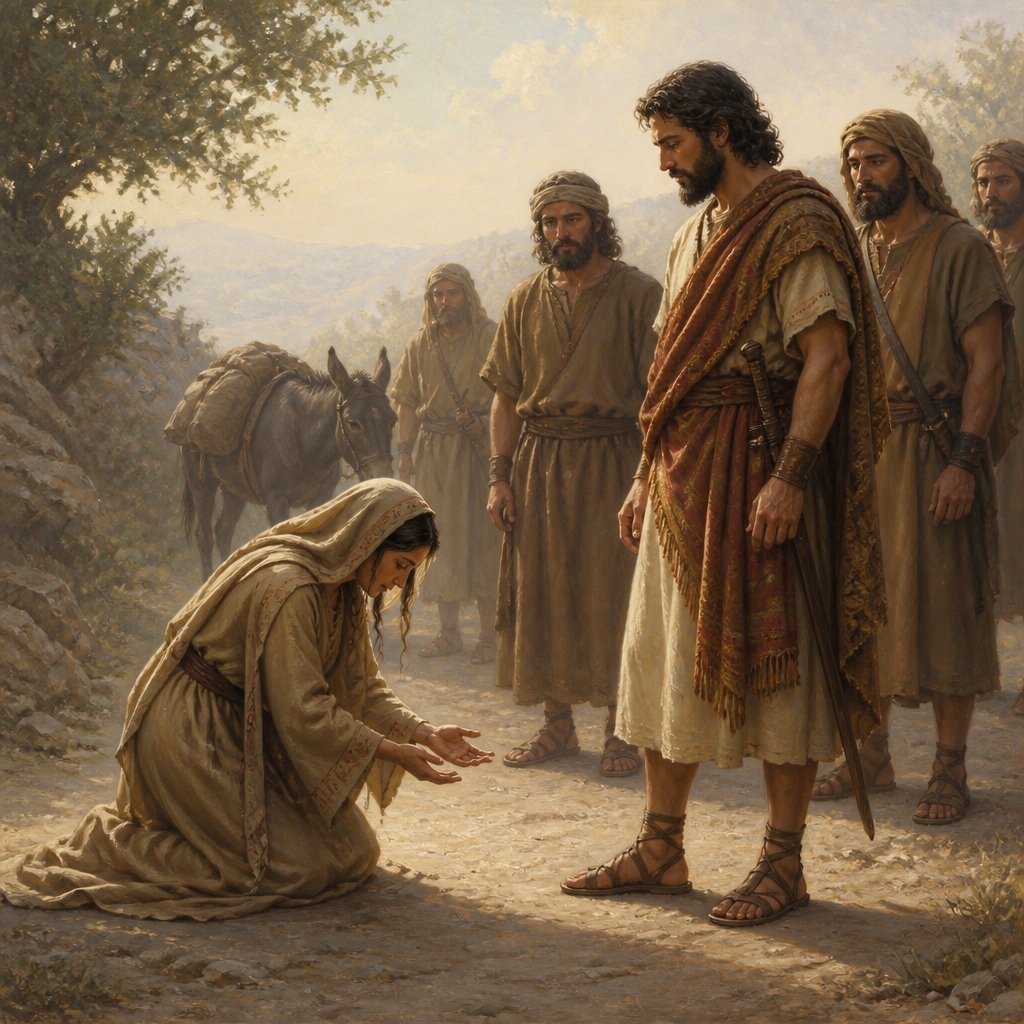
In the narrative of 1 Samuel 25, we encounter a powerful moment of humility and intercession through the character of Abigail. The backdrop of this encounter is laden with tension, as David, the anointed king of Israel, is faced with insult and affront by Nabal, a wealthy but foolish man. Nabal’s disdain for David is an affront not only to a future king but also to the Lord’s anointed. David’s reaction is understandably one of anger, prompting him to rally his men to seek revenge against Nabal. But in the midst of this escalation, Abigail steps in and changes the course of events with her actions and words.
The verse we focus on, “And fell at his feet, and said, Upon me, my lord, upon me let this iniquity be: and let thine handmaid, I pray thee, speak in thine audience, and hear the words of thine handmaid,” (1 Samuel 25:24, KJV) embodies deep humility and a willingness to bear the burdens of another. Abigail’s approach to David is marked by an acute awareness of her position relative to him and an understanding of the gravity of the situation.
Abigail’s first act of courage is falling at David’s feet. This physical posture signifies her submission, respect, and recognition of David’s authority. It serves as a poignant reminder of how we must approach God and others—with reverence and an open heart. In a culture that often values assertiveness and self-promotion, Abigail’s humble approach is a counter-cultural act of faith. She does not come demanding justice or favor; rather, she pleads for understanding and mercy. This humility is further exemplified when she accepts the iniquity of her household upon herself. It reflects a profound understanding of the interconnectedness of community and the responsibility we bear for one another.
In her plea, Abigail speaks not only for herself but as a voice for her household, embodying the spirit of intercession. This act is a call for us to intercede on behalf of others, bearing their burdens and standing in the gap. By saying, "Upon me, my lord, upon me let this iniquity be,” Abigail accepts the weight of her husband’s foolishness and seeks to mitigate the consequences of his actions. There is power in taking responsibility—even for actions not directly our own. In our own lives, we are often called to bear the burdens of others, to advocate for those who cannot advocate for themselves.
As Abigail continues her entreaty, she presents a wise and eloquent argument that highlights David’s identity and the larger plan of God. She reminds him of his destiny and the importance of maintaining his integrity as the future king. This is a strategic yet loving confrontation that gently redirects David's anger and foreshadows his rightful place in God's plan. Abigail’s wisdom speaks to us about the way we engage in conflict resolution; often, it is not just about addressing the issue but also encouraging righteousness and purpose.
Moreover, Abigail’s actions reveal that God often places humble individuals in critical positions to achieve His purposes. Though she was not the one in authority, her courage, wisdom, and humility transformed the situation from one of potential bloodshed to one of reconciliation and peace. She becomes a catalyst for David to act according to his better nature rather than succumbing to anger and revenge.
In our prayer lives, we should strive to emulate Abigail’s spirit of intercession. When faced with conflict or when witnessing the folly of others, let us take the posture of humility, fall at the feet of Christ, and advocate for wisdom, mercy, and grace. May we learn to speak words that bring healing and restoration, thus allowing us to play our part in God’s redemptive story.
Let this reflection inspire us to choose humility, to accept responsibility, and to intercede on behalf of others, trusting that God will use our actions for His glory and the good of His people.
Want to reflect more on 1 Samuel 25:24?
Continue your spiritual journey with Bible Chat — an AI-powered tool for exploring God's Word through conversation. Ask questions, discover connections, and deepen your understanding.
Get Our Apps


1 Samuel 25:24 Artwork

1 Samuel 25:24 - "And fell at his feet, and said, Upon me, my lord, upon me let this iniquity be: and let thine handmaid, I pray thee, speak in thine audience, and hear the words of thine handmaid."
"And fell at his feet, and said, Upon me, my lord, upon me let this iniquity be: and let thine handmaid, I pray thee, speak in thine audience, and hear the words of thine handmaid." - 1 Samuel 25:24

1 Peter 1:24-25

1 Samuel 1:25 - "And they slew a bullock, and brought the child to Eli."

2 Samuel 24:22

2 Samuel 24:22

2 Samuel 24:22

2 Samuel 24:25 - "And David built there an altar unto the LORD, and offered burnt offerings and peace offerings. So the LORD was intreated for the land, and the plague was stayed from Israel."

1 Samuel 9:25 - "¶ And when they were come down from the high place into the city, Samuel communed with Saul upon the top of the house."

1 Chronicles 24:25 - "The brother of Michah was Isshiah: of the sons of Isshiah; Zechariah."

1 Samuel 25:1 - "And Samuel died; and all the Israelites were gathered together, and lamented him, and buried him in his house at Ramah. And David arose, and went down to the wilderness of Paran."

1 Samuel 10:25 - "Then Samuel told the people the manner of the kingdom, and wrote it in a book, and laid it up before the LORD. And Samuel sent all the people away, every man to his house."

1 Samuel 14:25 - "And all they of the land came to a wood; and there was honey upon the ground."

1 Samuel 18:24 - "And the servants of Saul told him, saying, On this manner spake David."

1 Samuel 25:4 - "¶ And David heard in the wilderness that Nabal did shear his sheep."

1 Chronicles 25:24 - "The seventeenth to Joshbekashah, he, his sons, and his brethren, were twelve:"

"And they slew a bullock, and brought the child to Eli." - 1 Samuel 1:25

1 Samuel 15:24 - "¶ And Saul said unto Samuel, I have sinned: for I have transgressed the commandment of the LORD, and thy words: because I feared the people, and obeyed their voice."

Nabal becomes like stone in 1 Samuel 25:37

Nabal becomes like stone in 1 Samuel 25:37

1 Samuel 25:43 - "David also took Ahinoam of Jezreel; and they were also both of them his wives."

1 Samuel 25:38 - "And it came to pass about ten days after, that the LORD smote Nabal, that he died."

1 Samuel 30:25 - "And it was so from that day forward, that he made it a statute and an ordinance for Israel unto this day."

1 Samuel 24:1 - "And it came to pass, when Saul was returned from following the Philistines, that it was told him, saying, Behold, David is in the wilderness of En-gedi."

1 Samuel 25:44 - "¶ But Saul had given Michal his daughter, David's wife, to Phalti the son of Laish, which was of Gallim."

1 Samuel 12:25 - "But if ye shall still do wickedly, ye shall be consumed, both ye and your king."

1 Samuel 28:25 - "And she brought it before Saul, and before his servants; and they did eat. Then they rose up, and went away that night."

1 Samuel 25:32 - "¶ And David said to Abigail, Blessed be the LORD God of Israel, which sent thee this day to meet me:"

2 Samuel 1:25 - "How are the mighty fallen in the midst of the battle! O Jonathan, thou wast slain in thine high places."

1 Samuel 2:24 - "Nay, my sons; for it is no good report that I hear: ye make the LORD'S people to transgress."