When Wisdom Meets Folly: Abigail's Response to Nabal
"¶ But one of the young men told Abigail, Nabal's wife, saying, Behold, David sent messengers out of the wilderness to salute our master; and he railed on them." - 1 Samuel 25:14
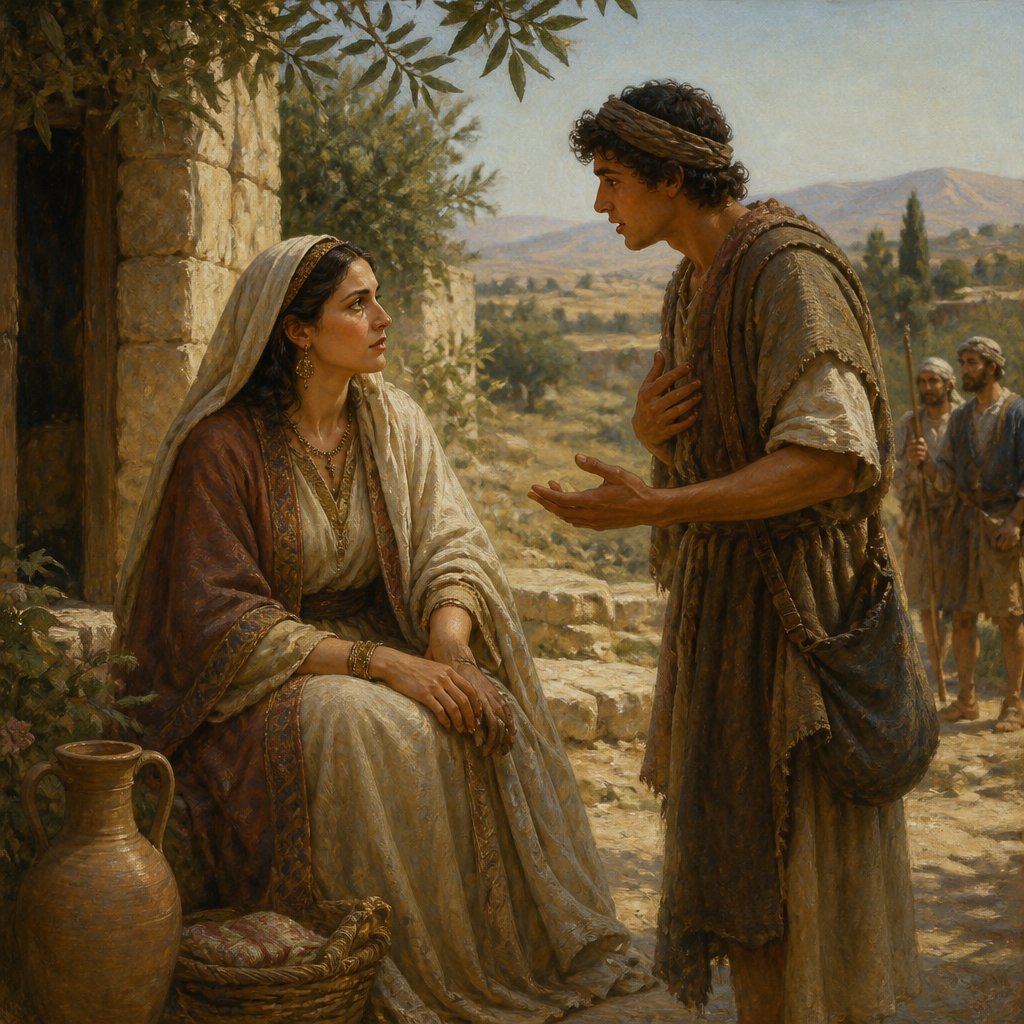
In 1 Samuel 25:14, we encounter a crucial moment not only in the narrative of David but also in the character study of Abigail and her husband, Nabal. The verse states, "But one of the young men told Abigail, Nabal's wife, saying, Behold, David sent messengers out of the wilderness to salute our master; and he railed on them." This brief but potent message encapsulates several themes worth exploring: the nature of wisdom, the peril of foolishness, and the vital role of intercession and timely action.
To set the scene, David, on the run from King Saul, had set his sights on establishing his future kingdom. Despite his dire circumstances, he did not resort to marauding or thievery but instead sought to honor Nabal's household by requesting provisions for his men. David’s request was one rooted in respect; he had protected Nabal’s shepherds by ensuring that they suffered no harm during their time in the wilderness. Yet, Nabal's response—one marked by rudeness and scorn—was a reflection of his character: he "railed" on David's servants, dismissing them with contempt. In stark contrast lies Abigail, Nabal's wife, who becomes the embodiment of wisdom and discernment amidst her husband's folly.
This narrative compels us to reflect on the dynamics of relationships. Abigail finds herself in a precarious position, married to a man whose name aptly means ‘fool.’ Yet, even amid Nabal’s obstinacy, Abigail’s actions reveal the profound truth that one can be surrounded by folly yet rise above it through wisdom and grace. We often encounter ‘Nabal’ types in our lives—people who react out of pride or ignorance, misunderstanding the nature of our requests and who we are. In these moments, God calls us to embody the spirit of Abigail: to listen, to discern, and most importantly, to act wisely instead of retaliating in folly.
Abigail's response to Nabal’s folly is not merely passive; she springs into action. The young man who relays information to her plays a crucial role. His act of sharing the news demonstrates the importance of communication and transparency in relationships. Often, we find ourselves privy to information that, if acted upon wisely, can avert disaster not just for ourselves but for others. Abigail couldn’t have received the news of her husband’s actions without the intervention of this young man. It reminds us of our responsibility to inform and protect one another in our communities.
Abigail’s immediate and strategic response is one of the most admirable aspects of this account. She does not engage in idle gossip or finger-pointing. Instead, she gathers a sizable amount of food and sets out to meet David, seeking to absolve her husband’s recklessness. Abigail’s approach illustrates the power of humility and the art of peace-making. She recognizes the potential for conflict and chooses a path of reconciliation rather than retaliation.
In our lives, how often do we encounter situations that can escalate into crises due to a lack of understanding or miscommunication? Abigail’s story calls us to position ourselves as peacemakers, as stated in Matthew 5:9, "Blessed are the peacemakers: for they shall be called the children of God." It is through our actions, words, and discernment that we can embody the love and grace of God, even in the face of foolishness.
Furthermore, Abigail’s boldness also serves as a lesson in self-advocacy. Though she is in a position subordinate to her husband, she recognizes her ability to act—leading us to consider our own permissions to stand against injustice, speak truth in love, and take steps to ensure righteousness prevails.
It is vital to remember that wisdom is not just a trait; it is a deliberate choice. Abigail teaches us that when faced with adversity, particularly that originating from those close to us, we can choose to respond in strength and truth, governed by wisdom and grace. Let us lean into God's enduring wisdom in our decisions, ensuring that, no matter the folly around us, we are agents of peace, equipped to respond with love and clarity.
Want to reflect more on 1 Samuel 25:14?
Continue your spiritual journey with Bible Chat — an AI-powered tool for exploring God's Word through conversation. Ask questions, discover connections, and deepen your understanding.
Get Our Apps


1 Samuel 25:14 Artwork

1 Samuel 25:14 - "¶ But one of the young men told Abigail, Nabal's wife, saying, Behold, David sent messengers out of the wilderness to salute our master; and he railed on them."
"¶ But one of the young men told Abigail, Nabal's wife, saying, Behold, David sent messengers out of the wilderness to salute our master; and he railed on them." - 1 Samuel 25:14

1 Samuel 14:25 - "And all they of the land came to a wood; and there was honey upon the ground."

"And all they of the land came to a wood; and there was honey upon the ground." - 1 Samuel 14:25

1 Samuel 1:25 - "And they slew a bullock, and brought the child to Eli."

1 Samuel 9:25 - "¶ And when they were come down from the high place into the city, Samuel communed with Saul upon the top of the house."

1 Samuel 14:6

1 Samuel 25:1 - "And Samuel died; and all the Israelites were gathered together, and lamented him, and buried him in his house at Ramah. And David arose, and went down to the wilderness of Paran."

1 Samuel 10:25 - "Then Samuel told the people the manner of the kingdom, and wrote it in a book, and laid it up before the LORD. And Samuel sent all the people away, every man to his house."

1 Samuel 14:27

2 Samuel 6:14

1 Samuel 14:7

1 Samuel 11:14 - "Then said Samuel to the people, Come, and let us go to Gilgal, and renew the kingdom there."

1 Samuel 25:4 - "¶ And David heard in the wilderness that Nabal did shear his sheep."

2 Samuel 14:25 - "¶ But in all Israel there was none to be so much praised as Absalom for his beauty: from the sole of his foot even to the crown of his head there was no blemish in him."

"And they slew a bullock, and brought the child to Eli." - 1 Samuel 1:25

1 Samuel 17:14 - "And David was the youngest: and the three eldest followed Saul."

1 Samuel 15:14 - "And Samuel said, What meaneth then this bleating of the sheep in mine ears, and the lowing of the oxen which I hear?"

Nabal becomes like stone in 1 Samuel 25:37

Nabal becomes like stone in 1 Samuel 25:37

1 Samuel 25:43 - "David also took Ahinoam of Jezreel; and they were also both of them his wives."

1 Samuel 25:38 - "And it came to pass about ten days after, that the LORD smote Nabal, that he died."

1 Samuel 30:25 - "And it was so from that day forward, that he made it a statute and an ordinance for Israel unto this day."

1 Samuel 25:44 - "¶ But Saul had given Michal his daughter, David's wife, to Phalti the son of Laish, which was of Gallim."

1 Samuel 14:51 - "And Kish was the father of Saul; and Ner the father of Abner was the son of Abiel."

1 Samuel 12:25 - "But if ye shall still do wickedly, ye shall be consumed, both ye and your king."

1 Chronicles 25:14 - "The seventh to Jesharelah, he, his sons, and his brethren, were twelve:"

1 Samuel 28:25 - "And she brought it before Saul, and before his servants; and they did eat. Then they rose up, and went away that night."

1 Samuel 25:32 - "¶ And David said to Abigail, Blessed be the LORD God of Israel, which sent thee this day to meet me:"

2 Samuel 1:25 - "How are the mighty fallen in the midst of the battle! O Jonathan, thou wast slain in thine high places."