Desires Unfulfilled: Understanding Ahab’s Lament
"And Ahab came into his house heavy and displeased because of the word which Naboth the Jezreelite had spoken to him: for he had said, I will not give thee the inheritance of my fathers. And he laid him down upon his bed, and turned away his face, and would eat no bread." - 1 Kings 21:4
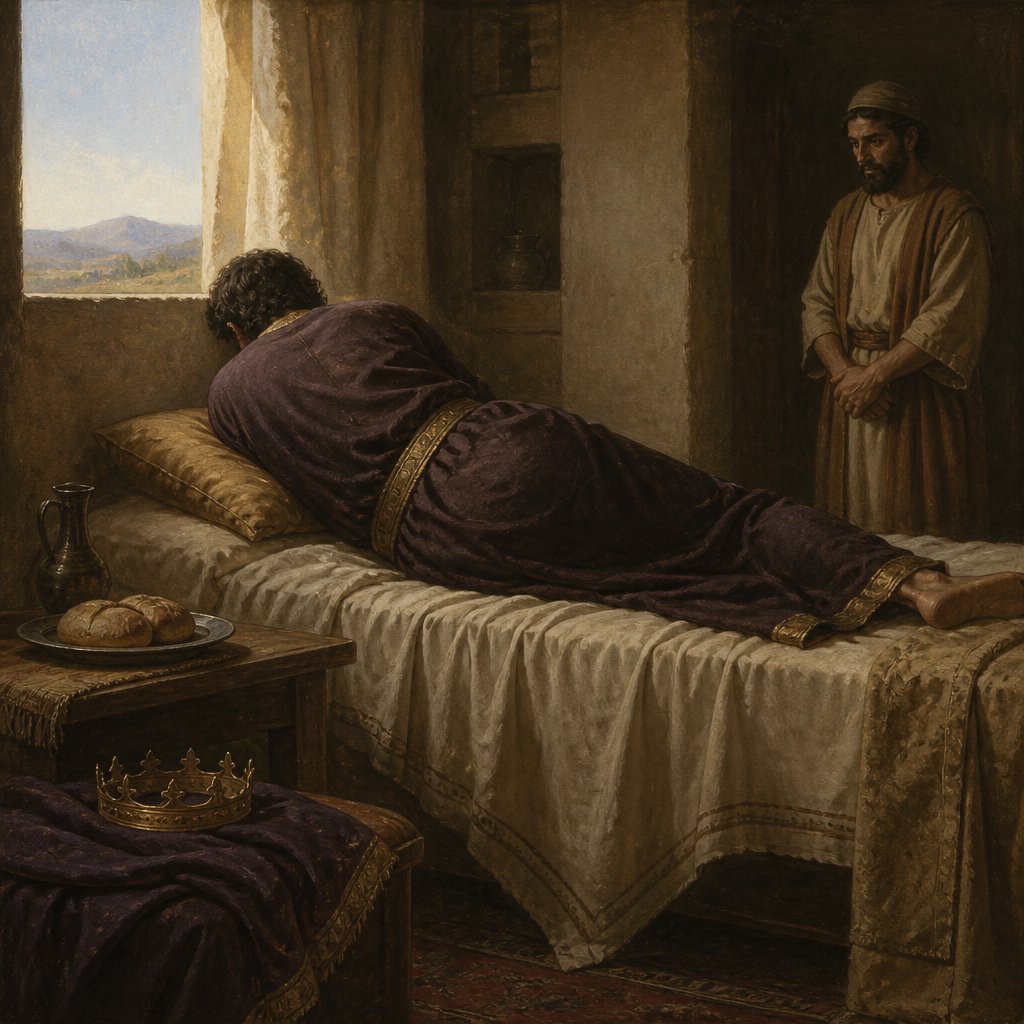
In the biblical narrative of 1 Kings 21:4, we encounter King Ahab in a moment of deep despair: "And Ahab came into his house heavy and displeased because of the word which Naboth the Jezreelite had spoken to him: for he had said, I will not give thee the inheritance of my fathers. And he laid him down upon his bed, and turned away his face, and would eat no bread." This passage highlights the profound discontent that plagued Ahab after being denied something he deeply desired—the vineyard of Naboth.
Ahab’s sorrow invites us to reflect on the nature of our desires and the emotional toll that unfulfilled wishes can exert on our lives. As we delve into this scripture, we can discern how it embodies a universal experience of longing and disappointment—a theme that resonates throughout the human experience. Ahab’s reaction, choosing to isolate himself in his chamber, signifies the often crippling effect of our desires when they are met with rejection.
### The Weight of Desire
To understand Ahab’s disappointment, we must first recognize what the vineyard represented to him. For Ahab, Naboth's vineyard was not merely a piece of land; it was a symbol of status, power, and perhaps even legacy. The desire for Naboth's inheritance was rooted in deeper values—the desire for recognition and control over his surroundings. It is essential for us to acknowledge that desires can sometimes stem from a good place, but when they lead us to envy or discontent, they become burdensome. Ahab, despite his royal status, was left feeling heavy; this reflects a truth about human nature: wealth and power do not absolve one from the pains of unfulfilled desires.
### Isolation in Discontent
Ahab’s response to his predicament—retreating to his bed and refusing to eat—illustrates how disappointment can lead us to withdraw from the world. In biblical times, the act of lying down and turning one’s face away was often a sign of mourning or defeat. Ahab's physical posture symbolizes a spiritual and emotional state; how often do we ourselves turn away from life when we feel let down by situations beyond our control?
This tendency to isolate can be a looming danger in our own lives. In moments of sadness, we may feel inclined to shut ourselves off, diving into despair rather than seeking comfort. Instead of retreating, we can learn from Ahab’s missteps that engaging with our community—seeking support and prayer—can bring healing and clarity.
### The Impact of Choices
Ahab’s descent into discontent led him down a dark path, spurred on by his wife Jezebel’s manipulations. This sets a cautionary tale of how desire and disappointment can distort our choices. In our lives, unfulfilled desires can tempt us to make ungodly decisions, driven by desperation and jealousy rather than faithfulness and integrity. Just as Ahab sought to manipulate circumstances in order to gain what he wanted, we too can be led to sin when we let our desires overshadow our moral compass.
### Redirecting Our Focus
Ultimately, Ahab’s story serves as a poignant reminder to evaluate the desires we carry and to confront them in light of our faith. An important question arises: Are our desires reflective of God's will for us? In moments of longing and discontent, we should direct our focus back to God, seeking His guidance and provision rather than succumbing to despair. Philippians 4:19 assures us, "But my God shall supply all your need according to his riches in glory by Christ Jesus.”
Instead of retreating into darkness as Ahab did, we are called to lift our heads, reach out to God, and allow Him to fill the voids in our lives that are filled with unfulfilled desires. Through prayer and community, we can find strength and perhaps discover that God has greater plans than we could ever imagine. Let us remember that while desires may weigh heavy on our hearts, turning to God can lighten our burdens.
Want to reflect more on 1 Kings 21:4?
Continue your spiritual journey with Bible Chat — an AI-powered tool for exploring God's Word through conversation. Ask questions, discover connections, and deepen your understanding.
Get Our Apps


1 Kings 21:4 Artwork

1 Kings 21:4 - "And Ahab came into his house heavy and displeased because of the word which Naboth the Jezreelite had spoken to him: for he had said, I will not give thee the inheritance of my fathers. And he laid him down upon his bed, and turned away his face, and would eat no bread."
"And Ahab came into his house heavy and displeased because of the word which Naboth the Jezreelite had spoken to him: for he had said, I will not give thee the inheritance of my fathers. And he laid him down upon his bed, and turned away his face, and would eat no bread." - 1 Kings 21:4

1 Kings 4:21 - "And Solomon reigned over all kingdoms from the river unto the land of the Philistines, and unto the border of Egypt: they brought presents, and served Solomon all the days of his life."

1 Kings 8:21

1 Kings 8:21

1 Kings 8:21

1 Kings 8:21

2 Kings 21:4 - "And he built altars in the house of the LORD, of which the LORD said, In Jerusalem will I put my name."

Revelations 21:4

Revelations 21:4

Revelation 21:4

1 Kings 21:14 - "Then they sent to Jezebel, saying, Naboth is stoned, and is dead."

2 Kings 4:21 - "And she went up, and laid him on the bed of the man of God, and shut the door upon him, and went out."

1 Kings 21:28 - "And the word of the LORD came to Elijah the Tishbite, saying,"

1 Kings 21:17 - "¶ And the word of the LORD came to Elijah the Tishbite, saying,"

1 Kings 4:1 - "So king Solomon was king over all Israel."

1 Kings 21:12 - "They proclaimed a fast, and set Naboth on high among the people."

1 Kings 21:1 - "And it came to pass after these things, that Naboth the Jezreelite had a vineyard, which was in Jezreel, hard by the palace of Ahab king of Samaria."

1 Kings 20:21 - "And the king of Israel went out, and smote the horses and chariots, and slew the Syrians with a great slaughter."

1 Kings 4:4 - "And Benaiah the son of Jehoiada was over the host: and Zadok and Abiathar were the priests:"

1 Kings 1:4 - "And the damsel was very fair, and cherished the king, and ministered to him: but the king knew her not."

1 Kings 22:21 - "And there came forth a spirit, and stood before the LORD, and said, I will persuade him."

1 Kings 4:18 - "Shimei the son of Elah, in Benjamin:"

1 Kings 2:21 - "And she said, Let Abishag the Shunammite be given to Adonijah thy brother to wife."

1 Kings 4:17 - "Jehoshaphat the son of Paruah, in Issachar:"

1 Chronicles 16:21 - "He suffered no man to do them wrong: yea, he reproved kings for their sakes,"

1 Kings 21:9 - "And she wrote in the letters, saying, Proclaim a fast, and set Naboth on high among the people:"

1 Kings 4:8 - "And these are their names: The son of Hur, in mount Ephraim:"

1 Kings 4:14 - "Ahinadab the son of Iddo had Mahanaim:"

1 Kings 21:23 - "And of Jezebel also spake the LORD, saying, The dogs shall eat Jezebel by the wall of Jezreel."