Two Altars, One Heart: The Dangers of Division
"And he set the one in Beth-el, and the other put he in Dan." - 1 Kings 12:29

As we delve into 1 Kings 12:29, which states, "And he set the one in Beth-el, and the other put he in Dan," we find ourselves at a significant crossroads in Israel's history. This moment encapsulates not only a political decision but also a profound spiritual turning away from the true worship of the Lord.
After King Solomon's reign, the kingdom of Israel experienced a fracture. This fracture occurred under the rule of Rehoboam, Solomon’s son, who was faced with the people's grievances. When he arrogantly rejected wise counsel, the ten northern tribes broke away to form their own kingdom, Israel, while Rehoboam continued to reign over the southern kingdom, Judah. The ensuing power struggle led to a crisis of faith as much as it was a crisis of governance.
Jeroboam, the new king of the northern tribes, was immediately confronted with a dilemma: how to unify his kingdom that was now separate from Judah, where the temple stood—the sole place designated for worship according to the Mosaic law. To secure his grasp on power, Jeroboam took drastic steps to prevent his people from returning to Jerusalem, fearing that their hearts would turn back to Rehoboam. In a moment of misguided leadership, he erected two golden calves—one in Beth-el and the other in Dan.
The choice of these locations was deeply symbolic. Beth-el held historical significance as the site where Jacob encountered God, and it was a place of sacred legacy. Similarly, Dan was at the north of the kingdom and represented an important boundary, not just geographically but spiritually. By choosing these places, Jeroboam established rival sites of worship, effectively polarizing the nation both politically and spiritually.
This act was not merely a logistical decision but reflected a deeper theological rebellion against God’s explicit command regarding worship and sacrifice. Exodus 20:4-5 warns against the making of graven images, yet Jeroboam's fear and ambition led him to create a religious system that catered to his agenda rather than to God’s holiness. The one true God was supplanted by hollow substitutes that professed power but held none.
What can we learn from Jeroboam’s faltering faith? Here lies a profound lesson for us today. In an era where cultural pressures can compel us to deviate from God’s truth, we can find ourselves setting up 'golden calves'—modern idolatry in the forms of materialism, success, and social acceptance. These idols can promise security, much like Jeroboam’s political maneuvering, but they lead only to spiritual desolation.
The establishment of these altars brought about division among God’s people. Worship that was supposed to unify them became a point of contention. As believers, we must guard against the fragmentation that arises from disobedience. It is imperative that we seek to worship God in spirit and in truth (John 4:24), prioritizing a heart that is wholly devoted to Him instead of crafting a faith that is convenient and self-serving.
Furthermore, we should reflect upon our own lives and consider how we might unintentionally create divisions through our choices. Are we erecting spiritual altars that distract us from the true source of our strength? Are we allowing societal norms to dictate our faith rather than anchoring ourselves in the Word of God?
As we meditate on this verse, let us be reminded to seek unity under the lordship of Christ, who calls us to be one body (1 Corinthians 12:12-27). We are meant to spur one another toward love and good deeds (Hebrews 10:24), not to set apart divisions that lead to spiritual apathy.
In conclusion, while Jeroboam’s actions led Israel away from God and into a cycle of sin and consequence, we can choose a different path. Let us commit ourselves to dismantle any altars in our lives that distract us from following God wholeheartedly. Let there be only one altar in our hearts, a place of worship dedicated solely to the One who saves and sanctifies.
Want to reflect more on 1 Kings 12:29?
Continue your spiritual journey with Bible Chat — an AI-powered tool for exploring God's Word through conversation. Ask questions, discover connections, and deepen your understanding.
Get Our Apps


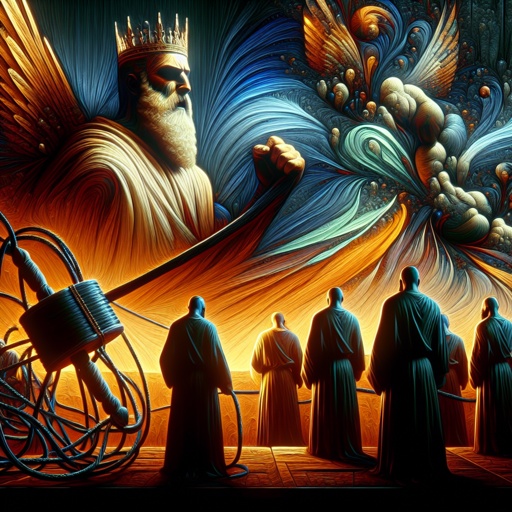
1 Kings 12:29 Artwork

1 Kings 12:29 - "And he set the one in Beth-el, and the other put he in Dan."

"And he set the one in Beth-el, and the other put he in Dan." - 1 Kings 12:29

1 Kings 11:29-32

1 Kings 12:11

1 Kings 12:11

1 Kings 12:10

1 Kings 12:10

1 Kings 14:29 - "¶ Now the rest of the acts of Rehoboam, and all that he did, are they not written in the book of the chronicles of the kings of Judah?"

1 Kings 12:10

1 Kings 12:11

1 Kings 12:10
1 Kings 12:11

1 Kings 12:14

1 Kings 12:14

1 Kings 12:11

1 Kings 1:29 - "And the king sware, and said, As the LORD liveth, that hath redeemed my soul out of all distress,"

1 Kings 22:29 - "So the king of Israel and Jehoshaphat the king of Judah went up to Ramoth-gilead."

1 Kings 10:29 - "And a chariot came up and went out of Egypt for six hundred shekels of silver, and an horse for an hundred and fifty: and so for all the kings of the Hittites, and for the kings of Syria, did they bring them out by their means."

1 kings 3:12

1 Corinthians 12:29 - "Are all apostles? are all prophets? are all teachers? are all workers of miracles?"

1 Kings 4:29 - "¶ And God gave Solomon wisdom and understanding exceeding much, and largeness of heart, even as the sand that is on the sea shore."

1 Kings 12:1 - "And Rehoboam went to Shechem: for all Israel were come to Shechem to make him king."

1 Kings 6:29 - "And he carved all the walls of the house round about with carved figures of cherubims and palm trees and open flowers, within and without."

1 Kings 12:19 - "So Israel rebelled against the house of David unto this day."

1 Kings 21:12 - "They proclaimed a fast, and set Naboth on high among the people."

1 Kings 12:12 - "¶ So Jeroboam and all the people came to Rehoboam the third day, as the king had appointed, saying, Come to me again the third day."

"¶ Now the rest of the acts of Rehoboam, and all that he did, are they not written in the book of the chronicles of the kings of Judah?" - 1 Kings 14:29

1 Chronicles 12:29 - "And of the children of Benjamin, the kindred of Saul, three thousand: for hitherto the greatest part of them had kept the ward of the house of Saul."

1 Kings 12:22 - "But the word of God came unto Shemaiah the man of God, saying,"

1 Kings 12:13 - "And the king answered the people roughly, and forsook the old men's counsel that they gave him;"