The Weight of Leadership: A Lesson from Rehoboam
"And the young men that were grown up with him spake unto him, saying, Thus shalt thou speak unto this people that spake unto thee, saying, Thy father made our yoke heavy, but make thou it lighter unto us; thus shalt thou say unto them, My little finger shall be thicker than my father's loins." - 1 Kings 12:10

In 1 Kings 12:10, we encounter a critical moment in the life of Rehoboam, son of Solomon and grandson of David. The verse reads: "And the young men that were grown up with him spake unto him, saying, Thus shalt thou speak unto this people that spake unto thee, saying, Thy father made our yoke heavy, but make thou it lighter unto us; thus shalt thou say unto them, My little finger shall be thicker than my father's loins" (1 Kings 12:10 KJV). This passage propels us into a terrain of leadership, humility, and the stark realities of human nature.
Rehoboam had just succeeded his father Solomon, whose reign had seen immense prosperity but also heavy taxation and forced labor to support grand building projects, including the Temple. As the people came to Rehoboam asking for relief, we stand on the precipice of a moment that would determine not just Rehoboam's fate, but also the fate of the nation. The young men around him, having grown up in the reflective shadows of privilege and authority, urge him to respond with bravado, to show strength and assert dominance over the people. They encourage him to tell the people that they had barely begun to experience the weight of leadership and that his rule would be even harsher than that of his father.
The temptation to wield power without care for the consequences was palpable—a narrative still relevant in today’s context. How often do leaders, whether in the public, corporate, or even spiritual spheres, fall prey to the same impulsive counsel? They seek to exhibit strength, competitiveness, and control, often neglecting the needs and cries of the people they are meant to serve.
Rehoboam finds himself at a crossroads where he must choose between listening to wise counsel and pursuing the path of power. He could have elected to heed the wisdom of the elders who advised him to speak kindly to the people, promising to serve them justly instead of increasing their burdens. How starkly different history could have been had he chosen humility over arrogance!
In our own lives, we may not hold the title of king, but we nonetheless engage in leadership every day—whether as parents, teachers, bosses, friends, or community members. Each interaction presents an opportunity to reflect Christ’s love and humility. Jesus Himself exemplified servant leadership, teaching that ‘the greatest among you shall be your servant’ (Matthew 23:11). When we allow our authority to be tempered with compassion, recognizing the weight that others bear, we demonstrate a leadership that resonates with the heart and soul of those around us.
On the other hand, Rehoboam’s choice was fueled by pride and a desire to assert his strength. This choice led to devastating consequences: the kingdom of Israel was torn apart, leading to a long history of division and turmoil. The northern tribes rebelled against his rule, and Israel was never to be fully united again. This serves as a potent reminder that decisions made from a place of arrogance can lead to long-lasting ramifications—both for ourselves and those we lead.
As we meditate on Rehoboam's story, let us examine our hearts. Where have we sought to wield authority without emphasizing servitude? Where might we need to extend grace and empathetic leadership? Today, let us pray for wisdom to lead with integrity and humility, and for open ears to hear the wise counsel around us, not just the voices that flatter our ambitions.
In this way, we can learn from Rehoboam’s error and strive towards a representation of leadership built on the foundation of love and a commitment to bettering the lives of others. May we approach leadership as Christ did, regulating our strength with kindness and perseverance in sacrifice, knowing that true power lies in serving others.
Want to reflect more on 1 Kings 12:10?
Continue your spiritual journey with Bible Chat — an AI-powered tool for exploring God's Word through conversation. Ask questions, discover connections, and deepen your understanding.
Get Our Apps


1 Kings 12:10 Artwork

1 Kings 12:10

1 Kings 12:10

1 Kings 12:10

1 Kings 12:10

1 Kings 12:10 - "And the young men that were grown up with him spake unto him, saying, Thus shalt thou speak unto this people that spake unto thee, saying, Thy father made our yoke heavy, but make thou it lighter unto us; thus shalt thou say unto them, My little finger shall be thicker than my father's loins."
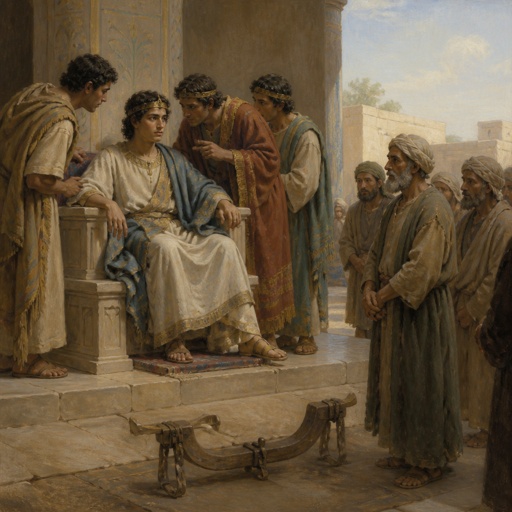
"And the young men that were grown up with him spake unto him, saying, Thus shalt thou speak unto this people that spake unto thee, saying, Thy father made our yoke heavy, but make thou it lighter unto us; thus shalt thou say unto them, My little finger shall be thicker than my father's loins." - 1 Kings 12:10

1 Kings 10:12 - "And the king made of the almug trees pillars for the house of the LORD, and for the king's house, harps also and psalteries for singers: there came no such almug trees, nor were seen unto this day."

1 Kings 12:11

1 Kings 12:11

1 Kings 12:11
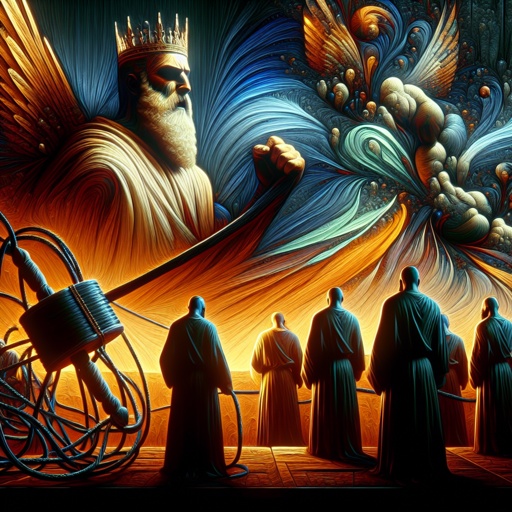
1 Kings 12:11

1 Kings 12:14

1 Kings 12:14

1 Kings 12:11

1 Kings 10:1

1 Kings 10:1

1 kings 10:1

2 Kings 10:12 - "¶ And he arose and departed, and came to Samaria. And as he was at the shearing house in the way,"

1 Kings 10:23 - "So king Solomon exceeded all the kings of the earth for riches and for wisdom."

1 kings 3:12

1 Kings 8:10

1 Kings 8:10

1 Kings 8:10

1 Kings 8:10

1 Kings 8:10

1 Kings 8:10

1 Kings 8:10

1 Kings 10:15 - "Beside that he had of the merchantmen, and of the traffick of the spice merchants, and of all the kings of Arabia, and of the governors of the country."

1 Kings 12:1 - "And Rehoboam went to Shechem: for all Israel were come to Shechem to make him king."

Psalm 10:12-18