Cities of Promise: Understanding Our Heritage in Christ
"And out of the tribe of Benjamin; Geba with her suburbs, and Alemeth with her suburbs, and Anathoth with her suburbs. All their cities throughout their families were thirteen cities." - 1 Chronicles 6:60
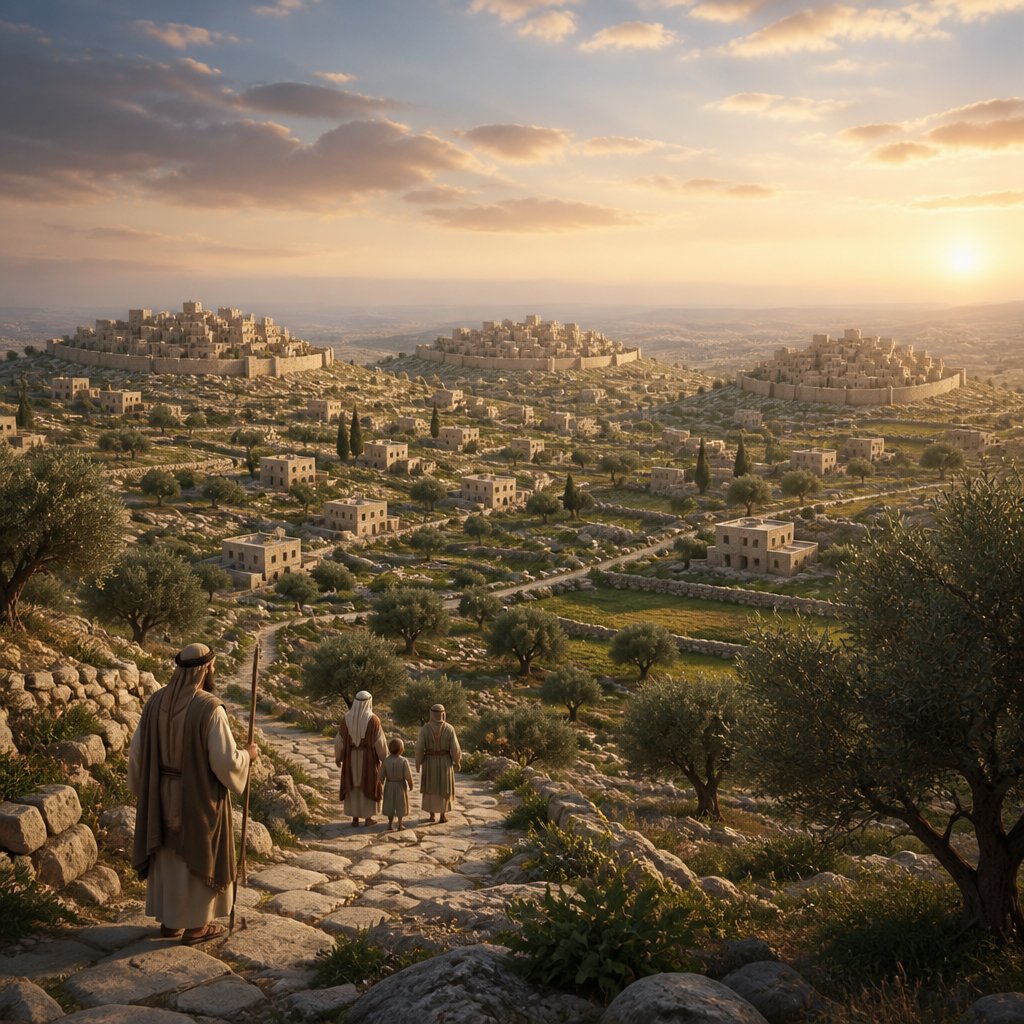
In the grand narrative of scripture, we often find ourselves traversing through lists, genealogies, and locations that may appear mundane at first glance. Yet, as we dig deeper, we discover that every word of God is significant, infused with divine purpose and meaning. One such verse is found in 1 Chronicles 6:60 (KJV), which states, "And out of the tribe of Benjamin; Geba with her suburbs, and Alemeth with her suburbs, and Anathoth with her suburbs. All their cities throughout their families were thirteen cities."
In the Old Testament, the tribe of Benjamin holds a unique place. Named after one of the twelve sons of Jacob, Benjamin is often overlooked in favor of more prominent tribes like Judah or Ephraim. However, this small but fierce tribe became the home of significant biblical figures, including King Saul and a portion of the early followers of Christ in the New Testament. The mention of specific cities within this tribe—Geba, Alemeth, and Anathoth—reflects not just geographical locations but the values and histories that shape our understanding of God’s faithfulness.
### The Significance of Geba, Alemeth, and Anathoth
Geba, often associated with battles and councils, symbolizes a place of decision-making. It represents the crossroads of life where choices are pivotal. In our spiritual walk, there are moments where we stand at our own Geba, contemplating the weight of our choices before God. Here, we can find solace—much like the Benjaminites—knowing that every decision, when anchored in prayer and aligned with God’s word, can lead us to His perfect will.
Alemeth, meanwhile, speaks to the idea of integrity and wholeness. The name itself translates to "hidden," suggesting that true strength and resilience are often found in places not visible to the world. In our lives, we may feel hidden or overlooked, but God sees and values every effort we invest in our journey with Him. Just as the cities in Benjamin were part of His grand design, each of us plays a crucial role in His plan, regardless of how visible our contributions might be.
Anathoth is perhaps the most poignant of the three. It is the birthplace of the prophet Jeremiah, often referred to as the "weeping prophet" for his deep sorrow over Israel's unfaithfulness. Anathoth symbolizes the call to prophetic witness amid turmoil. Similarly, God calls us to stand firm in our faith, speaking truth and championing hope where desolation may reign. Just as Jeremiah found strength to carry out his prophetic ministry, we too must embrace our call as messengers of God’s hope in our families, workplaces, and communities.
### The Wholeness of Thirteen Cities
The verse concludes with the mention of "All their cities throughout their families were thirteen cities." In biblical numerology, the number thirteen often signifies rebellion or a departure from order, as seen in instances such as the rebellion of Absalom. However, in the context of God’s provision, these thirteen cities can be seen as a reminder of grace even amid human frailty. Life frequently pushes us into patterns of rebellion, whether through our own actions or the consequences of the fallen world around us. Yet God, in His infinite mercy, provides spaces—cities, if you will—where restoration can occur.
As believers, just as the Benjaminites had a designated inheritance, we too have a rich heritage woven through the cross of Christ. Our cities today may not be geographical but rather represent the spiritual sanctuaries we create through prayer, community, and faithfulness.
### Conclusion: Our Inheritance in Christ
As we reflect on 1 Chronicles 6:60, let us remember the lessons from the tribe of Benjamin and the cities within it. May we find strength in our paths, integrity in our decisions, and prophetic courage in the face of adversity. Each of us is a part of the body of Christ, intricately designed and placed in unique positions to reflect His glory.
In Christ, we are heirs to an eternal promise, much greater than any city. Let us walk in confidence, knowing that every suburb of our spiritual journey holds purpose, and all of it culminates in the beauty of our identity as children of God.
Want to reflect more on 1 Chronicles 6:60?
Continue your spiritual journey with Bible Chat — an AI-powered tool for exploring God's Word through conversation. Ask questions, discover connections, and deepen your understanding.
Get Our Apps


1 Chronicles 6:60 Artwork

1 Chronicles 6:60 - "And out of the tribe of Benjamin; Geba with her suburbs, and Alemeth with her suburbs, and Anathoth with her suburbs. All their cities throughout their families were thirteen cities."
"And out of the tribe of Benjamin; Geba with her suburbs, and Alemeth with her suburbs, and Anathoth with her suburbs. All their cities throughout their families were thirteen cities." - 1 Chronicles 6:60

isaiah 60:6

Isaiah 60:1

Izaiáš 60:1

1 Chronicles 6:6 - "And Uzzi begat Zerahiah, and Zerahiah begat Meraioth,"

John 6:60 - "Many therefore of his disciples, when they had heard this, said, This is an hard saying; who can hear it?"

1 Chronicles 1:6 - "And the sons of Gomer; Ashchenaz, and Riphath, and Togarmah."

1 Chronicles 6:1 - "The sons of Levi; Gershon, Kohath, and Merari."

Psalms 60:6 - "God hath spoken in his holiness; I will rejoice, I will divide Shechem, and mete out the valley of Succoth."

1 Chronicles 14:6 - "And Nogah, and Nepheg, and Japhia,"

1 Chronicles 3:6 - "Ibhar also, and Elishama, and Eliphelet,"

1 Chronicles 6:25 - "And the sons of Elkanah; Amasai, and Ahimoth."

1 Chronicles 6:16 - "¶ The sons of Levi; Gershom, Kohath, and Merari."

1 Chronicles 6:17 - "And these be the names of the sons of Gershom; Libni, and Shimei."

1 Chronicles 6:28 - "And the sons of Samuel; the firstborn Vashni, and Abiah."

Luke 1:60 - "And his mother answered and said, Not so; but he shall be called John."

1 Chronicles 6:14 - "And Azariah begat Seraiah, and Seraiah begat Jehozadak,"

1 Chronicles 6:58 - "And Hilen with her suburbs, Debir with her suburbs,"

1 Chronicles 6:12 - "And Ahitub begat Zadok, and Zadok begat Shallum,"

1 Chronicles 7:6 - "¶ The sons of Benjamin; Bela, and Becher, and Jediael, three."

1 Chronicles 6:53 - "Zadok his son, Ahimaaz his son."

1 Chronicles 6:11 - "And Azariah begat Amariah, and Amariah begat Ahitub,"

1 Chronicles 6:5 - "And Abishua begat Bukki, and Bukki begat Uzzi,"

1 Chronicles 6:45 - "The son of Hashabiah, the son of Amaziah, the son of Hilkiah,"

1 Chronicles 6:9 - "And Ahimaaz begat Azariah, and Azariah begat Johanan,"

1 Chronicles 6:41 - "The son of Ethni, the son of Zerah, the son of Adaiah,"

1 Chronicles 6:40 - "The son of Michael, the son of Baaseiah, the son of Malchiah,"

1 Chronicles 12:6 - "Elkanah, and Jesiah, and Azareel, and Joezer, and Jashobeam, the Korhites,"

1 Chronicles 6:8 - "And Ahitub begat Zadok, and Zadok begat Ahimaaz,"