The Transforming Power of Relationships: Lessons from Sheshan and Jarha
"¶ Now Sheshan had no sons, but daughters. And Sheshan had a servant, an Egyptian, whose name was Jarha." - 1 Chronicles 2:34
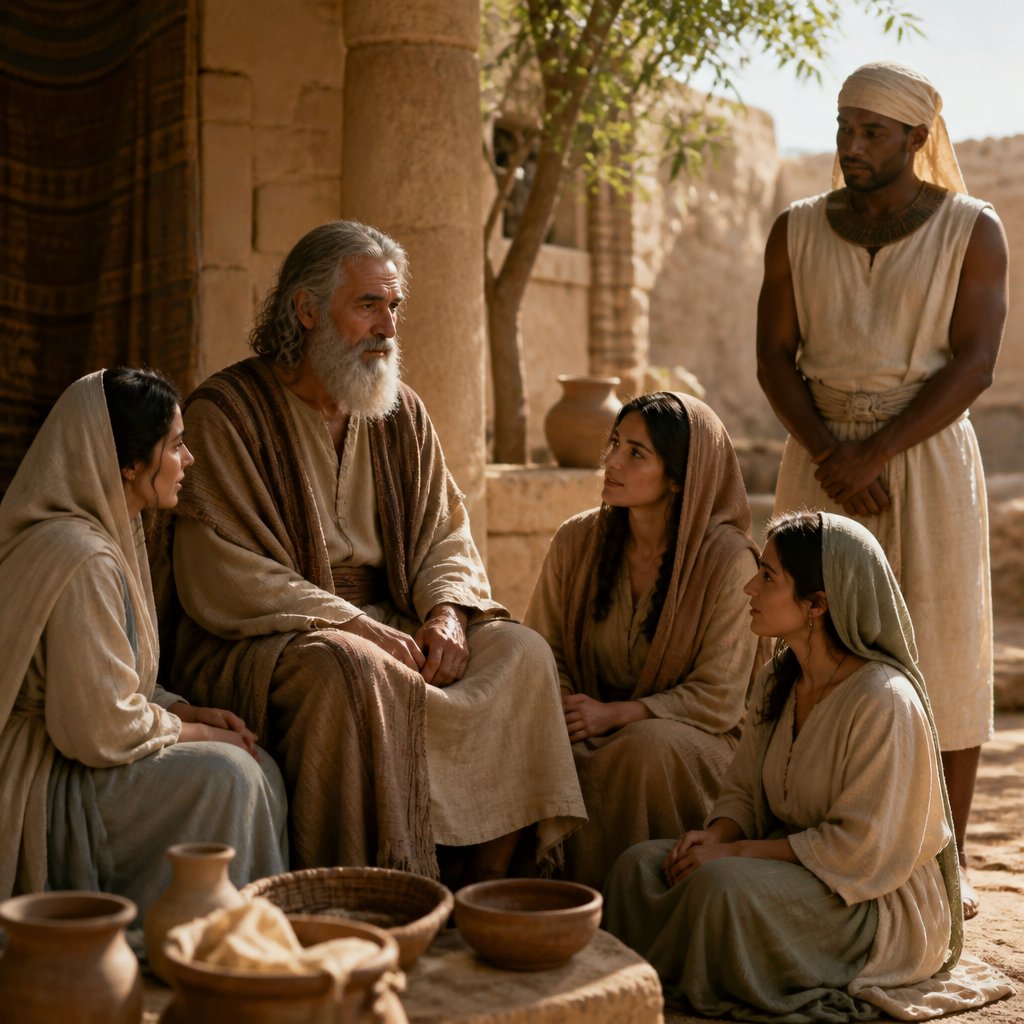
In 1 Chronicles 2:34, we read, "Now Sheshan had no sons, but daughters. And Sheshan had a servant, an Egyptian, whose name was Jarha." At first glance, this verse may seem unremarkable, a mere historical notation among many in the genealogies of the Israelites. However, like so many passages in Scripture, there is much more beneath the surface that speaks to us today.
Sheshan, like many individuals mentioned in the genealogical records, seems to be defined by his familial status: he had daughters but no sons. In a patriarchal culture, where lineage and inheritance were typically passed through male offspring, Sheshan's situation could be perceived as somewhat tragic or limiting. The ancient Near Eastern world often viewed sons as a vital source of family continuity and strength. However, Sheshan’s identity was not solely limited to what he lacked; it also encompassed the relationships he nurtured during his lifetime—most notably with his servant, Jarha.
The Scriptures tell us that Sheshan had a servant named Jarha, an Egyptian. This brief mention raises a series of profound and thought-provoking questions. Who was Jarha? How had he come to serve Sheshan? And why is it significant that he is identified as an Egyptian? In a culturally divided world, where the relationships between Israelites and Egyptians were often marked by tension, the inclusion of Jarha in this family dynamic suggests a deeper, richer narrative at play.
In the Bible, servants often play pivotal roles. They are not merely background characters but are conduits for life-altering decisions and actions. Jarha’s presence indicates that Sheshan was not defined merely by his lineage. Instead, he fostered relationships that crossed cultural and national boundaries. This prompts us to examine our own lives. Who do we allow to enter our inner circles? Whom do we lift up as important in our lives, even if they do not share our same background or culture? The act of forming relationships with those who are different enriches our lives and broadens our understanding of the world around us.
The significance of Sheshan having daughters also introduces another layer of meaning. In Scripture, daughters often symbolize a different kind of inheritance. The daughters of Sheshan may not carry forward a traditional male lineage, but they are still vital to his legacy. They had the potential to form alliances through marriage that could bear fruit for generations to come. This illustrates that our value and legacy are not limited to societal expectations or norms. As individuals in Christ, we are called to redefine what legacy means—to understand that true inheritance lies not solely in lineage but in relationships, love, and the lives we touch.
Furthermore, in biblical narratives, Egyptians frequently represent oppression or foreignness, yet here, Jarha becomes part of Sheshan’s household. This speaks volumes about the Gospel message: it is one of inclusion and reconciliation. God’s heart is for the marginalized and the outsider. In Jesus, we see that barriers are broken down, and all are called to be part of the family of God. Sheshan’s relationship with Jarha demonstrates that the Kingdom of God transcends earthly boundaries. Just as Sheshan embraced Jarha, we too are called to embrace those who differ from us, showing love and acceptance.
Ultimately, we can learn from Sheshan and Jarha that our worth and purpose are not confined to conventional standards or societal norms. Whether we face family challenges or forge unexpected relationships, God is always working within our stories to display His glory. May we have eyes to see the Jarhas in our lives and the courage to reach out in love and acceptance, fostering relationships that can change our heart and, indeed, the world around us.
Want to reflect more on 1 Chronicles 2:34?
Continue your spiritual journey with Bible Chat — an AI-powered tool for exploring God's Word through conversation. Ask questions, discover connections, and deepen your understanding.
Get Our Apps


1 Chronicles 2:34 Artwork

1 Chronicles 2:34 - "¶ Now Sheshan had no sons, but daughters. And Sheshan had a servant, an Egyptian, whose name was Jarha."

"¶ Now Sheshan had no sons, but daughters. And Sheshan had a servant, an Egyptian, whose name was Jarha." - 1 Chronicles 2:34

2 Chronicles 34:1 - "Josiah was eight years old when he began to reign, and he reigned in Jerusalem one and thirty years."

2 Chronicles 34:19

2 Chronicles 34:19

1 Chronicles 1:34 - "And Abraham begat Isaac. The sons of Isaac; Esau and Israel."

1 Chronicles 4:34 - "And Meshobab, and Jamlech, and Joshah the son of Amaziah,"

1 Chronicles 7:34 - "And the sons of Shamer; Ahi, and Rohgah, Jehubbah, and Aram."

2 Chronicles 34:29 - "¶ Then the king sent and gathered together all the elders of Judah and Jerusalem."

2 Chronicles 34:5 - "And he burnt the bones of the priests upon their altars, and cleansed Judah and Jerusalem."

1 Chronicles 11:34 - "The sons of Hashem the Gizonite, Jonathan the son of Shage the Hararite,"

1 Chronicles 6:34 - "The son of Elkanah, the son of Jeroham, the son of Eliel, the son of Toah,"

1 Chronicles 8:34 - "And the son of Jonathan was Merib-baal; and Merib-baal begat Micah."

1 Chronicles 12:34 - "And of Naphtali a thousand captains, and with them with shield and spear thirty and seven thousand."

1 Chronicles 9:34 - "These chief fathers of the Levites were chief throughout their generations; these dwelt at Jerusalem."

1 Chronicles 27:34 - "And after Ahithophel was Jehoiada the son of Benaiah, and Abiathar: and the general of the king's army was Joab."

2 Chronicles 34:19 - "And it came to pass, when the king had heard the words of the law, that he rent his clothes."

1 Chronicles 16:34 - "O give thanks unto the LORD; for he is good; for his mercy endureth for ever."

2 Chronicles 34:2 - "And he did that which was right in the sight of the LORD, and walked in the ways of David his father, and declined neither to the right hand, nor to the left."

2 Chronicles 34:17 - "And they have gathered together the money that was found in the house of the LORD, and have delivered it into the hand of the overseers, and to the hand of the workmen."

2 Chronicles 34:6 - "And so did he in the cities of Manasseh, and Ephraim, and Simeon, even unto Naphtali, with their mattocks round about."

2 Chronicles 34:23 - "¶ And she answered them, Thus saith the LORD God of Israel, Tell ye the man that sent you to me,"

2 Chronicles 34:10 - "And they put it in the hand of the workmen that had the oversight of the house of the LORD, and they gave it to the workmen that wrought in the house of the LORD, to repair and amend the house:"

2 Chronicles 34:14 - "¶ And when they brought out the money that was brought into the house of the LORD, Hilkiah the priest found a book of the law of the LORD given by Moses."

2 Chronicles 34:18 - "Then Shaphan the scribe told the king, saying, Hilkiah the priest hath given me a book. And Shaphan read it before the king."

2 Kings 10:34 - "Now the rest of the acts of Jehu, and all that he did, and all his might, are they not written in the book of the chronicles of the kings of Israel?"

2 Chronicles 34:20 - "And the king commanded Hilkiah, and Ahikam the son of Shaphan, and Abdon the son of Micah, and Shaphan the scribe, and Asaiah a servant of the king's, saying,"

2 Chronicles 34:16 - "And Shaphan carried the book to the king, and brought the king word back again, saying, All that was committed to thy servants, they do it."

"And Abraham begat Isaac. The sons of Isaac; Esau and Israel." - 1 Chronicles 1:34

2 Chronicles 34:11 - "Even to the artificers and builders gave they it, to buy hewn stone, and timber for couplings, and to floor the houses which the kings of Judah had destroyed."