Serving in the Sacred: A Devotional on 1 Chronicles 23:28
"Because their office was to wait on the sons of Aaron for the service of the house of the LORD, in the courts, and in the chambers, and in the purifying of all holy things, and the work of the service of the house of God;" - 1 Chronicles 23:28
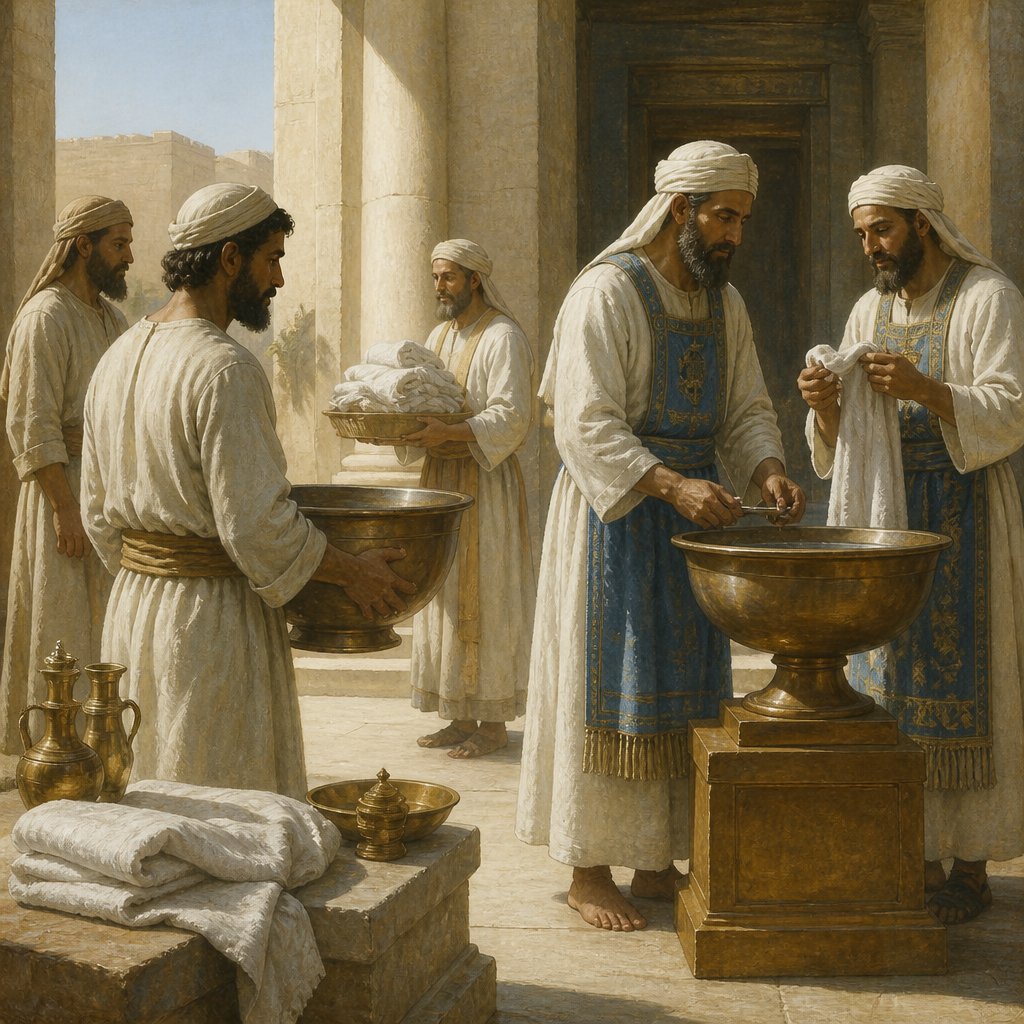
**Introduction**
In 1 Chronicles 23:28, we read: *"Because their office was to wait on the sons of Aaron for the service of the house of the LORD, in the courts, and in the chambers, and in the purifying of all holy things, and the work of the service of the house of God;"* This verse captures a profound truth about divine service and dedication to God. It invites us to reflect on the significance of our roles in the ministry and the calling we each hold as believers in the body of Christ.
**Understanding the Context**
The context of this verse is rooted in David's organization of the Levites and priests, tasked with specific responsibilities regarding the worship and service within the tabernacle, and later the temple. Here, the Levites are described as those who serve alongside the priests (the sons of Aaron) in a variety of capacities. This hierarchical and functional organization illustrates a divine order and a tapestry of roles that contribute to the worship of God. Each role, whether prominent or behind the scenes, is important and vital to the overall function of the house of the LORD.
**The Call to Service**
The phrase *“to wait on the sons of Aaron”* suggests a posture of servanthood and dedication to the duties assigned to them. To wait means more than mere idleness; it implies active engagement in support of the work of the priests. This serves as a reminder that in God’s house, every task, whether seen or unseen, is crucial. Whether we are leading worship, teaching the Word, or performing administrative duties, every action matters in the grander scheme of glorifying God.
the tasks mentioned in this verse remind us that our service to God encompasses various forms of work - from the mundane to the sacred. The Levites were engaged in *“the courts”* and *“the chambers,”* which symbolizes both the public spaces where worship was performed and the more intimate, secluded areas of the temple. This indicates that every space dedicated to the Lord carries significance, and every form of service has its place in His design.
**Purifying and Preparing**
In particular, the emphasis on *“purifying of all holy things”* strikes at the heart of what it means to serve God in a holy fashion. Purification symbolizes sanctification, leading us to consider our own hearts and lives in relation to our service. As we engage in communal worship and service, we must first ensure our personal sanctification. Are our hearts pure as we serve in the ministry? Do we hold onto sin or distraction that may hinder the work of God? In John 13, Jesus washed the disciples’ feet to model servanthood and humility, illustrating that true service is often found in acts of love and care for others.
**The Heart of Worship**
Furthermore, the verse reminds us that the primary focus of all these duties is *“the service of the house of God.”* This is the essential heart of worship and service. When we serve, we are ultimately serving God, and our heart attitude towards that service matters immensely. Are we serving out of obligation, or is it born from a genuine love for God and His house?
**Conclusion**
1 Chronicles 23:28 teaches us that serving God involves various functions, each with its sanctity and significance. It challenges us to examine our own roles within the church and to embrace the service with humility, recognizing it as worship. Let us dedicate ourselves to the Lord’s work with a spirit of servanthood, purifying our hearts and offering sincere worship in all we do. In this way, we fulfill our calling to be a part of the service of the house of God, contributing to His glory and ministering to His people.
Want to reflect more on 1 Chronicles 23:28?
Continue your spiritual journey with Bible Chat — an AI-powered tool for exploring God's Word through conversation. Ask questions, discover connections, and deepen your understanding.
Get Our Apps


1 Chronicles 23:28 Artwork

1 Chronicles 23:28 - "Because their office was to wait on the sons of Aaron for the service of the house of the LORD, in the courts, and in the chambers, and in the purifying of all holy things, and the work of the service of the house of God;"
"Because their office was to wait on the sons of Aaron for the service of the house of the LORD, in the courts, and in the chambers, and in the purifying of all holy things, and the work of the service of the house of God;" - 1 Chronicles 23:28

Exodus 23:28

2 Kings 23:28 - "Now the rest of the acts of Josiah, and all that he did, are they not written in the book of the chronicles of the kings of Judah?"

Exodus 23:28

1 Chronicles 1:28 - "The sons of Abraham; Isaac, and Ishmael."

Exodus 23:27-28

Exodus 23:28-29

1 Chronicles 23:23 - "The sons of Mushi; Mahli, and Eder, and Jeremoth, three."

1 Chronicles 6:28 - "And the sons of Samuel; the firstborn Vashni, and Abiah."

1 Chronicles 8:23 - "And Abdon, and Zichri, and Hanan,"

1 Chronicles 4:28 - "And they dwelt at Beer-sheba, and Moladah, and Hazar-shual,"

1 Chronicles 24:28 - "Of Mahli came Eleazar, who had no sons."

1 Chronicles 11:28 - "Ira the son of Ikkesh the Tekoite, Abiezer the Antothite,"

1 Chronicles 1:23 - "And Ophir, and Havilah, and Jobab. All these were the sons of Joktan."

1 Chronicles 23:7 - "¶ Of the Gershonites were, Laadan, and Shimei."

1 Chronicles 26:23 - "Of the Amramites, and the Izharites, the Hebronites, and the Uzzielites:"

1 Chronicles 23:18 - "Of the sons of Izhar; Shelomith the chief."

1 Chronicles 23:16 - "Of the sons of Gershom, Shebuel was the chief."

"The sons of Abraham; Isaac, and Ishmael." - 1 Chronicles 1:28

1 Chronicles 23:15 - "The sons of Moses were, Gershom, and Eliezer."

1 Chronicles 15:23 - "And Berechiah and Elkanah were doorkeepers for the ark."

1 Chronicles 8:28 - "These were heads of the fathers, by their generations, chief men. These dwelt in Jerusalem."

1 Chronicles 2:28 - "And the sons of Onam were, Shammai, and Jada. And the sons of Shammai; Nadab, and Abishur."

1 Chronicles 23:20 - "Of the sons of Uzziel; Michah the first, and Jesiah the second."

1 Chronicles 3:23 - "And the sons of Neariah; Elioenai, and Hezekiah, and Azrikam, three."

1 Chronicles 23:8 - "The sons of Laadan; the chief was Jehiel, and Zetham, and Joel, three."

1 Chronicles 25:28 - "The one and twentieth to Hothir, he, his sons, and his brethren, were twelve:"

1 Chronicles 23:12 - "¶ The sons of Kohath; Amram, Izhar, Hebron, and Uzziel, four."

"The sons of Mushi; Mahli, and Eder, and Jeremoth, three." - 1 Chronicles 23:23