The Weight of Victory: Lessons in David's Conquest
"And he brought out the people that were in it, and cut them with saws, and with harrows of iron, and with axes. Even so dealt David with all the cities of the children of Ammon. And David and all the people returned to Jerusalem." - 1 Chronicles 20:3
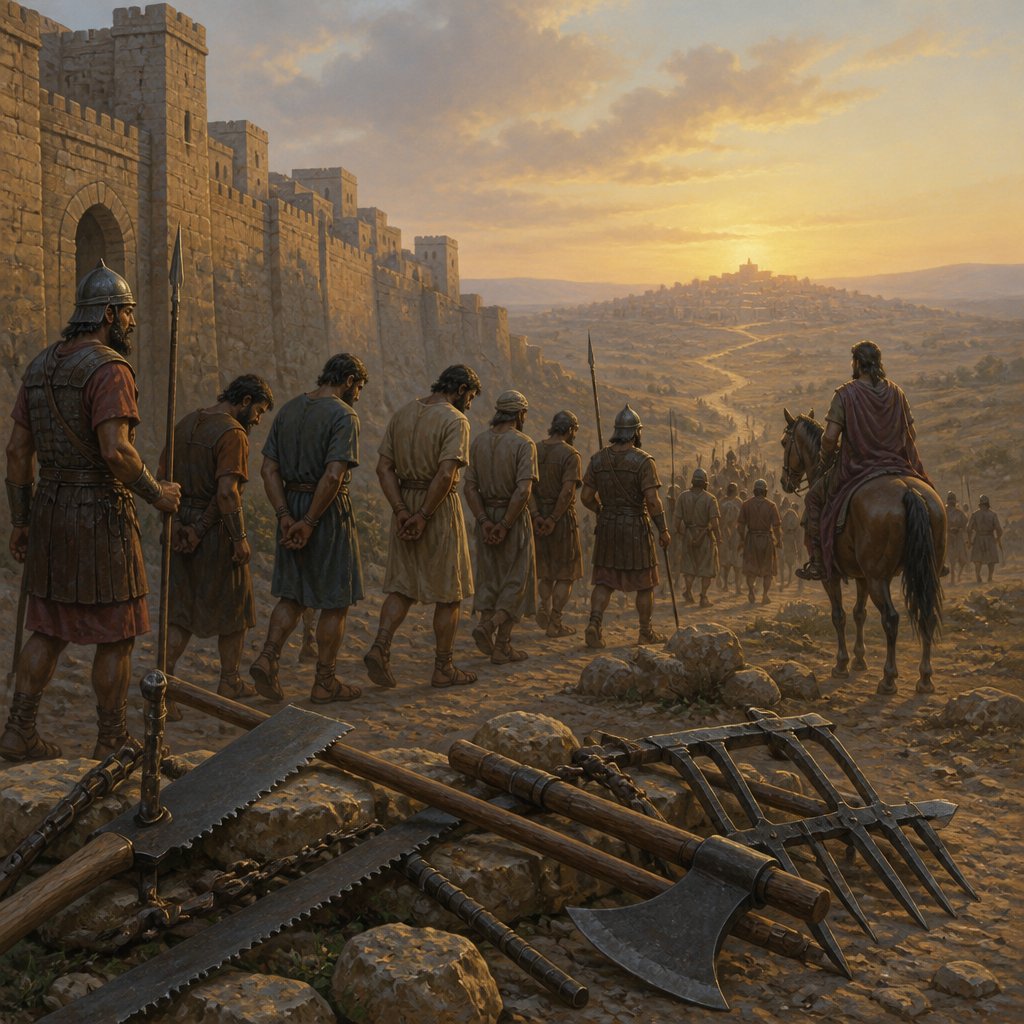
In the tapestry of Scripture, few accounts stir the imagination quite like that of David's conquests and the harsh realities that accompanied them. The verse we find in 1 Chronicles 20:3, "And he brought out the people that were in it, and cut them with saws, and with harrows of iron, and with axes. Even so dealt David with all the cities of the children of Ammon. And David and all the people returned to Jerusalem," speaks volumes about the nature of warfare, conflict, and the cost of victory in the life of a leader.
At first glance, this verse describes a grim scene: the wretched fate of the defeated people of Ammon at the hands of David's forces. This treatment might leave us feeling disturbed and questioning the character of David, a man known as "a man after God's own heart" (1 Samuel 13:14). However, it invites a deeper exploration into the dynamics of power, justice, and divine sovereignty that permeate much of David's story and our spiritual lives.
Within the context of biblical history, the conflict with the Ammonites wasn't born from mere territorial ambition but was part of God's broader narrative involving His chosen people. When looking closely at David's life, we often see that his victories came as a result of faithfulness to God, a sensitivity to God's leading, and an acknowledgment of God’s sovereignty over battles that were much larger than David himself. The victories David experienced were significant, not because of his strength or military prowess, but because they were seen as manifestations of divine promise and intervention.
But as we reflect upon the brutality of warfare during that period, we must also wrestle with the reality of human conflict and suffering. The harsh measures taken by David towards the Ammonites prompt important questions about justice, mercy, and the God of the Old Testament. Have we not also, at times, been called to confront the difficult aspects of our lives—severing relationships or systems that do not reflect God's glory?
As we look deeper, we find that in this specific incident, David's actions were likely a form of punishment and were meant to serve as a cautionary tale against those who would oppose God's people. This concept of dealing decisively with sin or opposition holds relevance for us today. The Apostle Paul reminds us in 2 Corinthians 10:4 that "the weapons of our warfare are not carnal, but mighty through God to the pulling down of strong holds." In our spiritual battles, we too must sometimes confront the strongholds in our lives; things that would keep us from intimacy with God.
Moreover, David's victorious return to Jerusalem symbolizes the restoration of the presence of God amidst a troubled people. It points to the idea that victory is not just about the triumph over enemies but rather about the return to fellowship with God and the community. After major battles, both literally and metaphorically, we often face the call to return to a place of worship, restoration, and communion with our Heavenly Father.
In our own lives, we may be confronted with challenges or conflicts that require us to cut away things that hinder our relationship with God, whether they be unhealthy relationships, harmful habits, or disobedience to His Word. While it may feel brutal or harsh, the act of cutting away can lead to growth and a renewal of purpose as we align ourselves more closely with God’s heart.
Finally, let us take encouragement from 1 Chronicles 20:3, recognizing that while victory may come at a cost, each victory under God's guidance also serves as a pathway back to His presence. As we grow and journey forward, may we ever remain sensitive to His leading, ever ready to engage in the battles of the soul, knowing that our ultimate victory lies in Christ alone. May our return to Jerusalem, our place of communion with God, always be accompanied by the necessary transformations that align us with His will.
Want to reflect more on 1 Chronicles 20:3?
Continue your spiritual journey with Bible Chat — an AI-powered tool for exploring God's Word through conversation. Ask questions, discover connections, and deepen your understanding.
Get Our Apps


1 Chronicles 20:3 Artwork

1 Chronicles 20:3 - "And he brought out the people that were in it, and cut them with saws, and with harrows of iron, and with axes. Even so dealt David with all the cities of the children of Ammon. And David and all the people returned to Jerusalem."
"And he brought out the people that were in it, and cut them with saws, and with harrows of iron, and with axes. Even so dealt David with all the cities of the children of Ammon. And David and all the people returned to Jerusalem." - 1 Chronicles 20:3

1 Chronicles 3:20 - "And Hashubah, and Ohel, and Berechiah, and Hasadiah, Jushab-hesed, five."

2 Chronicles 20:3 - "And Jehoshaphat feared, and set himself to seek the LORD, and proclaimed a fast throughout all Judah."

"And Hashubah, and Ohel, and Berechiah, and Hasadiah, Jushab-hesed, five." - 1 Chronicles 3:20

1 Chronicles 1:20 - "And Joktan begat Almodad, and Sheleph, and Hazarmaveth, and Jerah,"

"And Jehoshaphat feared, and set himself to seek the LORD, and proclaimed a fast throughout all Judah." - 2 Chronicles 20:3

1 Chronicles 8:20 - "And Elienai, and Zilthai, and Eliel,"

1 Chronicles 1:3 - "Henoch, Methuselah, Lamech,"

1 Chronicles 23:20 - "Of the sons of Uzziel; Michah the first, and Jesiah the second."

1 Chronicles 2:20 - "And Hur begat Uri, and Uri begat Bezaleel."

Revelation 3:20

Revelation 3:20

1 Chronicles 3:3 - "The fifth, Shephatiah of Abital: the sixth, Ithream by Eglah his wife."

1 Chronicles 3:7 - "And Nogah, and Nepheg, and Japhia,"

1 Chronicles 25:20 - "The thirteenth to Shubael, he, his sons, and his brethren, were twelve:"

"And Elienai, and Zilthai, and Eliel," - 1 Chronicles 8:20

1 Chronicles 6:20 - "Of Gershom; Libni his son, Jahath his son, Zimmah his son,"

1 Chronicles 15:20 - "And Zechariah, and Aziel, and Shemiramoth, and Jehiel, and Unni, and Eliab, and Maaseiah, and Benaiah, with psalteries on Alamoth;"

1 Chronicles 16:20 - "And when they went from nation to nation, and from one kingdom to another people;"

1 Chronicles 9:20 - "And Phinehas the son of Eleazar was the ruler over them in time past, and the LORD was with him."

1 Chronicles 3:8 - "And Elishama, and Eliada, and Eliphelet, nine."

1 Chronicles 3:6 - "Ibhar also, and Elishama, and Eliphelet,"

1 Chronicles 24:20 - "¶ And the rest of the sons of Levi were these: Of the sons of Amram; Shubael: of the sons of Shubael; Jehdeiah."

1 Chronicles 26:20 - "¶ And of the Levites, Ahijah was over the treasures of the house of God, and over the treasures of the dedicated things."

1 Chronicles 20:8 - "These were born unto the giant in Gath; and they fell by the hand of David, and by the hand of his servants."

1 Chronicles 20:7 - "But when he defied Israel, Jonathan the son of Shimea David's brother slew him."

1 Chronicles 27:20 - "Of the children of Ephraim, Hoshea the son of Azaziah: of the half tribe of Manasseh, Joel the son of Pedaiah:"

"And Joktan begat Almodad, and Sheleph, and Hazarmaveth, and Jerah," - 1 Chronicles 1:20

"Henoch, Methuselah, Lamech," - 1 Chronicles 1:3