The Golden Shields: A Testament to God's Provision
"And David took the shields of gold that were on the servants of Hadarezer, and brought them to Jerusalem." - 1 Chronicles 18:7
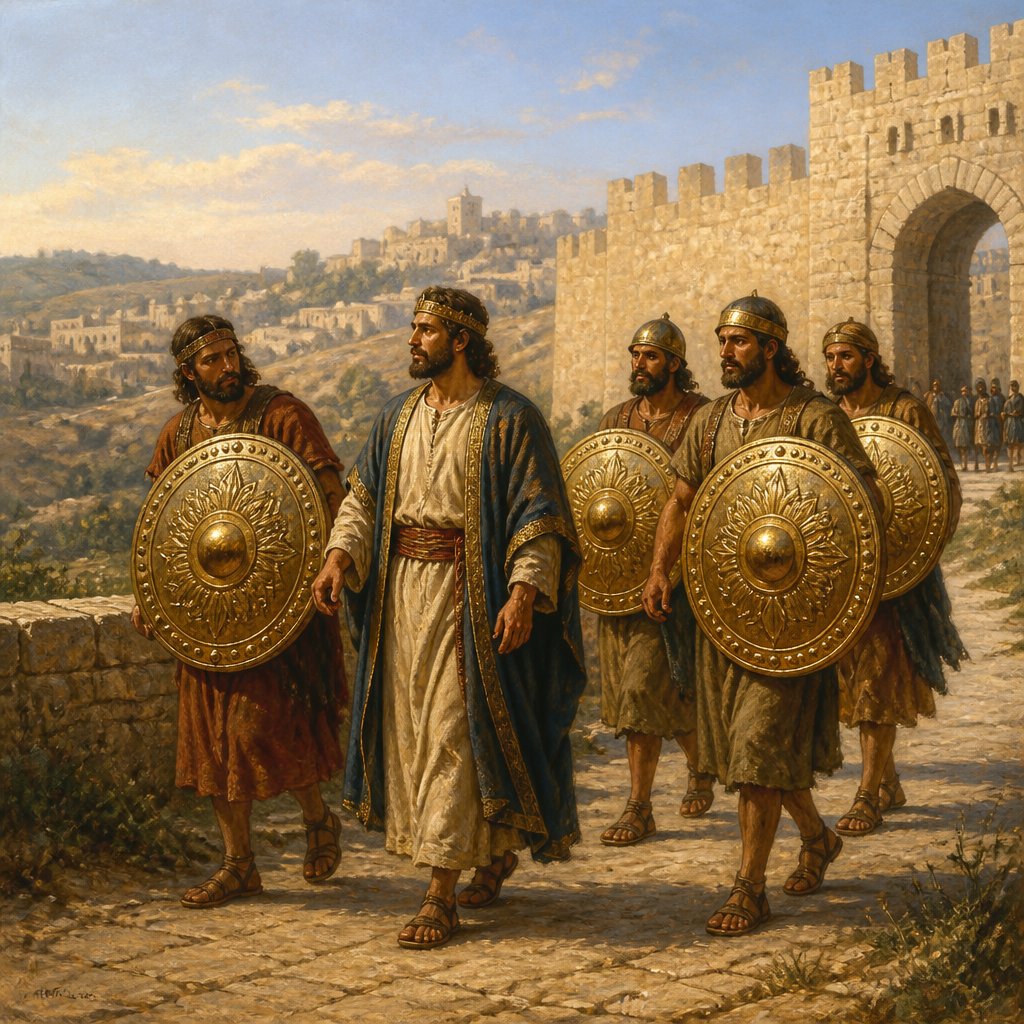
In 1 Chronicles 18:7, we read, "And David took the shields of gold that were on the servants of Hadarezer, and brought them to Jerusalem." This verse may seem straightforward, yet beneath its surface lies a profound message about God's provision, the nature of victory, and the importance of consecrating our gains back to Him.
**Contextual Backdrop**
To fully appreciate this moment, we must consider the landscape of David’s reign. Emerging from a tumultuous past, David had united the tribes of Israel. His military victories were decisive and divinely ordained, allowing him to establish a kingdom characterized by peace and prosperity. The conflict with Hadarezer is significant; Hadarezer was a formidable opponent, representing the forces against Israel. David's prevailing over such adversaries was not merely a matter of martial prowess but was rooted deeply in a covenant relationship with God.
**The Symbolism of the Shields**
The gold shields taken from the servants of Hadarezer symbolize more than material wealth; they represent the spoils of victory. In ancient times, shields were not only weapons of defense but also vital symbols of power and protection. When David took these beautiful golden shields, he wasn’t hoarding treasure. He was strategically acquiring resources that reflected God’s favor upon him, showcasing the victory granted by divine assistance. Every shield represented a battle fought and ultimately won because of God’s presence with David.
**God’s Provision**
This moment underlines a significant truth: God provides for His people. Throughout the life of David, we see that although he experienced trials, he also experienced overwhelming blessings. The acquisition of the shields is a poignant reminder that our victories, whether small or monumental, are a result of divine grace. Just as David brought the shields to Jerusalem, we too are encouraged to bring our victories—our achievements, blessings, and gifts—into the household of faith, acknowledging that they come from the hand of God.
**Consecrating our Gains**
David's act of bringing the gold shields to Jerusalem is also an act of worship and consecration. It demonstrates his understanding that all glory belongs to God. By dedicating his victories back to God, David fosters a culture of gratitude and recognition of divine favor. In our lives, how often do we acknowledge God's role in our victories? Are we quick to celebrate our successes without an attitude of thanksgiving? Building an attitude of gratitude transforms our perspective, turning our successes into testimonies that glorify God.
**Recognition of Legacy**
Additionally, the act of bringing these shields to Jerusalem can be viewed through the lens of legacy building. David’s actions would eventually influence the next generation. The golden shields would become part of the treasures stored in the temple, a place where future generations would come to worship. Similarly, our actions today lay the foundation for what we pass on to those who come after us. When we purposefully recognize God’s goodness and glory in our lives, we create a legacy of faith for our children and those around us.
**Conclusion: A Call to Action**
In contemplating 1 Chronicles 18:7, we are invited to reflect on our own victories and possessions. Are there aspects of our lives we need to dedicate to God? Have we tended to haul our golden shields into our own earthly profit, forgetting to acknowledge the One who brought us through? As we navigate life’s challenges, let us remember to regard every triumph as an opportunity to glorify God. Just as David did, let us take our spoils—not just material but spiritual—and bring them into the presence of the Lord, giving thanks for His unyielding faithfulness. May our lives echo the sentiment of David, recognizing that every shield we acquire is not ours by right, but a gift from Heaven that calls for consecration and grateful surrender.
Want to reflect more on 1 Chronicles 18:7?
Continue your spiritual journey with Bible Chat — an AI-powered tool for exploring God's Word through conversation. Ask questions, discover connections, and deepen your understanding.
Get Our Apps


1 Chronicles 18:7 Artwork

1 Chronicles 18:7 - "And David took the shields of gold that were on the servants of Hadarezer, and brought them to Jerusalem."
"And David took the shields of gold that were on the servants of Hadarezer, and brought them to Jerusalem." - 1 Chronicles 18:7

1 Chronicles 7:18 - "And his sister Hammoleketh bare Ishod, and Abiezer, and Mahalah."
"And his sister Hammoleketh bare Ishod, and Abiezer, and Mahalah." - 1 Chronicles 7:18

1 Chronicles 1:18 - "And Arphaxad begat Shelah, and Shelah begat Eber."

1 Chronicles 23:18 - "Of the sons of Izhar; Shelomith the chief."

1 Chronicles 8:18 - "Ishmerai also, and Jezliah, and Jobab, the sons of Elpaal;"

1 Chronicles 1:7 - "And the sons of Javan; Elishah, and Tarshish, Kittim, and Dodanim."

1 Chronicles 24:18 - "The three and twentieth to Delaiah, the four and twentieth to Maaziah."

1 Chronicles 26:18 - "At Parbar westward, four at the causeway, and two at Parbar."

1 Chronicles 14:7 - "And Elishama, and Beeliada, and Eliphalet."

1 Chronicles 3:7 - "And Nogah, and Nepheg, and Japhia,"

1 Chronicles 3:18 - "Malchiram also, and Pedaiah, and Shenazar, Jecamiah, Hoshama, and Nedabiah."

1 Chronicles 6:18 - "And the sons of Kohath were, Amram, and Izhar, and Hebron, and Uzziel."

1 Chronicles 23:7 - "¶ Of the Gershonites were, Laadan, and Shimei."

1 Chronicles 7:39 - "And the sons of Ulla; Arah, and Haniel, and Rezia."

1 Chronicles 7:38 - "And the sons of Jether; Jephunneh, and Pispah, and Ara."

1 Chronicles 12:7 - "And Joelah, and Zebadiah, the sons of Jeroham of Gedor."

1 Chronicles 7:1 - "Now the sons of Issachar were, Tola, and Puah, Jashub, and Shimron, four."

1 Chronicles 27:18 - "Of Judah, Elihu, one of the brethren of David: of Issachar, Omri the son of Michael:"

1 Chronicles 25:18 - "The eleventh to Azareel, he, his sons, and his brethren, were twelve:"

2 Chronicles 18:1 - "Now Jehoshaphat had riches and honour in abundance, and joined affinity with Ahab."

1 Chronicles 18:2 - "And he smote Moab; and the Moabites became David's servants, and brought gifts."

1 Chronicles 18:15 - "And Joab the son of Zeruiah was over the host; and Jehoshaphat the son of Ahilud, recorder."

1 Chronicles 7:6 - "¶ The sons of Benjamin; Bela, and Becher, and Jediael, three."

1 Chronicles 7:34 - "And the sons of Shamer; Ahi, and Rohgah, Jehubbah, and Aram."

1 Chronicles 4:7 - "And the sons of Helah were, Zereth, and Jezoar, and Ethnan."

1 Chronicles 6:7 - "Meraioth begat Amariah, and Amariah begat Ahitub,"

2 Chronicles 7:18 - "Then will I stablish the throne of thy kingdom, according as I have covenanted with David thy father, saying, There shall not fail thee a man to be ruler in Israel."

1 Chronicles 7:37 - "Bezer, and Hod, and Shamma, and Shilshah, and Ithran, and Beera."