Winning the Battle in the Pit: Lessons from Benaiah
"Benaiah the son of Jehoiada, the son of a valiant man of Kabzeel, who had done many acts; he slew two lionlike men of Moab: also he went down and slew a lion in a pit in a snowy day." - 1 Chronicles 11:22
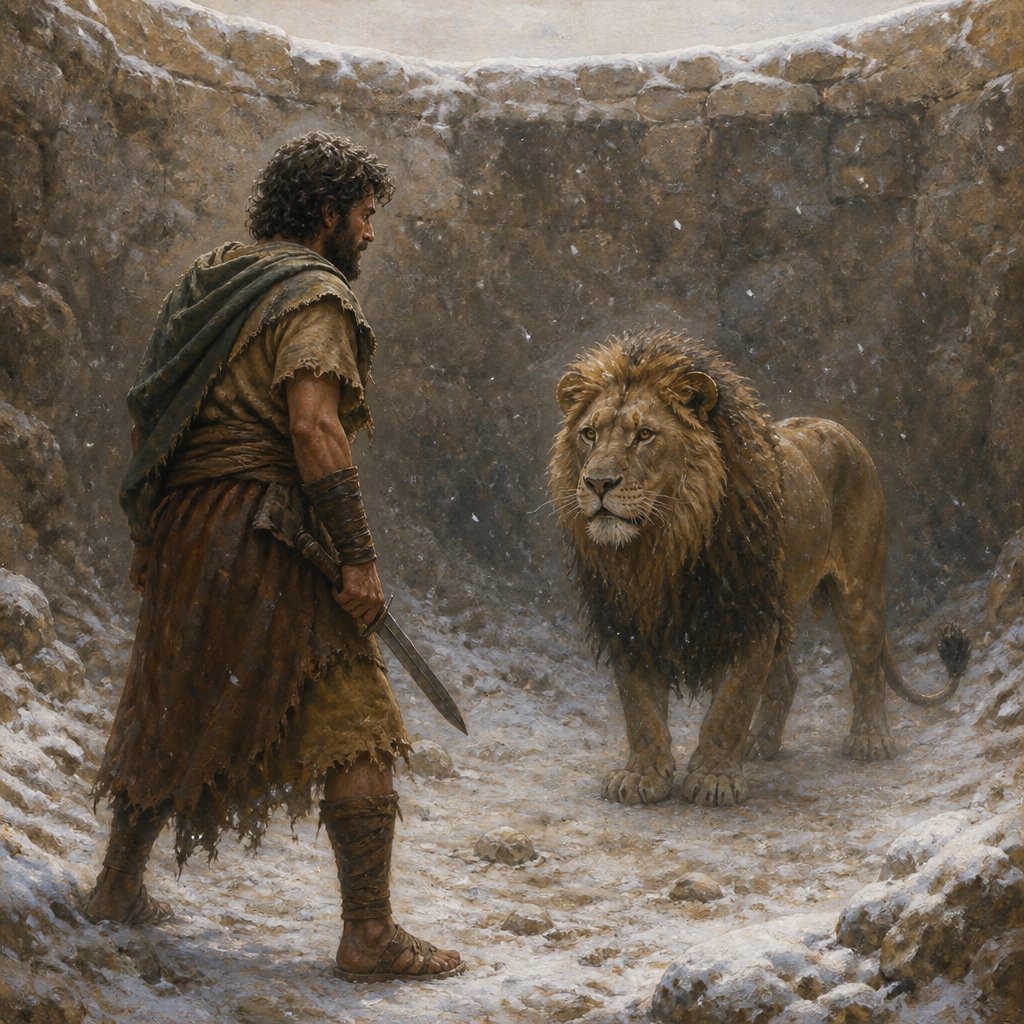
In the annals of biblical poetry and valor, few characters stand out as vividly as Benaiah, the son of Jehoiada. As narrated in 1 Chronicles 11:22, we encounter a man whose exploits not only embellish the pages of scripture but also impart profound lessons on courage, faith, and the nature of true valor. The verse states:
"Benaiah the son of Jehoiada, the son of a valiant man of Kabzeel, who had done many acts; he slew two lionlike men of Moab: also he went down and slew a lion in a pit in a snowy day."
At first glance, this account might appear to be a mere recounting of military feats. However, as we delve deeper, we uncover a rich tapestry of themes that resonate with our daily struggles in faith and life.
**Valiance and Heritage**
Benaiah's lineage is introduced with notable significance; he is described as the son of Jehoiada and the grandson of a valiant man. This heritage encapsulates the essence of leadership shaped not just by personal valor, but by the foundational legacy left by previous generations. In a world that often celebrates individual achievements, the biblical narrative reminds us that our character is often forged in the fires of familial influence and community. We are encouraged to honor our heritage while being mindful of the legacy we shall leave behind. Are we instilling courage and faith in our children?
**Confronting the Lionlike Men**
Benaiah's first significant act—slaying 'two lionlike men of Moab'—symbolizes confronting seemingly insurmountable enemies in our lives. The phrase ‘lionlike men’ evokes the idea of formidable opponents or overwhelming challenges. Each of us faces different ‘lionlike’ adversaries, whether they manifest as personal struggles, societal pressures, or spiritual battles. Benaiah didn’t shy away from his dilemmas; instead, he demonstrated that true valor lies in confronting our challenges head-on with God's guidance.
**The Lion in the Pit**
The more profound act in this verse is Benaiah's encounter with the lion within a pit on a snowy day. This imagery stirs the imagination: a lion, symbolizing danger and strength, in a restricted area—representing a moment of adversity faced in less than favorable conditions, such as the snow that makes the terrain perilous. This scenario prompts us to reflect on our own lives when we find ourselves in pits—be it in times of despair, anxiety, or overwhelming difficulties.
In this context, the 'pit' symbolizes those low and dark places where we often feel trapped, while the 'snowy day' suggests harsh conditions that heighten our fears and uncertainties. Benaiah did not wait for the conditions to become favorable; he acted with boldness, ready to face whatever came at him head-on. Likewise, we are called to step out in faith, not waiting for the snow to melt or the circumstances to improve. God does not promise us an easy journey, but He calls us to face our lions, knowing that with Him, we are never alone.
**Divine Empowerment**
Benaiah’s victory serves as a profound reminder of the spiritual empowerment available to us through faith. In Romans 8:31, we read, "If God be for us, who can be against us?" Just as Benaiah operated with a conviction that he was equipped for the battles ahead, so too must we embrace our identity as children of the Almighty, equipped for every good work. Fighting our battles with reliance on God guarantees that we can face the lions in our lives with confidence, knowing that victory is assured by His strength.
**Conclusion: Engaging the Battle**
In conclusion, the life and actions of Benaiah inspire us to engage the battles we face with courage and faith. His commitment to conquering formidable foes in the face of adverse conditions teaches us that we are capable of achieving great things through divine empowerment. While the circumstances surrounding us may often be daunting, we are reminded that our faith can pierce through the darkness of the 'pits' in which we find ourselves. Let us look to Benaiah's example as a call to action—boldly facing our challenges today and trusting that God is with us in the fight.
In moments of fear and uncertainty, may we find strength in Benaiah’s story, embracing the warrior that resides within us as we partner with God to face our lions.
Want to reflect more on 1 Chronicles 11:22?
Continue your spiritual journey with Bible Chat — an AI-powered tool for exploring God's Word through conversation. Ask questions, discover connections, and deepen your understanding.
Get Our Apps


1 Chronicles 11:22 Artwork

1 Chronicles 11:22 - "Benaiah the son of Jehoiada, the son of a valiant man of Kabzeel, who had done many acts; he slew two lionlike men of Moab: also he went down and slew a lion in a pit in a snowy day."
"Benaiah the son of Jehoiada, the son of a valiant man of Kabzeel, who had done many acts; he slew two lionlike men of Moab: also he went down and slew a lion in a pit in a snowy day." - 1 Chronicles 11:22

1 Chronicles 22:11 - "Now, my son, the LORD be with thee; and prosper thou, and build the house of the LORD thy God, as he hath said of thee."

1 Chronicles 1:22 - "And Ebal, and Abimael, and Sheba,"

2 Chronicles 4:22

1 Chronicles 8:22 - "And Ishpan, and Heber, and Eliel,"

1 Chronicles 24:22 - "Of the Izharites; Shelomoth: of the sons of Shelomoth; Jahath."

1 Chronicles 22:1 - "Then David said, This is the house of the LORD God, and this is the altar of the burnt offering for Israel."

2 Chronicles 11:22 - "And Rehoboam made Abijah the son of Maachah the chief, to be ruler among his brethren: for he thought to make him king."

"And Ebal, and Abimael, and Sheba," - 1 Chronicles 1:22

1 Chronicles 1:11 - "And Mizraim begat Ludim, and Anamim, and Lehabim, and Naphtuhim,"

1 Chronicles 11:29 - "Sibbecai the Hushathite, Ilai the Ahohite,"

1 Chronicles 12:11 - "Attai the sixth, Eliel the seventh,"

1 Chronicles 11:40 - "Ira the Ithrite, Gareb the Ithrite,"

1 Chronicles 24:11 - "The ninth to Jeshua, the tenth to Shecaniah,"

1 Chronicles 11:27 - "Shammoth the Harorite, Helez the Pelonite,"

1 Chronicles 11:36 - "Hepher the Mecherathite, Ahijah the Pelonite,"

1 Samuel 22:11-13

1 Chronicles 11:47 - "Eliel, and Obed, and Jasiel the Mesobaite."

1 Chronicles 11:33 - "Azmaveth the Baharumite, Eliahba the Shaalbonite,"

1 Chronicles 16:22 - "Saying, Touch not mine anointed, and do my prophets no harm."

1 Chronicles 27:22 - "Of Dan, Azareel the son of Jeroham. These were the princes of the tribes of Israel."

1 Chronicles 8:11 - "And of Hushim he begat Abitub, and Elpaal."

1 Chronicles 11:43 - "Hanan the son of Maachah, and Joshaphat the Mithnite,"

1 Chronicles 11:32 - "Hurai of the brooks of Gaash, Abiel the Arbathite,"

1 Chronicles 11:41 - "Uriah the Hittite, Zabad the son of Ahlai,"

1 Chronicles 11:37 - "Hezro the Carmelite, Naarai the son of Ezbai,"

1 Chronicles 25:22 - "The fifteenth to Jeremoth, he, his sons, and his brethren, were twelve:"

"And Ishpan, and Heber, and Eliel," - 1 Chronicles 8:22

1 Chronicles 6:11 - "And Azariah begat Amariah, and Amariah begat Ahitub,"