The Weight of Honor and the Depths of Despair: Reflecting on 1 Chronicles 10:4
"Then said Saul to his armourbearer, Draw thy sword, and thrust me through therewith; lest these uncircumcised come and abuse me. But his armourbearer would not; for he was sore afraid. So Saul took a sword, and fell upon it." - 1 Chronicles 10:4
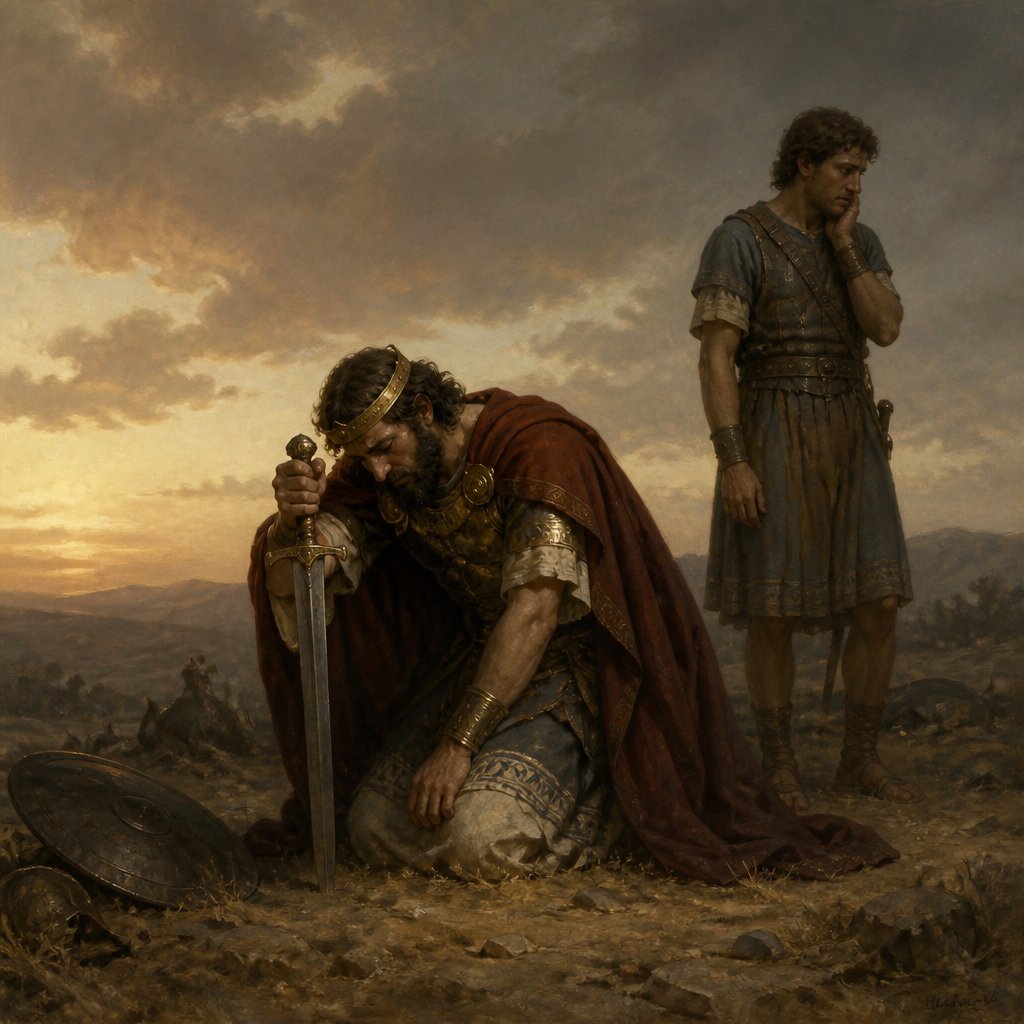
The biblical narrative is often marked by moments of profound triumph and despair, and in 1 Chronicles 10:4 we find King Saul, anointed yet troubled, standing at the precipice of both. The verse states, "Then said Saul to his armourbearer, Draw thy sword, and thrust me through therewith; lest these uncircumcised come and abuse me. But his armourbearer would not; for he was sore afraid. So Saul took a sword, and fell upon it." This poignant moment encapsulates the essence of a soul crushed by the weight of defeat, honor, and the desperate need for dignity in the face of overwhelming adversity.
To understand Saul's plea, we must delve into the circumstances surrounding his reign. Saul was once a humble man, chosen by God to be king, gifted with the Spirit for leadership. However, his life took a sorrowful turn as he became increasingly consumed by jealousy, fear, and pride, leading him away from God and into a spiral of disobedience. The final battle at Mount Gilboa is a culmination of this tragic trajectory. Not only is he fighting against the Philistines, but he is also battling his own inner demons—doubt, regret, and a sense of utter failure.
In Saul's desperate request to his armorbearer, we witness the depth of his despair. He sees the Philistines closing in, and the prospect of mutilation and humiliation looms large in his mind. To die at their hands would mean disgrace, not only for himself but also for his legacy and the people of Israel. The phrase "lest these uncircumcised come and abuse me" speaks volumes of his understanding of honor. To be "uncircumcised" in Jewish culture signified being outside of the covenant community, an outsider, and a direct affront to the values and identity of Israel. No greater shame could befall a king than to be mocked and abused by those perceived as enemies and social outcasts.
Yet, in this moment of requested violence against himself, we also see the loyalty of the armorbearer, who is "sore afraid" and refuses to carry out Saul's death wish. His reluctance highlights an element of honor in a world steeped in tragedy—loyalty and the sanctity of life. The armorbearer recognizes that taking a life, even that of a king, is a grave act. The implications of Saul's command reveal the complexity of honor and duty, and ultimately lead to a heartbreaking choice: Saul’s own life becomes a casualty of his failure, as he takes matters into his own hands, plunging himself upon his sword.
For us, this narrative forces a confrontation with our own struggles. How many times have we been faced with despair, feeling utterly defeated and contemplating our worth? How often have we felt the need to escape our pain in act of desperation? Saul's devastating choice serves as a warning about the dangers of isolation and despair. Refusing to seek God in moments of crisis can lead us to extremes we never thought us capable of taking. Just as Saul reached the end of his hopes while failing to turn back to the Lord, we too can miss the redemption that exists even in our darkest hours.
This passage further invites us to consider the burdens of leadership and responsibility, how easily they can overwhelm. Leaders, even in spiritual contexts, can suffer immense pressure and temptation. Saul’s tragic demise offers a call to humility. When faced with devastation, let us not resort to despair, but rather rise up and seek God's counsel and community. In every circumstance, even in the depths of our struggles, we can trust that God is near, offering grace and a path back to Him.
In conclusion, let us reflect on the legacy we wish to leave. May we choose life, seek connection over isolation, and in moments of profound despair, remember that God’s love redeems even the gravest of circumstances. By doing so, we will not follow Saul’s path but instead forge a legacy of honor that reflects God’s glory, mercy, and grace.
Want to reflect more on 1 Chronicles 10:4?
Continue your spiritual journey with Bible Chat — an AI-powered tool for exploring God's Word through conversation. Ask questions, discover connections, and deepen your understanding.
Get Our Apps


1 Chronicles 10:4 Artwork

1 Chronicles 10:4 - "Then said Saul to his armourbearer, Draw thy sword, and thrust me through therewith; lest these uncircumcised come and abuse me. But his armourbearer would not; for he was sore afraid. So Saul took a sword, and fell upon it."
"Then said Saul to his armourbearer, Draw thy sword, and thrust me through therewith; lest these uncircumcised come and abuse me. But his armourbearer would not; for he was sore afraid. So Saul took a sword, and fell upon it." - 1 Chronicles 10:4

1 Chronicles 4 : 10

2 Chronicles 10:4 - "Thy father made our yoke grievous: now therefore ease thou somewhat the grievous servitude of thy father, and his heavy yoke that he put upon us, and we will serve thee."

2 Chronicles 4:10 - "And he set the sea on the right side of the east end, over against the south."

1 Chronicles 1:4 - "Noah, Shem, Ham, and Japheth."

1 Chronicles 10:10 - "And they put his armour in the house of their gods, and fastened his head in the temple of Dagon."

1 Chronicles 9:10 - "¶ And of the priests; Jedaiah, and Jehoiarib, and Jachin,"

2 Chronicles 4:22

1 Chronicles 1:10 - "And Cush begat Nimrod: he began to be mighty upon the earth."

1 Chronicles 12:10 - "Mishmannah the fourth, Jeremiah the fifth,"

1 Chronicles 24:10 - "The seventh to Hakkoz, the eighth to Abijah,"

1 Chronicles 10:6 - "So Saul died, and his three sons, and all his house died together."

1 Chronicles 4:29 - "And at Bilhah, and at Ezem, and at Tolad,"

1 Chronicles 4:30 - "And at Bethuel, and at Hormah, and at Ziklag,"

1 Chronicles 8:4 - "And Abishua, and Naaman, and Ahoah,"

1 Chronicles 4:1 - "The sons of Judah; Pharez, Hezron, and Carmi, and Hur, and Shobal."

1 Chronicles 10:11 - "¶ And when all Jabesh-gilead heard all that the Philistines had done to Saul,"

1 Chronicles 15:4 - "And David assembled the children of Aaron, and the Levites:"

1 Chronicles 4:34 - "And Meshobab, and Jamlech, and Joshah the son of Amaziah,"

1 Chronicles 10:5 - "And when his armourbearer saw that Saul was dead, he fell likewise on the sword, and died."

1 Chronicles 4:10 - "And Jabez called on the God of Israel, saying, Oh that thou wouldest bless me indeed, and enlarge my coast, and that thine hand might be with me, and that thou wouldest keep me from evil, that it may not grieve me! And God granted him that which he requested."

1 Chronicles 4:28 - "And they dwelt at Beer-sheba, and Moladah, and Hazar-shual,"

1 Chronicles 4:16 - "And the sons of Jehaleleel; Ziph, and Ziphah, Tiria, and Asareel."

1 Chronicles 4:7 - "And the sons of Helah were, Zereth, and Jezoar, and Ethnan."

1 Chronicles 6:4 - "¶ Eleazar begat Phinehas, Phinehas begat Abishua,"

1 Chronicles 15:10 - "Of the sons of Uzziel; Amminadab the chief, and his brethren an hundred and twelve."

1 Chronicles 8:10 - "And Jeuz, and Shachia, and Mirma. These were his sons, heads of the fathers."

1 Chronicles 4:4 - "And Penuel the father of Gedor, and Ezer the father of Hushah. These are the sons of Hur, the firstborn of Ephratah, the father of Beth-lehem."

1 Chronicles 10:3 - "And the battle went sore against Saul, and the archers hit him, and he was wounded of the archers."